


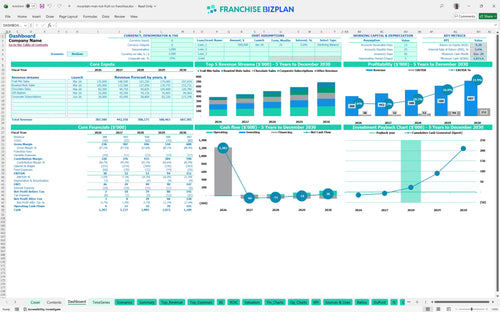
All-in-one Dashboard
Core inputs and core outputs



This franchise investment return analysis spreadsheet includes dynamic revenue drivers, detailed payroll calculators, and a full set of financial statements for your retail unit.
Core inputs and core outputs
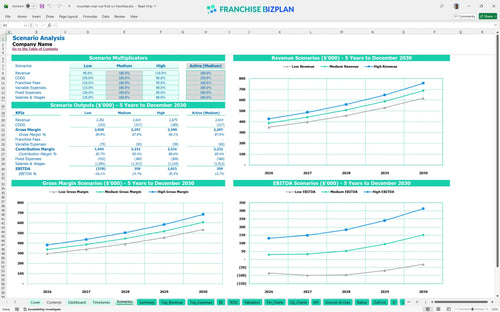
Three scenario analysis
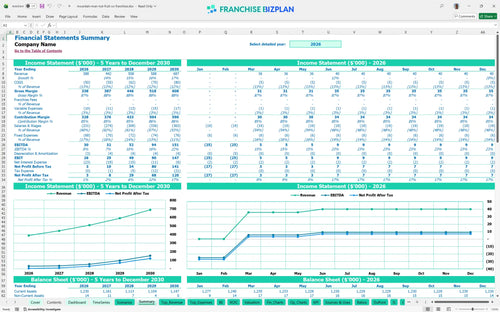
Presentation ready
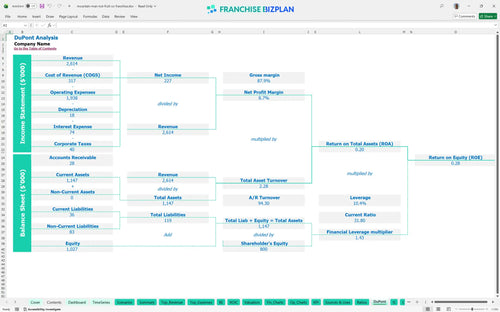
DuPont analysis
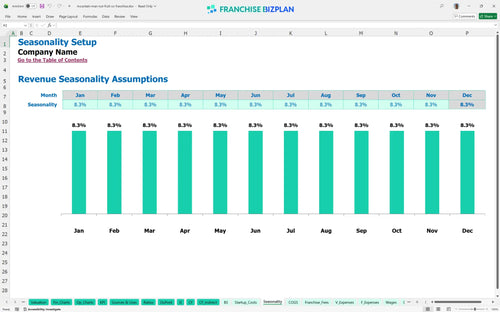
Researched revenue assumptions
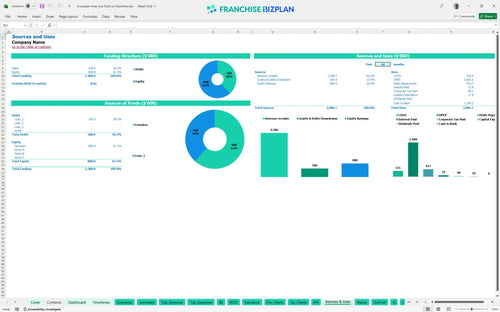
Lender-friendly financial outputs
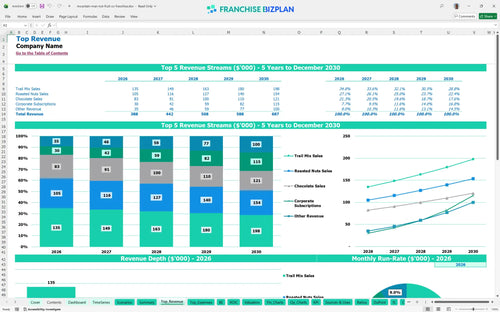
Revenue stream detailed view
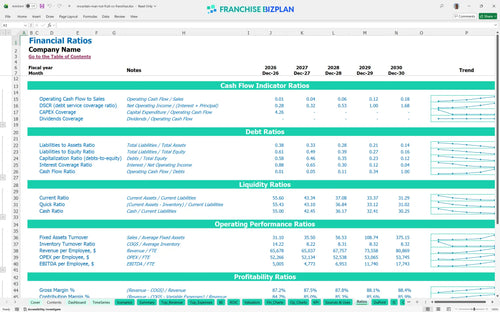
Performance metrics benchmark
We developed this franchise business plan template using deep market research into the gourmet snack sector. Every assumption, from the $90,000 initial trail mix sales to the $4,000 Pearl Street Mall rent, is pre-populated and fully adjustable to reflect your local market reality. Year one EBITDA starts at $30,000, providing a clear baseline for your first 12 months of operation.
The unit reaches profitability early, with a year one EBITDA of $30,000. By year five, as B2B subscriptions and gift basket sales scale, EBITDA is projected to hit $151,000. This growth is driven by a steady decline in COGS from 11% to 9.8% as you gain purchasing scale and improve throughput.
You will need approximately $17,800 for the initial capital expenditure budget plus working capital to launch. This covers the $7,500 franchise fee, the $3,000 kiosk build-out, and $2,000 for the POS system. Your largest ongoing fixed cost is the $4,000 monthly rent for a high-traffic location.
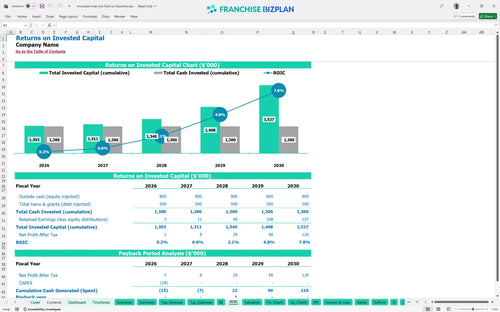
Investors can expect an Internal Rate of Return (IRR) of 5.57% and a Return on Equity (ROE) of 0.28. Based on the projected cash flows, the full payback period for your retail franchise startup costs is 3 years. This is a solid timeline for a retail unit in the gourmet food space.
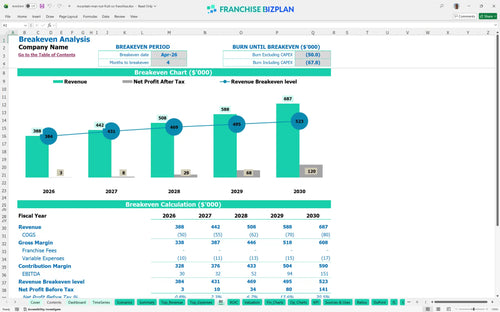
The model shows a fast path to stability, with the break-even date occurring in April 2026, just 4 months after launch. Calculating break-even point for retail franchise units depends heavily on maintaining your 11% COGS and managing the $4,000 monthly rent on Pearl Street Mall.
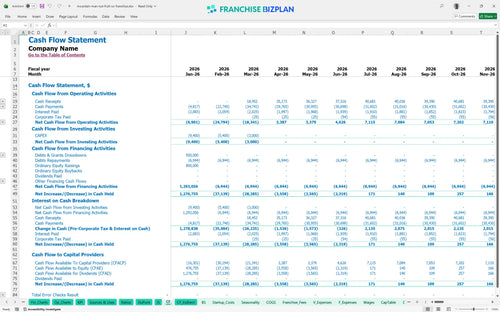
The lowest cash point is projected for December 2029 at $1,072,000, assuming significant cash accumulation from operations. You have a very comfortable runway, but you should still maintain a buffer for seasonal inventory spikes. Managing opening inventory and B2B sales rep hiring timing is key to protecting your liquidity during ramp-up.
The model functions as a franchise ROI calculator, allowing you to toggle between Low, Medium, and High scenarios. You can see how a 10% drop in gift basket sales or a spike in labor costs impacts your 5.57% IRR. In the High case, aggressive B2B outreach can significantly improve these food franchise business model projections.
This franchise financial model is built entirely in Excel, giving you total control over the numbers. You can adjust pre-filled formulas and editable assumptions to match your specific territory, whether you are looking at a mall kiosk or a standalone retail store. It defintely simplifies the complex task of building a retail franchise financial model excel template from scratch.

Planning for the long haul is critical for any multi-unit operator. This tool provides a detailed 5-year outlook, showing how revenue scales from $388,000 in year one to $687,000 by year five. You get a clear view of how your franchise profitability analysis evolves as your customer base and corporate subscriptions mature over time.

Understanding the real cost of brand alignment is vital for maintaining healthy unit economics. The model tracks the initial $7,500 franchise fee and accounts for ongoing obligations like royalties and marketing fund contributions. Even with the current 0% fee structure in the data, the framework is ready to handle standard industry percentages to ensure your store-level margin stays accurate.

Knowing how to calculate startup costs for a food franchise is the first step to securing funding. This model breaks down your initial investment, including the $3,000 kiosk build-out and $1,200 roasting equipment. It maps out the exact sales volume needed to cover your $4,000 monthly rent and other fixed costs to reach the break-even point.

Don't fly blind when estimating operating costs for a gourmet snack store. The model includes an operating expenses forecast and benchmarks for labor and occupancy, helping you see if your $48,000 manager salary or 11% COGS for nuts and fruits aligns with industry standards. It is a vital franchise unit financial forecasting tool for sanity-checking your retail store profit and loss projection template.


Simply purchase and download the financial model template, then access it instantly using Microsoft Excel or Google Sheets. No installation or technical expertise required-just open and start working.

Enter your business-specific numbers, including revenue projections, costs, and investment details. The pre-built formulas will automatically calculate financial insights, saving you time and effort.

Leverage the investor-ready format to confidently showcase your financial projections to banks, franchise representatives, or investors. Impress stakeholders with clear, data-driven insights and professional reports.

Leverage the investor-ready format to confidently present your projections to banks, franchise representatives, or investors.