


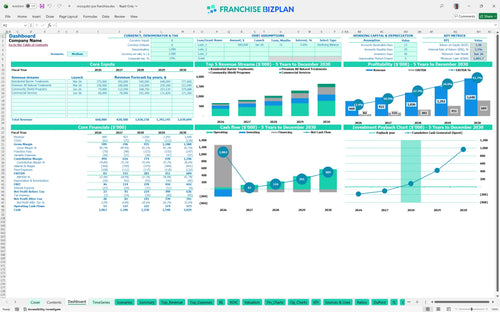
All-in-one Dashboard
Core inputs and core outputs



This Excel spreadsheet for franchise financial forecasting provides a complete toolkit for projecting ROI and managing the daily unit economics of a service territory.
Core inputs and core outputs
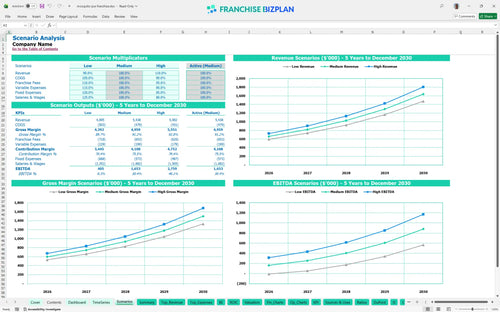
Three scenario analysis
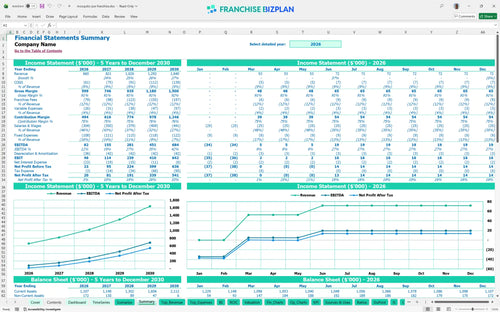
Presentation ready
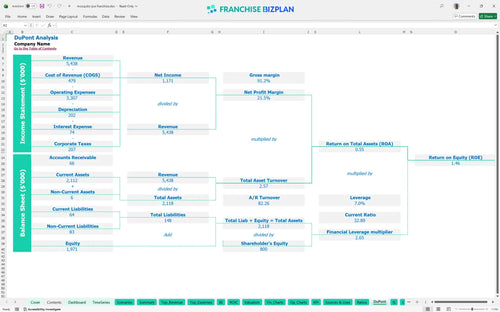
DuPont analysis
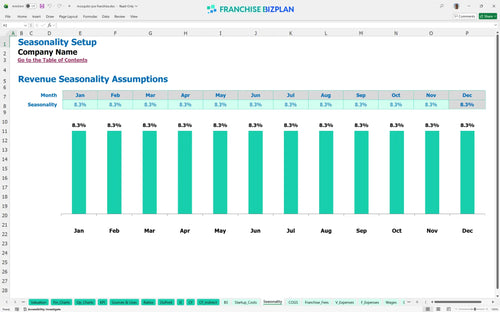
Researched revenue assumptions
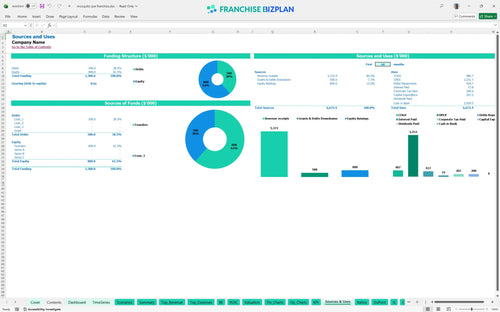
Lender-friendly financial outputs
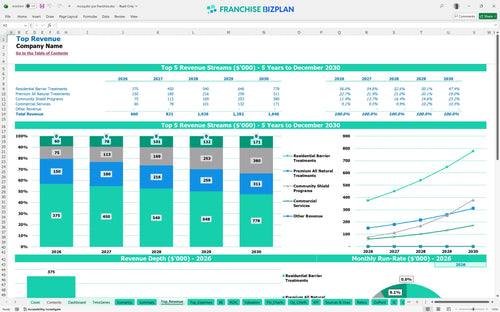
Revenue stream detailed view
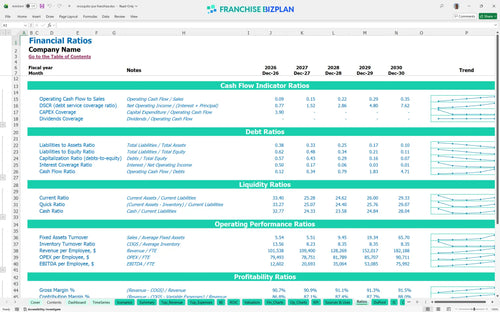
Performance metrics benchmark
We built this franchise unit financial model using our own research into the pest control sector. Key assumptions like the $42,500 franchise fee, 10% royalties, and revenue streams like Residential Barrier Treatments are pre-populated and fully editable. With a projected year one revenue of $660,000, this tool helps you track every dollar from the first spray to year five.
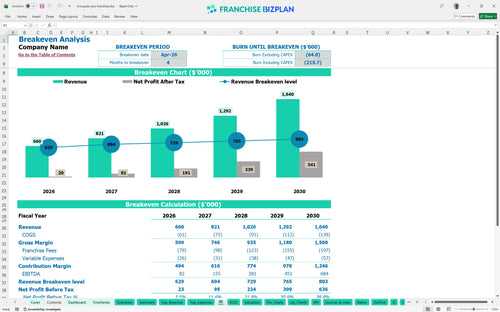
Based on the pest control franchise business plan, the unit reaches its break-even date in April 2026, just four months after launch. With year one EBITDA projected at $82,000, the business scales significantly as route density improves, reaching $684,000 in annual EBITDA by year five.
To launch this franchise unit, you need to account for capital expenditure planning plus a significant working capital reserve. The total initial investment covers the $42,500 franchise fee, $85,000 for branded service vehicles, and $25,000 for leasehold improvements at your headquarters. Total startup costs are offset by a large liquidity buffer to handle the ramp-up phase.
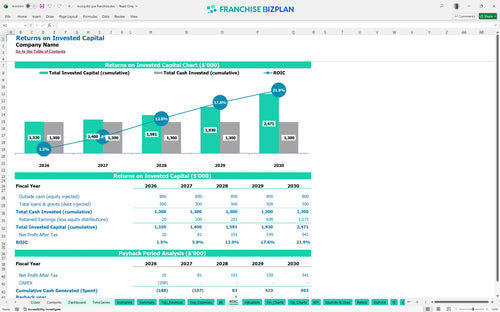
This franchise investment feasibility study shows an Internal Rate of Return (IRR) of 5.48% and a Return on Equity (ROE) of 1.46. The model shows a 3-year payback period, which is standard for a service business with high initial equipment costs. Knowing how to project ROI for a residential service franchise helps set realistic expectations for your equity partners.
The unit hits break-even in month 4, requiring enough monthly revenue to cover $4,200 in rent and $8,800 in total fixed monthly expenses. Break-even analysis for franchises depends heavily on route density and fuel costs, which are modeled at 2.8% of sales. Efficiency in the field is the fastest way to cover your fixed nut.
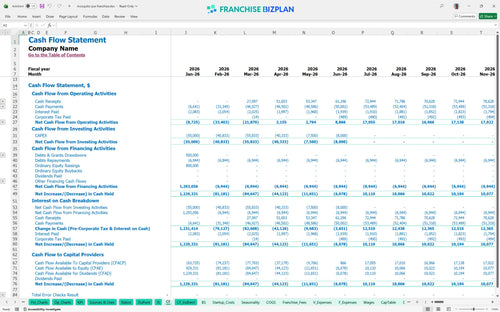
The lowest cash point occurs in June 2026, with a minimum cash balance of $1,002,000, suggesting a very conservative funding approach. You should use this franchise operating budget template for small businesses to maintain at least six months of fixed costs as a buffer. Managing cash flow is about timing your technician hires against seasonal demand spikes.
The financial model for new home service franchise allows you to toggle between scenarios; a High case would see year one revenue exceed $660,000 through faster adoption. Underperforming on sales would delay the 3-year payback and defintely increase the working capital pressure during the off-season. Use the franchise unit economic performance template to stress test your assumptions before signing a lease. Finance: update unit break-even and payback model by Friday.
This franchise financial model template is built in Excel, allowing you to tweak every variable from service frequency to technician pay. You can adjust the pre-filled formulas to match your specific territory's density and local labor rates. It is a flexible tool designed to handle the unique seasonality of a home service business.

Map out your growth from a single van to a full fleet with an integrated operating expense forecast and cash flow tool. The model tracks how scaling from $660,000 in year one to $1,640,000 in year five impacts your bottom line and tax obligations. Estimating annual revenue for pest control business becomes a data-driven exercise rather than a guess.

Analyzing franchise profitability and royalty structures is simple with dedicated inputs for the 10% royalty and 2% marketing fund. The tool calculates these off gross sales so you see exactly how much cash stays in the business after corporate obligations. Every dollar is accounted for before it hits your local operating account.

Use this franchise startup cost analysis to estimate your total initial investment, including the $42,500 franchise fee and $85,000 for branded vehicles. It calculates the exact sales volume needed to cover your $4,200 monthly rent and other fixed overhead. Knowing how to calculate startup costs for a pest control franchise is the first step to securing financing.

This small business financial projection template includes benchmarks for chemical costs, which we have modeled at 7.5% of sales initially. Compare your projected 12.4% EBITDA margin in year one against home service industry standards to ensure your plan is realistic. These financial planning tools for new franchise owners provide the sanity check needed for a solid launch.


Simply purchase and download the financial model template, then access it instantly using Microsoft Excel or Google Sheets. No installation or technical expertise required-just open and start working.

Enter your business-specific numbers, including revenue projections, costs, and investment details. The pre-built formulas will automatically calculate financial insights, saving you time and effort.

Leverage the investor-ready format to confidently showcase your financial projections to banks, franchise representatives, or investors. Impress stakeholders with clear, data-driven insights and professional reports.

Leverage the investor-ready format to confidently present your projections to banks, franchise representatives, or investors.