


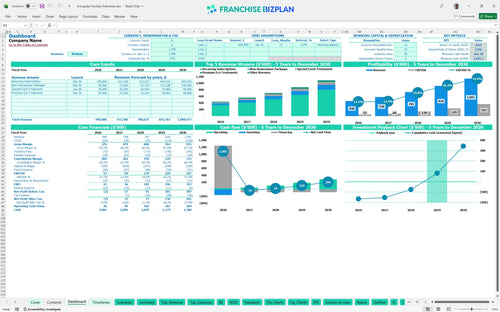
All-in-one Dashboard
Core inputs and core outputs



This franchise financial model for home service businesses provides a data-driven framework to project revenue, manage royalties, and track cash flow for a pest control unit.
Core inputs and core outputs
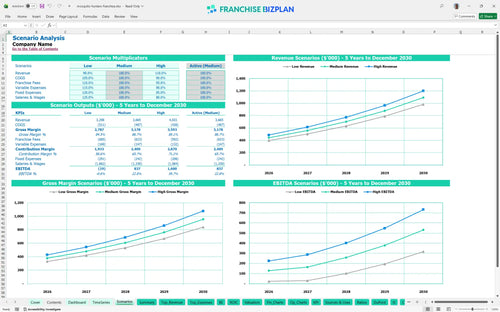
Three scenario analysis
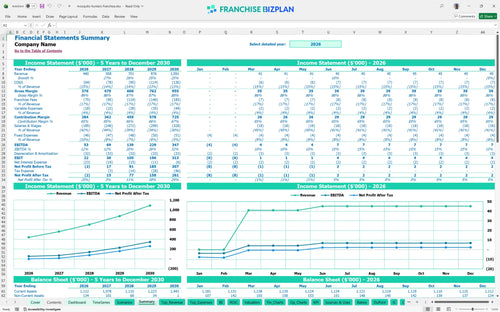
Presentation ready
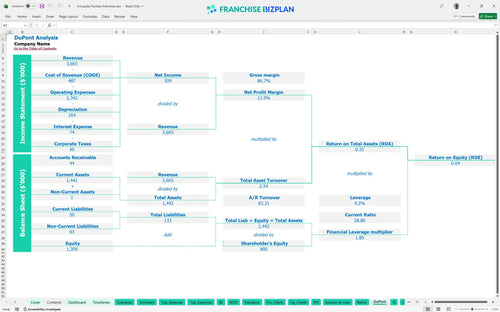
DuPont analysis
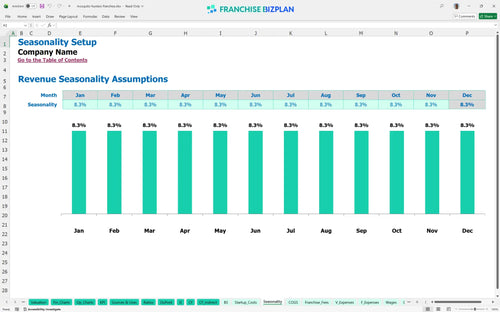
Researched revenue assumptions
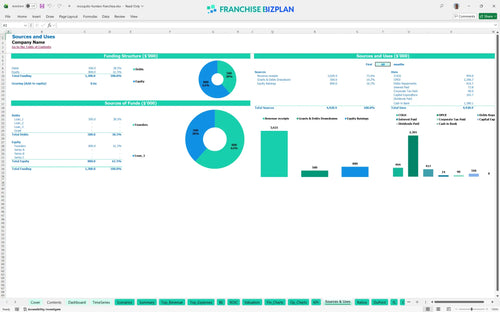
Lender-friendly financial outputs
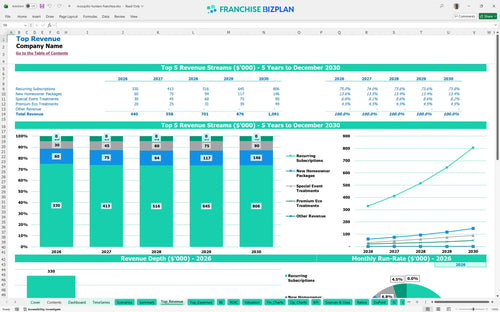
Revenue stream detailed view
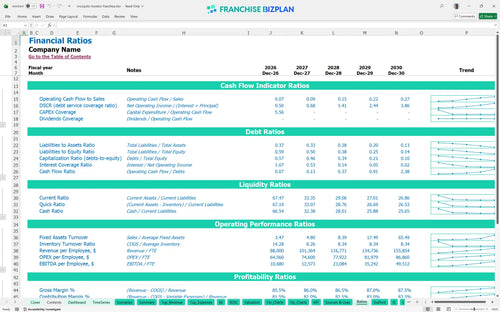
Performance metrics benchmark
We built this pest control franchise business plan using deep research into the home services sector and specific unit economics. Key assumptions like the 10% royalty fee and $440,000 year-one revenue target are pre-populated and ready for you to customize for your specific territory. This Excel template for franchise unit financial planning includes everything from technician wages to seasonal marketing spend.
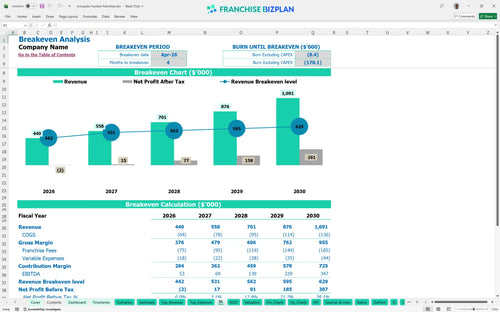
Based on the recurring revenue model, this unit is projected to reach profitability in April 2026, just four months after launch. This assumes you hit your initial sales targets for subscriptions and special event treatments while keeping fixed costs like the $1,000 monthly office lease in check. This break-even analysis for new franchise owners shows that early volume is key to covering the $107,000 initial fee.
You will need significant capital to cover the $107,000 franchise fee and initial equipment needs like $12,000 for spraying gear. The total startup cost also includes $25,000 for branded vehicles and a small buffer for permits and professional services. Estimating labor costs for pest control businesses is also factored into the initial working capital needs.
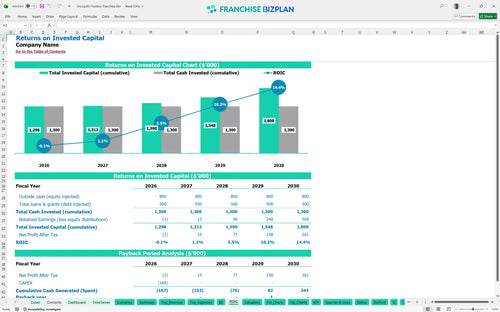
The model shows a 4-year payback period with an internal rate of return (IRR) of 3.78% over the first five years. While the initial return on equity is 0.64, the unit's value grows as EBITDA climbs from $53,000 in year one to $347,000 by year five. This return on investment (ROI) profile is typical for service brands that rely on building a local customer density.
You reach monthly break-even by April 2026, driven primarily by the volume of recurring subscription customers. Since royalties and marketing fees take 17% off the top, your ability to manage labor costs for your three initial technicians is the biggest factor in hitting this milestone. Pest control business recurring revenue projections are the foundation of this monthly cash flow forecast for service franchises.
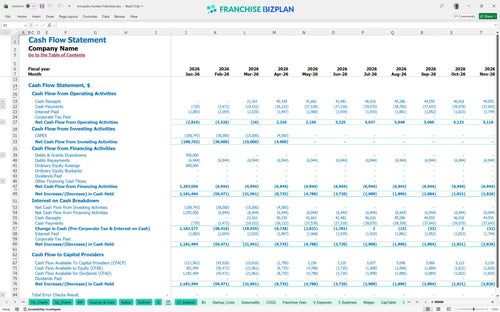
The lowest cash point occurs in January 2028, requiring a minimum cash reserve of $1,046,000 to navigate the ramp-up phase. This highlights the need for a solid working capital cushion to handle seasonal dips in pest control demand and timing gaps in payment processing. Financial planning for seasonal pest control services requires careful monitoring of this minimum cash month.
Moving from a medium to a high-growth scenario can accelerate your path to the $1,091,000 revenue mark by year five. Underperforming on lead generation or technician productivity could delay your 4-year payback, making local marketing execution the most critical variable for success. Evaluating franchise territory profitability in Excel allows you to stress-test these different growth paths.
Finance: update unit break-even and payback model by Friday.
This franchise unit financial model lives in Excel, giving you full control over every variable from local labor rates to chemical costs. You can swap out pre-filled assumptions to see how different pricing tiers or territory sizes impact your bottom line. It is a flexible franchise financial model template designed for real-world adjustments.

Map your path from a single territory to a mature operation with detailed annual projections for revenue, expenses, and cash flow. The model tracks how scaling from 3 to 5 field technicians affects your margins as you move toward $1,091,000 in annual sales. These franchise unit financial projections provide a clear view of long-term scalability.

Managing a 10% royalty and 7% marketing fee is critical for maintaining store-level margins in the service sector. This model automates these calculations against your monthly revenue streams, ensuring you always know exactly what is owed to the franchisor. Understanding the franchise royalty fee structure is essential for accurate cash flow forecasting.

Estimate your total initial investment, including the $107,000 franchise fee and $25,000 for branded service vehicles, to determine your true startup needs. Use the franchise startup cost calculator to identify the exact month your recurring subscription revenue covers your fixed monthly overhead. This helps you understand how to calculate startup costs for a pest control franchise effectively.

Compare your projected 12% chemical costs and 3% fuel expenses against industry standards to ensure your unit remains competitive. These benchmarks help you spot margin leaks early, defintely before they impact your year-one EBITDA of $53,000. This pest control franchise profitability analysis ensures your operating expenses (OPEX) stay within healthy limits.


Simply purchase and download the financial model template, then access it instantly using Microsoft Excel or Google Sheets. No installation or technical expertise required-just open and start working.

Enter your business-specific numbers, including revenue projections, costs, and investment details. The pre-built formulas will automatically calculate financial insights, saving you time and effort.

Leverage the investor-ready format to confidently showcase your financial projections to banks, franchise representatives, or investors. Impress stakeholders with clear, data-driven insights and professional reports.

Leverage the investor-ready format to confidently present your projections to banks, franchise representatives, or investors.