


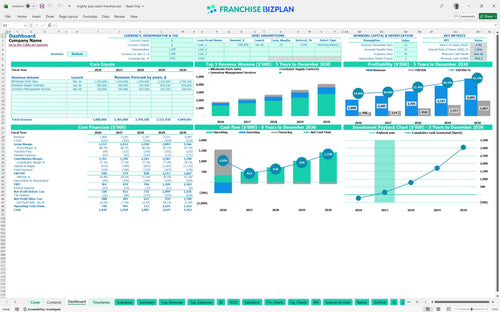
All-in-one Dashboard
Core inputs and core outputs



This template provides a complete framework to manage everything from inventory software setup to multi-year staffing plans for a vehicle parts distribution hub.
Core inputs and core outputs
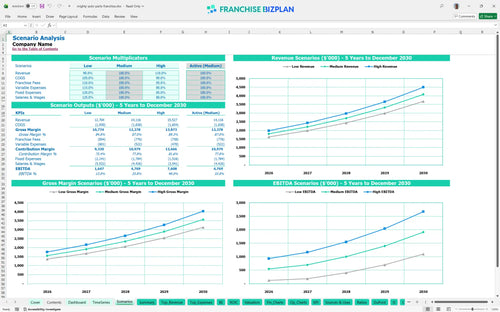
Three scenario analysis
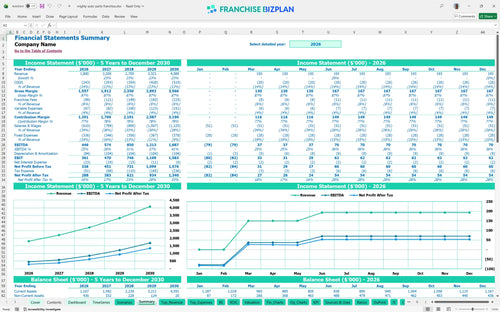
Presentation ready
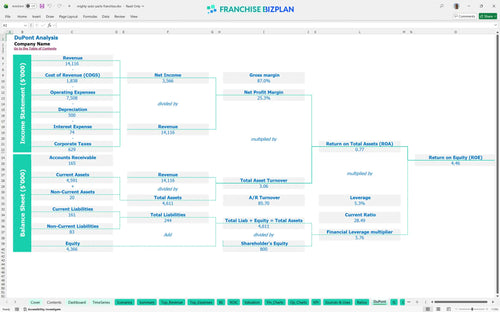
DuPont analysis
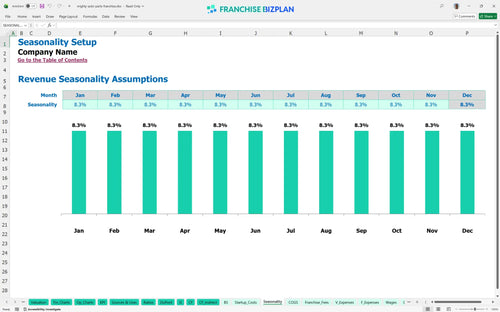
Researched revenue assumptions
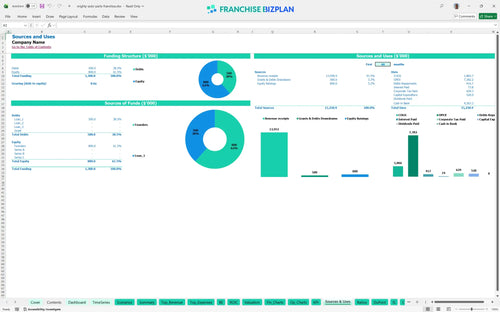
Lender-friendly financial outputs
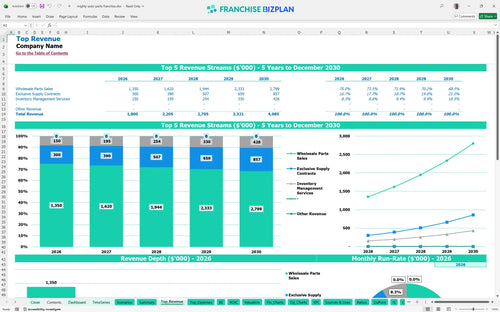
Revenue stream detailed view
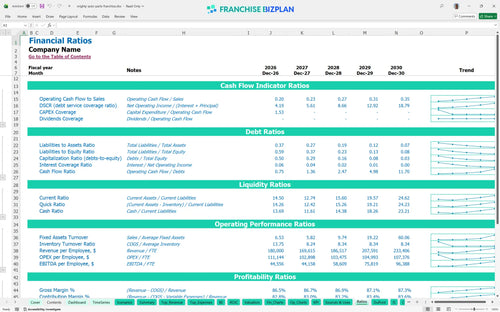
Performance metrics benchmark
We built this franchise unit financial model using deep research into B2B automotive distribution economics. Key assumptions like wholesale revenue streams, delivery logistics, and warehouse staffing are pre-populated with researched data and remain fully editable. The model shows a path to $446,000 in year-one EBITDA, providing a realistic baseline for your territory planning.
You can expect this unit to reach profitability very quickly, with the model showing a break-even date in April 2026. By the end of year one, you are looking at an EBITDA of $446,000, which scales to $1.687M by year five as you secure more exclusive supply contracts. Profitability depends on managing the 13.5% combined COGS and keeping delivery logistics efficient as you scale.
To get this hub off the ground, you will need to fund $520,000 in initial CAPEX plus your starting working capital. The biggest upfront hits are the $200,000 for leasehold improvements and $100,000 for the delivery vehicle fleet. Your $40,000 franchise fee is just the starting point for creating a budget for a new vehicle parts distribution hub.
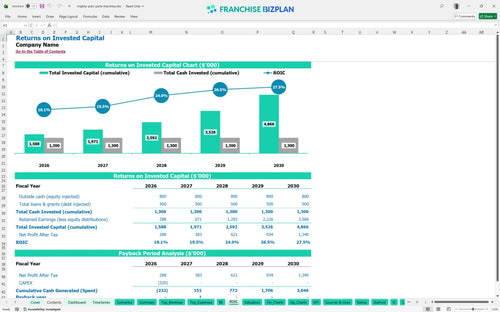
The ROI analysis for a new franchise shows a solid 2-year payback period, which is quite fast for a B2B distribution model. With an IRR of 7.83% and an ROE of 4.46, the model suggests steady, predictable growth for an owner-operator. Honestly, the real value is in the scaling EBITDA, which nearly quadruples between year one and year five as you dominate the local market.
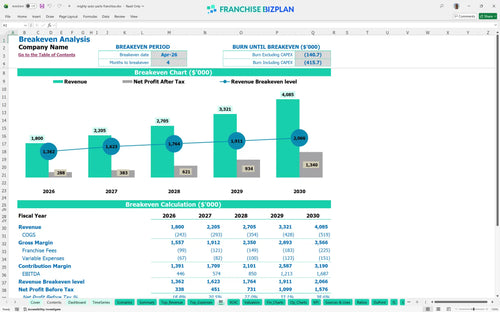
You reach break-even in just 4 months, which is a strong indicator of the model's B2B efficiency. The main driver is the automotive wholesale revenue projection, which starts at $900,000 for parts sales in year one. To stay above water, you must cover $18,000 in monthly rent and a payroll that includes a $85,000 General Manager and a $75,000 Sales Manager.
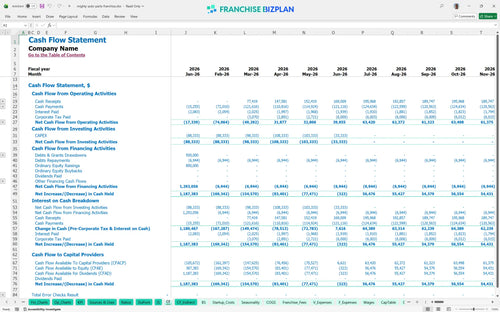
Your lowest cash point hits in June 2026 at $702,000, so you need to ensure your initial funding covers this dip during the ramp-up. Since you start operations in March but do not hit full stride until later, that three-month gap is critical for your cash flow. If leasehold improvements take longer than planned, your cash runway could tighten defintely.
Estimating profitability for B2B auto parts distribution requires looking at the 'what-ifs' of local demand. A high-growth scenario where you hit $4M+ in revenue by year five drastically improves your IRR, while a low-revenue year-1 might push your break-even back. The model shows that even a small 1% shift in parts COGS has a massive impact on your $446,000 year-1 EBITDA.
This Excel-based tool lets you swap out every assumption to match your specific territory and warehouse needs. You can adjust local rent, delivery fuel costs, or sales rep commissions without breaking the underlying math. It is built to handle the nuances of B2B distribution, from inventory turns to local labor rates, making it a versatile franchise startup cost template.

Scaling a distribution hub requires looking past the first six months of operations. This model provides a five-year roadmap for revenue, EBITDA, and cash flow to help you visualize long-term automotive franchise profitability analysis. You can see how adding more delivery routes or sales reps in year three impacts your bottom line as revenue grows from $1.8M to over $4M.

Every dollar sent to the franchisor is a dollar off your store-level margin. The model automatically calculates the 5% royalty and 0.5% marketing fee based on your wholesale volume, so you know exactly what remains after brand obligations. This is essential for any B2B franchise business plan Excel to ensure your net take-home pay stays on target.

Launching a warehouse involves significant capital expenditure planning, with leasehold improvements and racking often hitting six figures. This tool helps you calculate startup costs for an automotive franchise by totaling your $520,000 in initial CAPEX and startup fees. You will see exactly when your monthly sales cover your $18,000 warehouse rent and $4,000 utility bills.

Do not guess if your $85,000 GM salary or 2.5% delivery logistics cost is reasonable for your market. The model includes built-in industry benchmarks to help you sanity-check your projections against typical B2B auto parts distribution standards. It serves as a comprehensive franchise investment feasibility study template for serious operators.


Simply purchase and download the financial model template, then access it instantly using Microsoft Excel or Google Sheets. No installation or technical expertise required-just open and start working.

Enter your business-specific numbers, including revenue projections, costs, and investment details. The pre-built formulas will automatically calculate financial insights, saving you time and effort.

Leverage the investor-ready format to confidently showcase your financial projections to banks, franchise representatives, or investors. Impress stakeholders with clear, data-driven insights and professional reports.

Leverage the investor-ready format to confidently present your projections to banks, franchise representatives, or investors.