


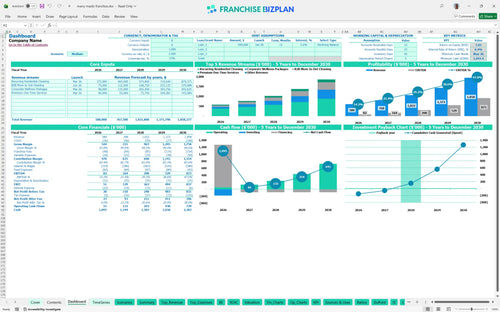
All-in-one Dashboard
Core inputs and core outputs



This cleaning service franchise financial spreadsheet provides a professional-grade framework for forecasting revenue, managing expenses, and calculating the total return on your investment.
Core inputs and core outputs
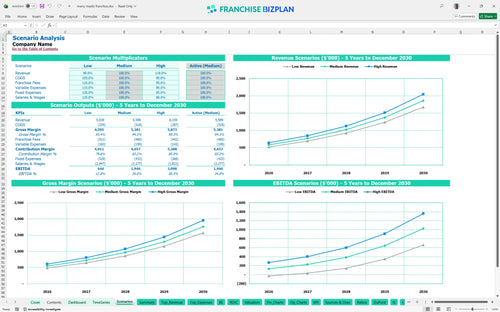
Three scenario analysis
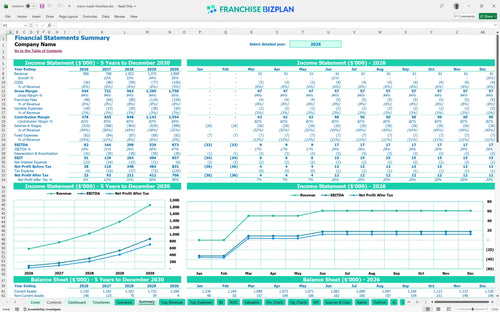
Presentation ready
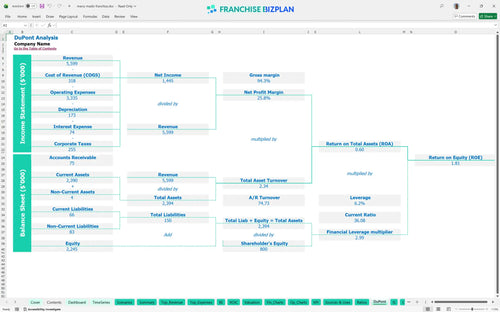
DuPont analysis
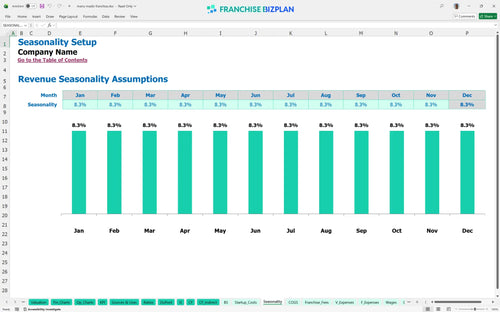
Researched revenue assumptions
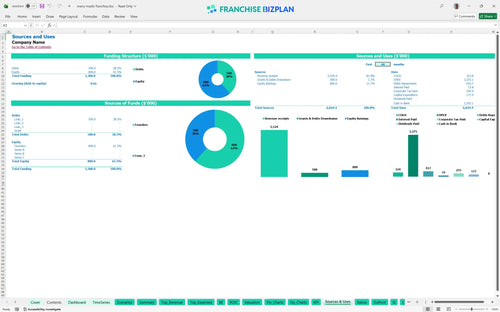
Lender-friendly financial outputs
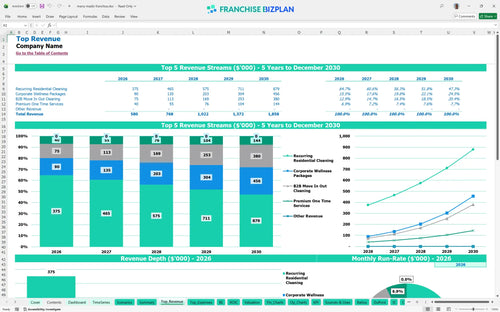
Revenue stream detailed view
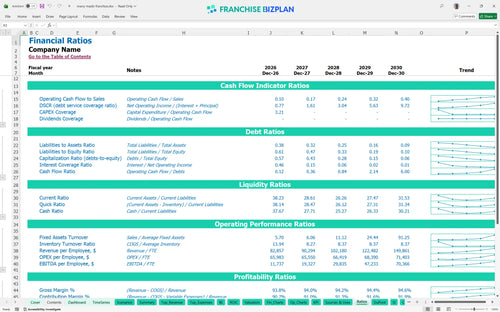
Performance metrics benchmark
We built this franchise unit financial model using our own research into the residential cleaning sector. The key assumptions, including revenue streams like recurring residential cleaning and corporate wellness packages, are pre-populated with data specific to this franchise unit and are fully editable. You can defintely see how the $580,000 year-one revenue target translates into an $82,000 EBITDA as you ramp up your crew.
This franchise unit is projected to be profitable within its first year, starting with an EBITDA of $82,000 and growing to $873,000 by year five. The franchise profitability analysis shows that as you scale your cleaning crew from 4 to 8 full-time employees, the net margin expands significantly due to fixed-cost absorption.
The total initial capital for this cleaning franchise startup costs includes $177,000 in primary CAPEX plus a significant cash buffer. Major uses of funds include the $45,000 franchise fee, $55,000 for service vehicles, and $28,000 for office improvements to get the operation running. Here is the quick math: you need enough liquidity to cover the $1,042,000 minimum cash point during the ramp-up phase.
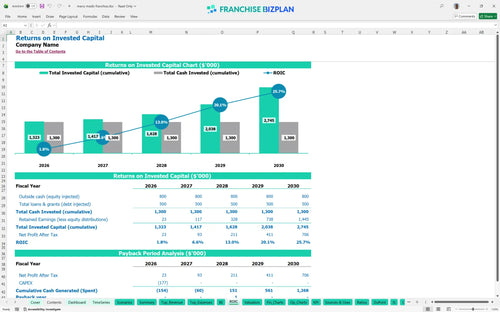
Investors can expect a 3-year payback period on their initial investment with an Internal Rate of Return (IRR) of 6.4%. While the IRR is conservative, the Return on Equity (ROE) of 1.81 shows a solid performance for a service-based business. Estimating profitability for a new franchise location requires looking at these long-term yields rather than just year-one cash flow.
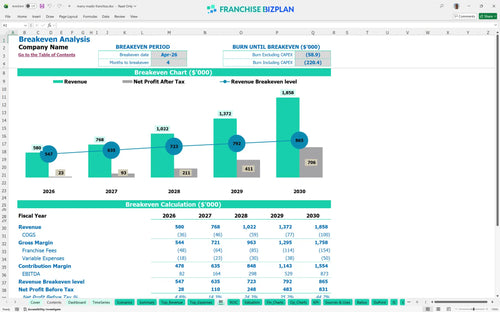
The unit reaches its break-even point in April 2026, just 4 months after launch. This fast break-even analysis is driven by the low fixed overhead and the immediate demand for recurring residential cleaning. To hit this goal, you must maintain a steady volume of bookings to cover the $7,000+ in monthly fixed expenses like rent, insurance, and software.
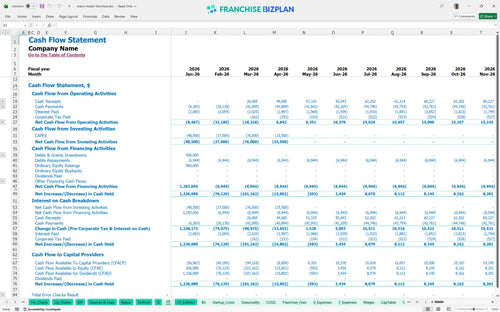
The lowest cash point occurs in May 2026, roughly five months after starting the business. Your cash flow projection indicates you need a substantial buffer to handle the timing gap between hiring your 4.0 FTE cleaning crew and collecting on your first few months of recurring contracts. Still, the model shows the business generates enough cash to sustain growth without additional debt after the initial ramp.
In a high-growth scenario, hitting the $1.85M revenue mark by year five is possible if you maximize your sales representative's productivity and maintain high customer retention. The financial template for professional home cleaning business allows you to test how a 10% drop in recurring revenue affects your ability to pay the 7% royalty. What this estimate hides is that a high-performing manager can often outperform these averages through better crew utilization.
This franchise financial model template is built in Excel to give you total control over your numbers. You can adjust the pre-filled formulas and editable assumptions to match your specific territory, whether you are looking at a single unit or a small cluster. It is a flexible franchise investment calculator that lets you swap out local labor rates or rent costs without breaking the logic.

Planning for the long term is the only way to survive in the cleaning industry. This cleaning business financial plan provides a 5-year outlook on revenue, costs, and profit, helping you see how scaling from 4 to 8 crews impacts your bottom line. It delivers a clear financial model template for residential cleaning services that maps out your growth from year one through year five.

The model handles the specific math of being a franchisee, including the 7% royalty and 1.3% marketing fund contributions. These franchise royalty fees are calculated automatically against your gross sales so you can see the actual cash left for the owner. It is essential for evaluating franchise investment opportunities where top-line revenue doesn't always tell the whole story.

Knowing your cleaning franchise startup costs is the first step toward a successful launch. This tool helps you estimate the total initial investment, from the $45,000 franchise fee to the $55,000 for service vehicles. It includes a detailed break-even analysis to show exactly what monthly sales volume you need to cover your fixed costs like the $3,500 office rent.

We have included benchmarks for operational expenses to help you sanity-check your budget against industry standards. For example, the model tracks fuel and transportation costs starting at 2% of revenue, which is typical for a mobile service business. These franchise unit performance benchmarking tools ensure your labor and supply costs stay within a realistic range for a professional cleaning operation.


Simply purchase and download the financial model template, then access it instantly using Microsoft Excel or Google Sheets. No installation or technical expertise required-just open and start working.

Enter your business-specific numbers, including revenue projections, costs, and investment details. The pre-built formulas will automatically calculate financial insights, saving you time and effort.

Leverage the investor-ready format to confidently showcase your financial projections to banks, franchise representatives, or investors. Impress stakeholders with clear, data-driven insights and professional reports.

Leverage the investor-ready format to confidently present your projections to banks, franchise representatives, or investors.