


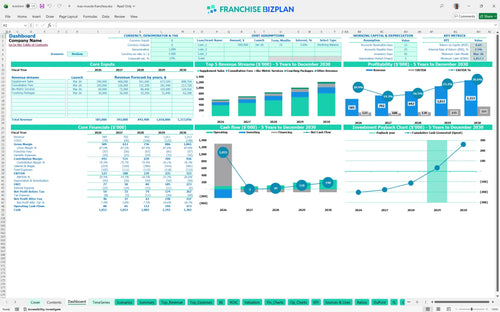
All-in-one Dashboard
Core inputs and core outputs



This Excel financial model template for franchise owners provides a detailed roadmap for your nutrition and wellness retail unit, covering everything from initial CAPEX to five-year EBITDA projections.
Core inputs and core outputs
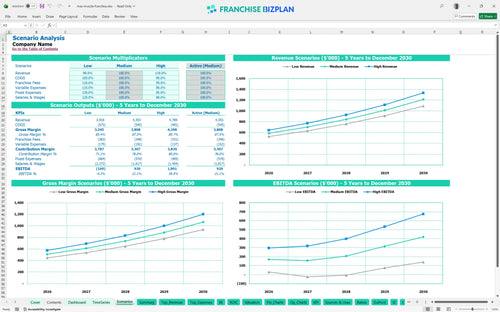
Three scenario analysis
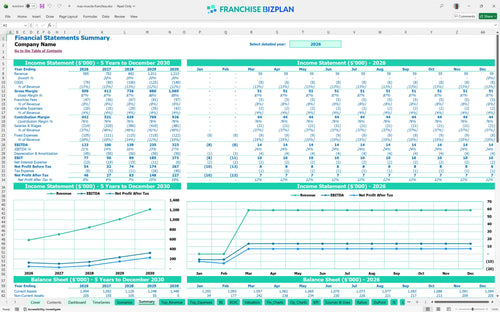
Presentation ready
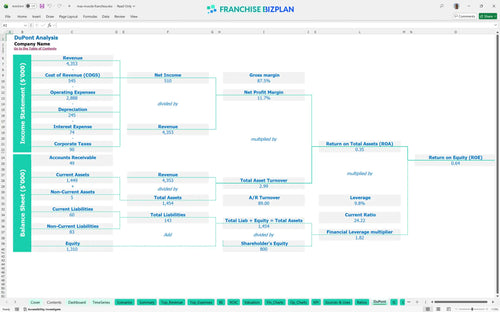
DuPont analysis
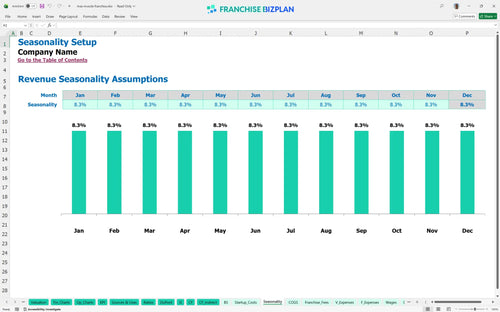
Researched revenue assumptions
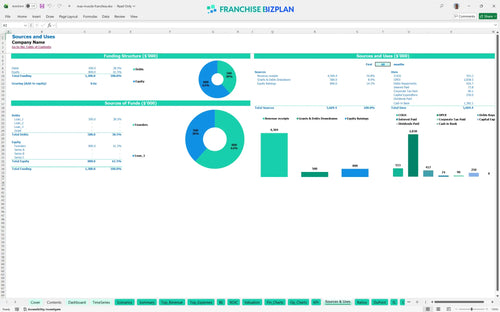
Lender-friendly financial outputs
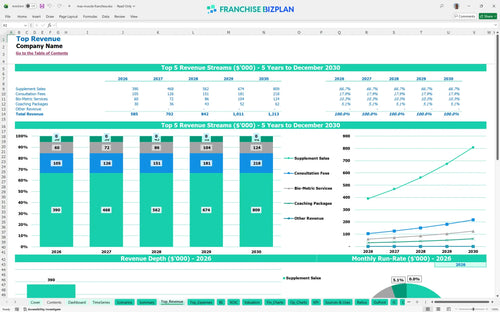
Revenue stream detailed view
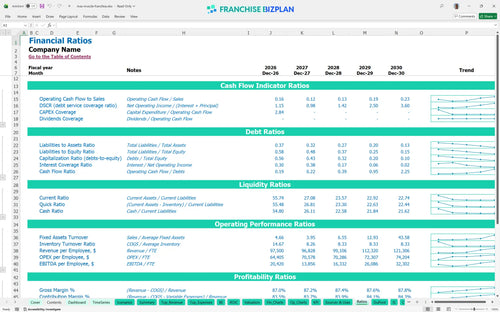
Performance metrics benchmark
We built this nutrition store financial projections model using deep research into the wellness retail sector. Key assumptions, including the $585,000 year-one revenue and the $6,200 monthly rent for a prime location, are pre-populated and fully editable. This tool helps you visualize the path to a $323,000 year-five EBITDA while managing the 6% royalty and 2% marketing fund obligations.
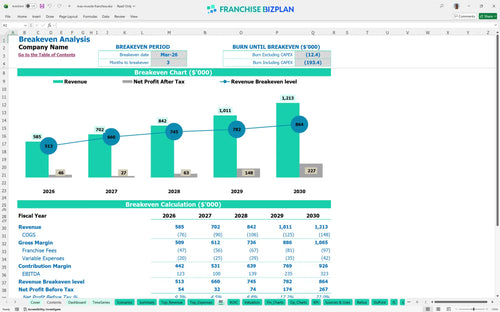
Based on the data, the unit hits its break-even point in March 2026, just three months after launch. While year one shows a solid $123,000 EBITDA, the real acceleration happens in year five as revenue scales to $1.213 million. Calculating profitability for a retail wellness franchise depends on maintaining high-margin service revenue alongside supplement sales.
You will need roughly $250,000 in startup capital to cover the $35,000 franchise fee, $100,000 in build-out, and equipment like the $28,000 bio-metric station. The model also accounts for a minimum cash requirement of $1,018,000 to ensure the business stays liquid during the ramp-up phase. Understanding these startup capital requirements is the first step in your financial feasibility study for retail franchise operations.
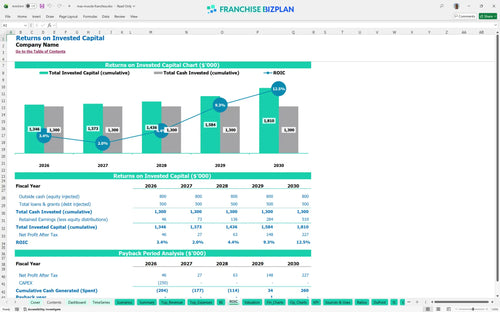
This unit shows an Internal Rate of Return (IRR) of 3.55% and a Return on Equity (ROE) of 0.64. The payback period is 4 years, which is standard for a retail wellness concept with high upfront build-out costs in premium locations. Calculating ROI for health and wellness franchise units requires looking at both cash flow and long-term equity growth.
The monthly break-even occurs in March 2026, just 3 months after starting. The biggest driver here is supplement sales, which need to hit about $260,000 in the first year to cover the $6,200 monthly rent and the $165,000 annual payroll. This franchise unit profitability analysis shows that service fees for coaching significantly lower the revenue volume needed to cover fixed costs.
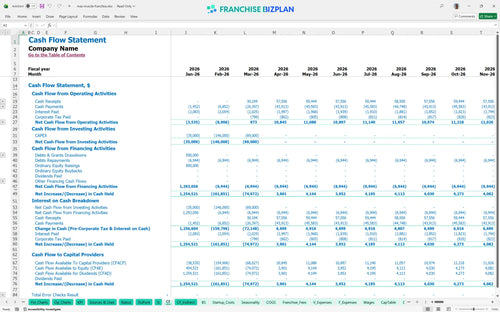
Your lowest cash point is projected for March 2026. Because you are opening in a high-rent district, you need to manage your inventory orders tightly in the first 90 days to avoid a liquidity crunch. This retail franchise operating expenses breakdown helps you see exactly where cash is going during the critical ramp-up months.
The model allows you to toggle between Low, Medium, and High cases to see how to create a financial projection for a fitness franchise under different market conditions. In a high-growth scenario where coaching revenue exceeds the $30,000 year-one estimate, your year-5 EBITDA could climb well past $323,000. Conversely, if supplement margins dip, you will need higher volume to maintain the same net profit.
Finance: update unit break-even and payback model by Friday
This franchise financial model template is built in Excel, allowing you to tweak every assumption to fit your specific territory. Whether you are adjusting supplement inventory levels or local labor rates, the pre-filled formulas handle the heavy lifting. It is designed to be a living document that grows with your business from day one, making it easy to see how different choices impact your bottom line.

Mapping out a five-year horizon helps you see the transition from a startup to a mature retail operation. The model tracks revenue climbing from $585,000 in year one to over $1.2 million by year five, providing a clear roadmap for long-term planning. This retail business forecasting tool is critical for understanding how scaling your coaching packages and supplement sales impacts your long-term franchise unit economics.

Royalties and brand fees are the ongoing costs you pay for the system, and they hit your top line every month. This model bakes in a 6% royalty and a 2% marketing fund contribution automatically based on your sales volume. By seeing these costs upfront, you can defintely plan your margins without any surprises during your monthly franchise P&L statement reviews.

Getting the doors open requires a clear view of your total initial investment, from the $35,000 franchise fee to the $100,000 in leasehold improvements. This tool identifies exactly when your unit stops burning cash and starts generating a surplus. Knowing your break-even sales level helps you set realistic daily targets for your retail team and manage your retail franchise startup costs effectively.

Don't guess if your $6,200 monthly rent or your staffing plan is out of whack. The model includes industry-standard benchmarks for retail wellness and nutrition stores to help you validate your projections. Comparing your gross margins against typical ranges ensures your fitness franchise business plan is grounded in reality, not just optimism.


Simply purchase and download the financial model template, then access it instantly using Microsoft Excel or Google Sheets. No installation or technical expertise required-just open and start working.

Enter your business-specific numbers, including revenue projections, costs, and investment details. The pre-built formulas will automatically calculate financial insights, saving you time and effort.

Leverage the investor-ready format to confidently showcase your financial projections to banks, franchise representatives, or investors. Impress stakeholders with clear, data-driven insights and professional reports.

Leverage the investor-ready format to confidently present your projections to banks, franchise representatives, or investors.