


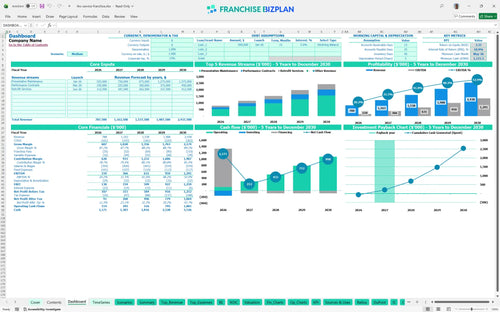
All-in-one Dashboard
Core inputs and core outputs



This comprehensive financial tool provides a data-driven roadmap for launching and scaling a commercial HVAC service unit with precision.
Core inputs and core outputs
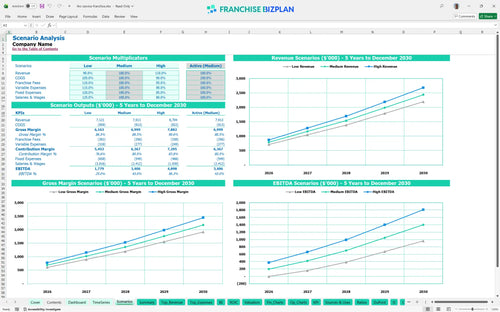
Three scenario analysis
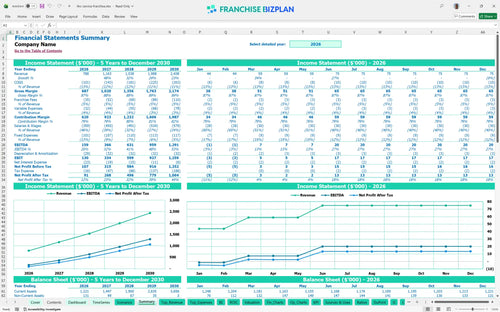
Presentation ready
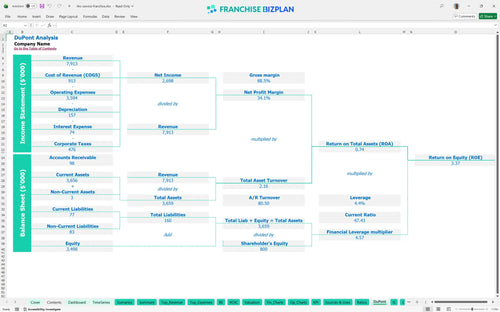
DuPont analysis
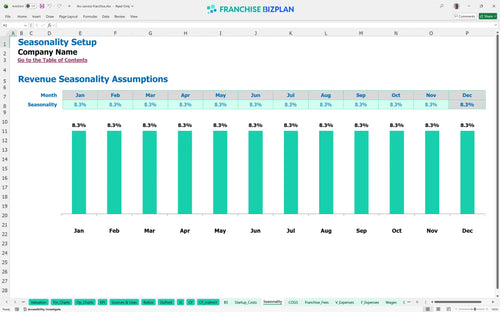
Researched revenue assumptions
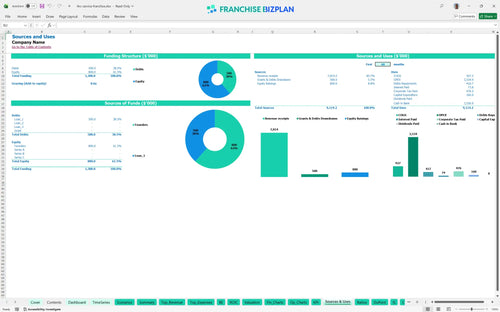
Lender-friendly financial outputs
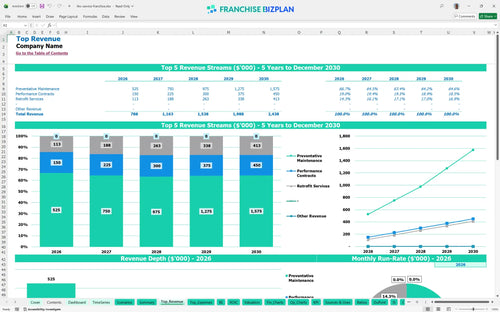
Revenue stream detailed view
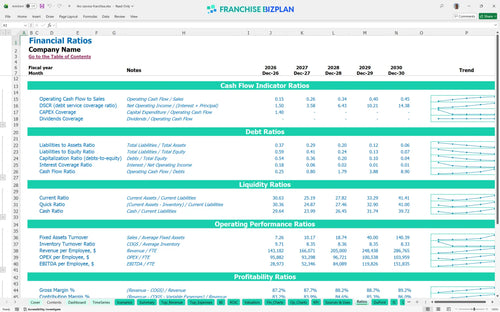
Performance metrics benchmark
We developed this HVAC service business financial projections model based on deep research into commercial service unit economics. The assumptions for preventative maintenance, performance contracts, and retrofit services are pre-populated with data reflecting a year-one revenue of $788,000 and an EBITDA of $159,000. These inputs are fully editable, allowing you to refine the $1.16 million year-two revenue target based on your specific local demand.
The unit reaches profitability almost immediately, with a break-even date of January 2026. By year three, the model projects an EBITDA of $631,000 as recurring revenue from maintenance contracts begins to dominate the mix. Net profit scales significantly by year five, reaching $1.29 million after accounting for all royalties and fixed costs.
Launching this unit in the US requires an initial capital outlay of approximately $160,000 for primary assets plus significant working capital. The total investment covers the $75,000 franchise fee, $30,000 for service vehicles, and $15,000 for diagnostic equipment. You will also need to account for pre-opening costs like branding and the initial parts inventory to ensure a smooth start.
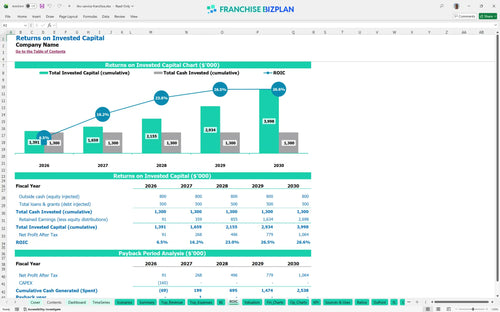
This financial template for HVAC service business owners shows a strong internal rate of return (IRR) of 10.86% over the five-year period. With a payback period of just 2 years, the model demonstrates a relatively fast recovery of the initial investment. The return on equity (ROE) of 3.37 indicates that the business generates substantial value for the owner relative to the capital contributed.
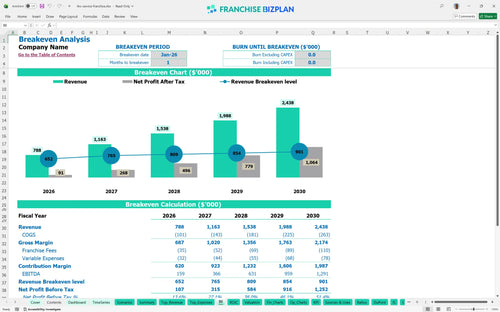
The franchise unit operational cost breakdown template shows you hit the break-even point in just 1 month, specifically by January 2026. The primary driver for this speed is the immediate launch of preventative maintenance contracts which provide steady cash flow. Managing the $5,500 monthly rent and the $250,000+ annual payroll for the initial crew is the biggest hurdle to maintaining this pace.
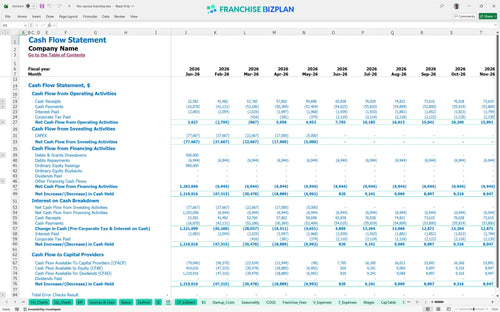
Managing recurring revenue in a maintenance franchise is vital, as the lowest cash point is projected to be $1,115,000 in May 2026. This suggests that while the unit is profitable, the timing of capital expenditures and ramp-up costs requires a solid cash buffer. You should defintely maintain a reserve to handle the gap between service delivery and payment collection on large retrofit projects.
Using best practices for HVAC franchise financial forecasting, the model allows you to toggle between performance levels to see how they impact your ROI. In a high-growth scenario, hitting the $2.4 million revenue mark in year 5 significantly boosts your exit valuation and cash distributions. Conversely, a low-revenue scenario highlights the risk of high fixed labor costs, which total over $280,000 in year one salaries alone.
Finance: update unit break-even and payback model by Friday
This franchise financial model template is built in Excel with fully editable assumptions and pre-linked formulas. You can adjust local labor rates, warehouse rent, and service pricing to match your specific territory and market conditions without breaking the underlying logic. It provides a flexible sandbox to test how different staffing levels or material costs impact your bottom line.

Mapping out an HVAC franchise business plan requires a long-term view of how recurring maintenance contracts stack up over time. This model delivers a detailed 5-year outlook on revenue growth, starting from $788,000 in year one and scaling to over $2.4 million by year five. It tracks the transition from initial setup to a mature operation with high-margin performance contracts.

The model specifically tracks your franchise royalty structure, including the 4.5% royalty fee and the initial $75,000 franchise fee. By automating these calculations against your projected revenue streams, you can see exactly how much gross profit remains after meeting your brand obligations. It ensures you account for every dollar owed to the franchisor before calculating your take-home pay.

Knowing how to calculate startup costs for a commercial HVAC franchise is critical for securing funding and managing early cash flow. This tool aggregates your initial $160,000 capital expenditure, covering everything from service vehicles to diagnostic equipment and office fit-out. It identifies the exact sales volume needed to cover your $5,500 monthly warehouse rent and other fixed overheads.

This franchise unit profitability analysis tool uses researched benchmarks for commercial HVAC operations to help you validate your projections. You can compare your planned technician wages, such as the $65,000 for a lead tech, against industry standards to ensure you remain competitive in the labor market. It acts as a sanity check for your gross margin and occupancy cost assumptions.


Simply purchase and download the financial model template, then access it instantly using Microsoft Excel or Google Sheets. No installation or technical expertise required-just open and start working.

Enter your business-specific numbers, including revenue projections, costs, and investment details. The pre-built formulas will automatically calculate financial insights, saving you time and effort.

Leverage the investor-ready format to confidently showcase your financial projections to banks, franchise representatives, or investors. Impress stakeholders with clear, data-driven insights and professional reports.

Leverage the investor-ready format to confidently present your projections to banks, franchise representatives, or investors.