


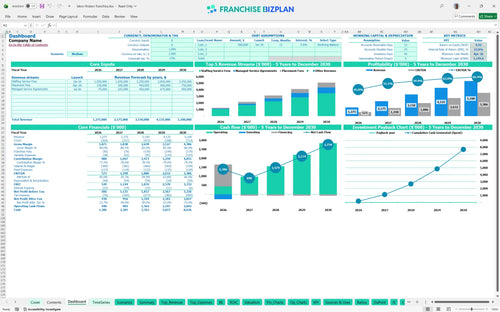
All-in-one Dashboard
Core inputs and core outputs



This franchise unit profitability spreadsheet provides a complete toolkit for forecasting revenue, managing payroll for five key roles, and tracking a $270,000 initial capital outlay.
Core inputs and core outputs
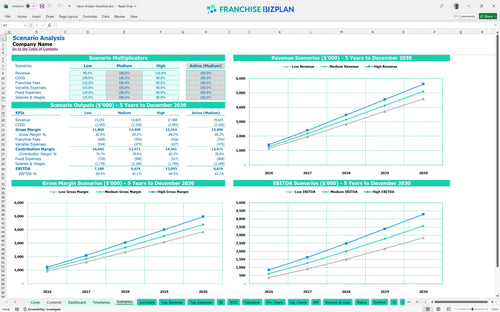
Three scenario analysis
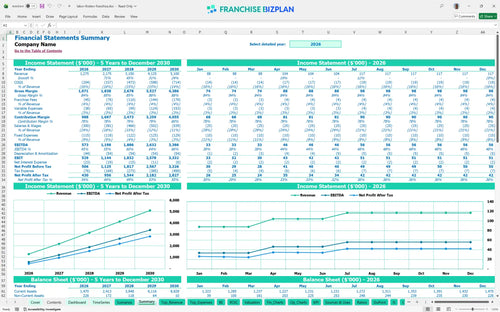
Presentation ready
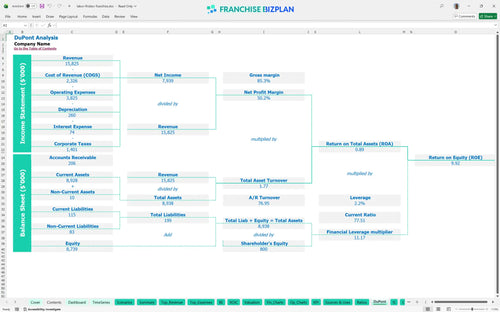
DuPont analysis
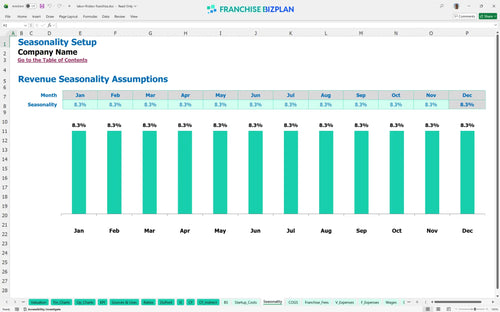
Researched revenue assumptions
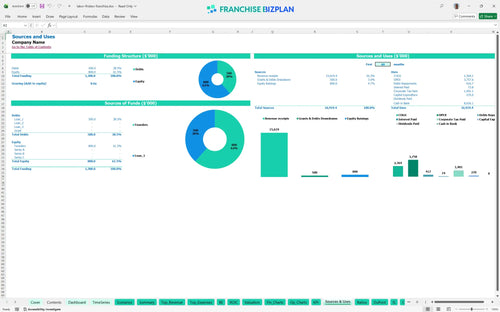
Lender-friendly financial outputs
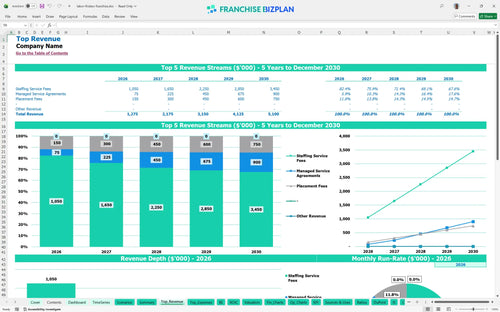
Revenue stream detailed view
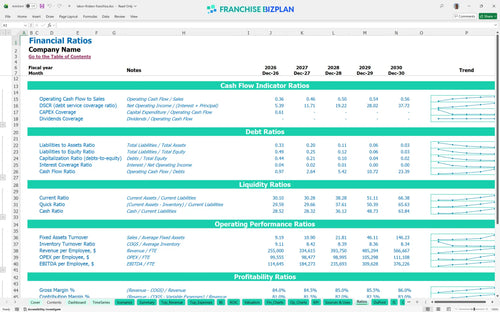
Performance metrics benchmark
We built this Labor Finders Franchise franchise unit financial model using our own research into the industrial staffing sector. Key assumptions, including year-one revenue of $1,275,000 and the 3.5% royalty fee, are pre-populated with researched data and are fully editable. This tool helps you map out everything from recruiter salaries to the $1.15M cash buffer needed for operations.
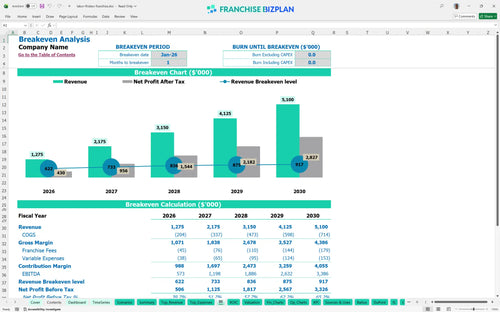
The unit hits the break-even point in January 2026, showing immediate traction in the market. By year five, the model projects EBITDA growing to $3,386,000 as you scale staffing agency revenue streams. Profitability metrics for temporary staffing franchises depend heavily on managing the 14% worker compensation cost effectively. Net profit hits $573,000 in the first twelve months.
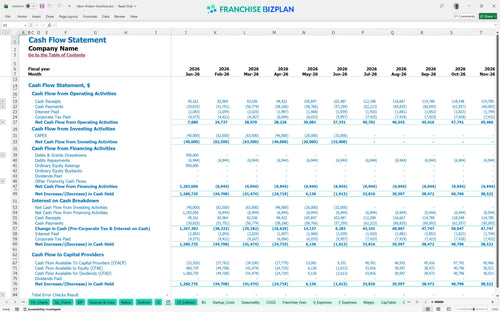
Your startup cost breakdown for temporary labor agency needs includes $20,000 for the franchise fee and $120,000 for leasehold improvements. Total liquidity is vital, as the minimum cash point hits $1,150,000 in April 2026 to cover the ramp-up. You need $1.15M in the bank to sleep well.
Analyzing franchise investment returns for logistics staffing shows an internal rate of return (IRR) of 22.79%. While the ROE stands at 9.92, the actual payback period occurs after year five due to the heavy working capital requirements. Still, the $5.1M revenue potential by year five makes the long-term ROI analysis for franchises in this space look compelling. A 22.79% IRR proves the model works.
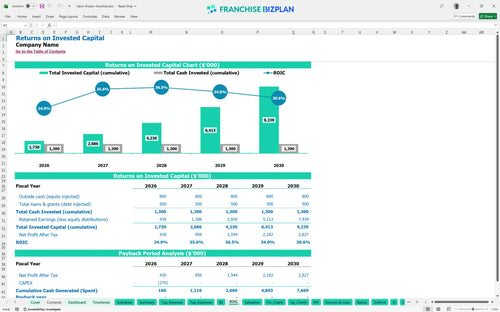
The monthly break-even point calculator shows you only need one month to cover your fixed costs of roughly $9,550, which includes rent and utilities. The primary driver for reaching this so fast is the $700,000 in year-one staffing service fees. One month to break-even is a fast start.
Your lowest cash point hits in April 2026 at $1,150,000, which serves as your operational safety net. You need this runway because financial projections for construction staffing business models often see a lag between paying workers and receiving client checks. April 2026 is your most critical cash month.
In a high-growth scenario, hitting $5.1M in revenue by year five pushes EBITDA to $3,386,000. If you follow best practices for managing franchise operating costs and keep temporary worker pay at 12%, your margins expand significantly. A low-case scenario where placement fees lag behind the $100,000 year-one goal will defintely delay your cash flow recovery. High-margin placements are the key to the best case.
This staffing agency franchise financial model lives in Excel, so you can tweak every cell to match your specific territory. It comes with pre-filled formulas and editable assumptions, making it easy to swap out local rent or adjust recruiter pay. Every cell is open for your local market data.

Planning for the long haul matters when you are scaling from $1.275M in year one to over $5M by year five. This industrial staffing franchise business plan maps out your revenue, costs, and cash flow over 60 months to ensure your growth is sustainable. Growth from $1.2M to $5.1M requires a clear roadmap.

We built this to handle the specific math of being a franchisee, including the $20,000 initial fee and the 3.5% royalty. Estimating royalty fees for franchise business planning is vital because that cash leaves your door before you pay your own light bill. Royalties take 3.5% off the top before you pay yourself.

Use this franchise startup cost template to see exactly where your capital goes, from the $120,000 leasehold improvements to the $35,000 for computer systems. Knowing your break-even point calculator results helps you understand the exact volume of staffing hours needed to cover your $6,200 monthly rent. Knowing your $6,200 rent coverage is step one.

This model uses labor services franchise financial projections that align with industrial staffing norms. You can sanity-check your worker compensation-which starts at 14% of revenue-against industry standards to ensure your margins stay healthy as you scale. Compare your 14% labor costs against the pros.


Simply purchase and download the financial model template, then access it instantly using Microsoft Excel or Google Sheets. No installation or technical expertise required-just open and start working.

Enter your business-specific numbers, including revenue projections, costs, and investment details. The pre-built formulas will automatically calculate financial insights, saving you time and effort.

Leverage the investor-ready format to confidently showcase your financial projections to banks, franchise representatives, or investors. Impress stakeholders with clear, data-driven insights and professional reports.

Leverage the investor-ready format to confidently present your projections to banks, franchise representatives, or investors.