


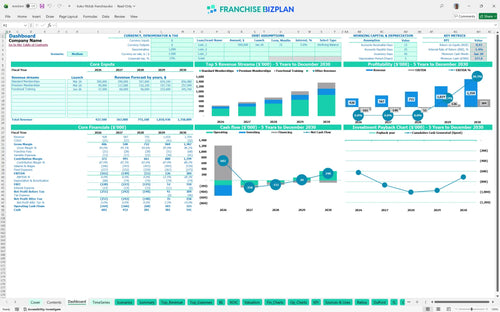
All-in-one Dashboard
Core inputs and core outputs



This franchise unit profit and loss template provides a complete toolkit for estimating monthly operating costs for fitness centers and performing profitability forecasting for new gym franchisees.
Core inputs and core outputs
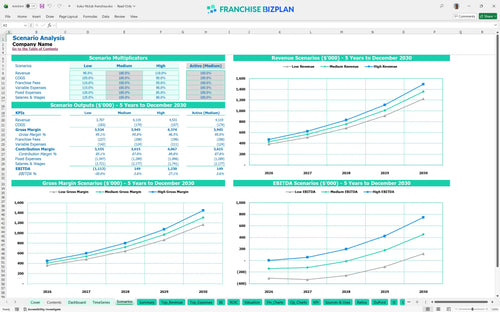
Three scenario analysis
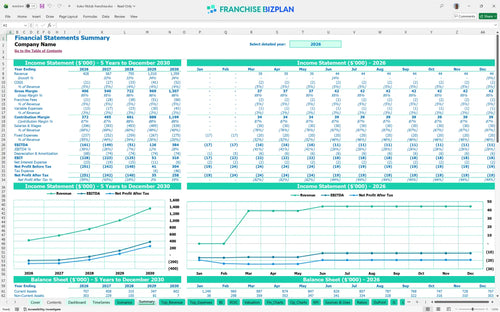
Presentation ready
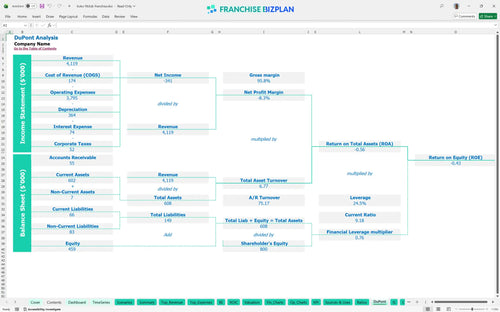
DuPont analysis
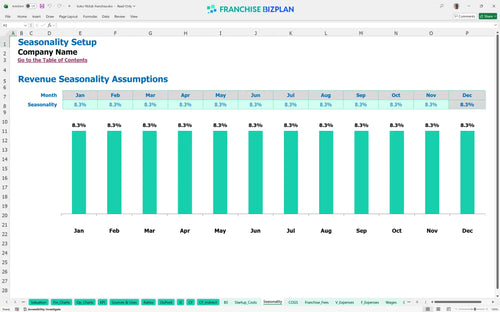
Researched revenue assumptions
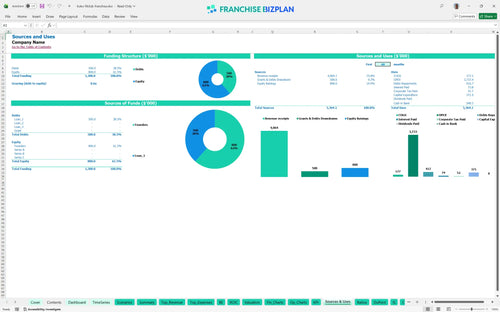
Lender-friendly financial outputs
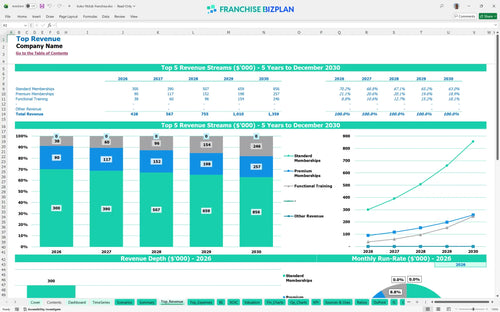
Revenue stream detailed view
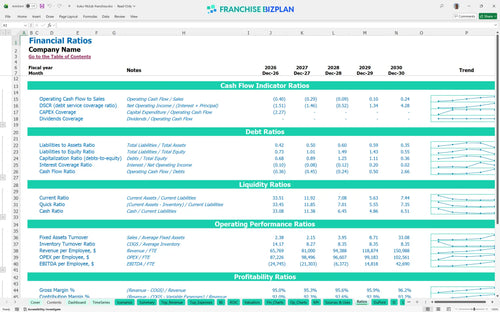
Performance metrics benchmark
We developed this fitness franchise unit financial model using detailed research on boutique gym operations and tech-forward fitness concepts. The pre-populated assumptions for $428,000 in year-one revenue and a 37-month break-even period are fully editable to match your specific Scottsdale or local market conditions. This tool provides a realistic look at how a $384,000 year-five EBITDA is achievable through disciplined management of royalties and staffing.
Based on the data, this fitness studio reaches positive EBITDA in year four with a projected $126,000 in earnings. While the first three years show negative results during the membership ramp-up, the scaling of standard and premium memberships eventually offsets the high fixed occupancy and labor costs.
To launch this unit, you will need approximately $371,000 in initial capital for the build-out and equipment. The largest allocations include $150,000 for leasehold improvements and $100,000 for specialized training technology, alongside the $39,000 initial franchise fee required to secure the territory.
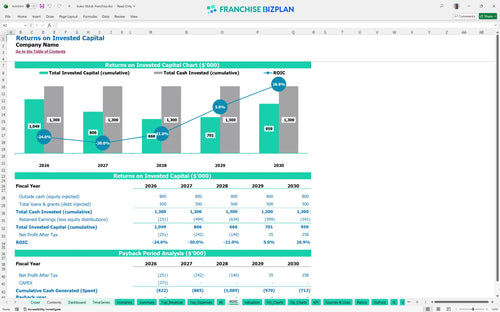
Calculating ROI for health and wellness franchise units reveals a longer horizon, with full payback occurring after year five. The model shows an internal rate of return (IRR) of -1.39% over the first five years, though the significant jump to a $384,000 EBITDA in year five suggests strong value for a multi-unit operator.
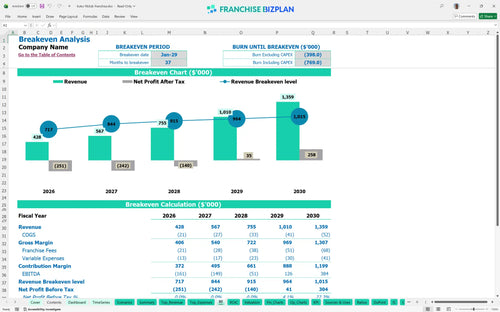
The monthly break-even point is reached in January 2029, which is month 37 of the operation. The primary driver is the $14,500 monthly rent for a premium location; you must maintain high membership density and a strong average ticket to cover these fixed occupancy and software licensing costs.
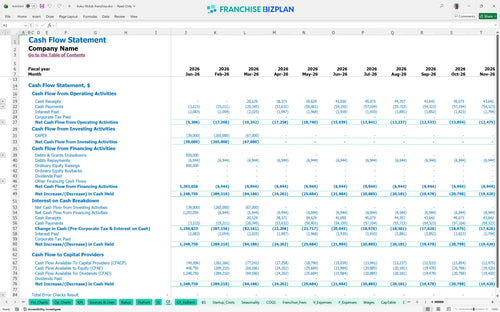
The lowest cash point occurs in January 2029, with a minimum cash requirement of $277,000 to cover cumulative operating losses. You defintely need a robust working capital buffer to survive the 37-month ramp-up period, especially with an annual payroll that starts at over $230,000 for a fully staffed club.
The fitness franchise unit economic analysis shows that a 10% revenue shortfall in the Low case extends the break-even date significantly and increases peak cash needs. However, the High case leverages the $14,500 fixed rent, allowing more of every dollar from premium memberships to flow directly to the bottom line by year five.
Finance: update unit break-even and payback model by Friday.
This fitness franchise financial model is an Excel-based tool designed for precision and flexibility. You can easily adjust the $14,500 monthly rent for a prime location or modify the 5% royalty fee to see how it impacts your bottom line. It is built so you can test different membership tiers and staffing levels without breaking the underlying math, making it a versatile franchise startup cost template for any territory.

Planning a boutique gym business plan requires a long-term view of performance and growth. This model tracks your trajectory from a $428,000 first-year revenue up to a projected $1.35 million by year five. It maps the path from initial pre-opening losses to a projected $384,000 EBITDA, providing a clear revenue projection model for scaling your fitness studio investment analysis over a standard franchise term.

Understanding fitness franchise royalties is vital for maintaining store-level margins. This template specifically accounts for the $39,000 initial fee and the ongoing 5% royalty on gross sales. By automating these calculations, you can see exactly how much cash stays in the unit versus what is paid to the franchisor as you scale your membership base and functional training sessions.

Knowing how to calculate startup costs for a fitness franchise is the first step to avoiding a mid-launch cash crunch. With $371,000 in upfront capital expenditures, including $150,000 for leasehold improvements, you need to know when the unit will stand on its own. This break-even analysis tool shows you will need approximately 37 months to cover your fixed and variable costs during the ramp-up phase.

This Excel spreadsheet for franchise financial projections includes benchmarks to keep your assumptions grounded in reality. For example, if your labor costs for trainers and managers exceed typical boutique fitness franchise business plan example norms, the model highlights the variance. It helps you sanity-check your $14,500 rent against your projected revenue to ensure occupancy costs do not exceed sustainable levels.


Simply purchase and download the financial model template, then access it instantly using Microsoft Excel or Google Sheets. No installation or technical expertise required-just open and start working.

Enter your business-specific numbers, including revenue projections, costs, and investment details. The pre-built formulas will automatically calculate financial insights, saving you time and effort.

Leverage the investor-ready format to confidently showcase your financial projections to banks, franchise representatives, or investors. Impress stakeholders with clear, data-driven insights and professional reports.

Leverage the investor-ready format to confidently present your projections to banks, franchise representatives, or investors.