


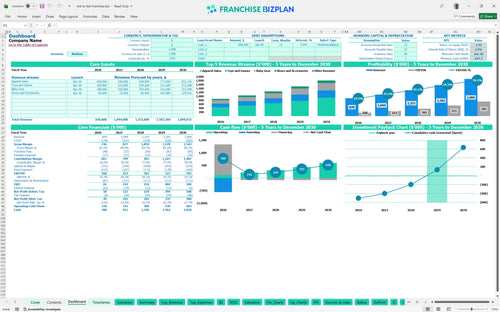
All-in-one Dashboard
Core inputs and core outputs



The model includes a detailed Excel template for franchise operating expenses, five-year pro forma statements, and a dynamic dashboard for tracking ROI and payback.
Core inputs and core outputs
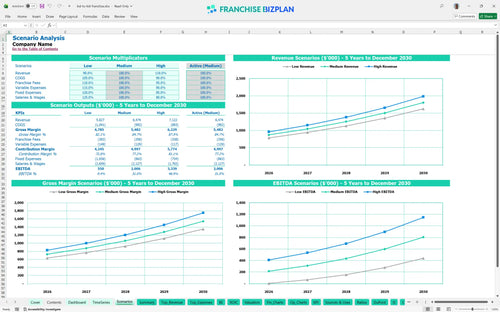
Three scenario analysis
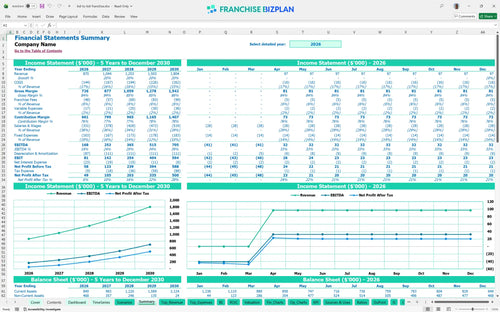
Presentation ready
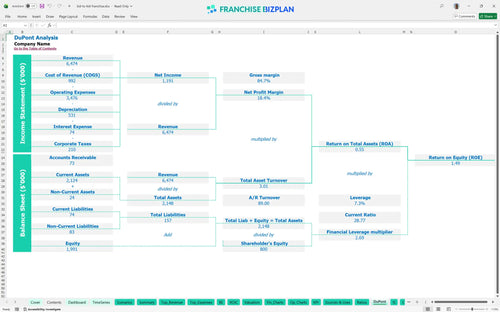
DuPont analysis
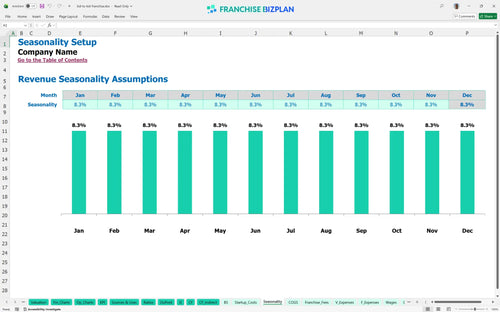
Researched revenue assumptions
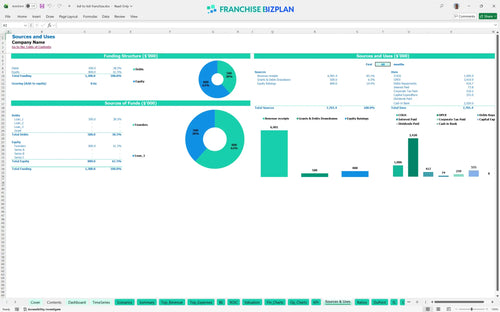
Lender-friendly financial outputs
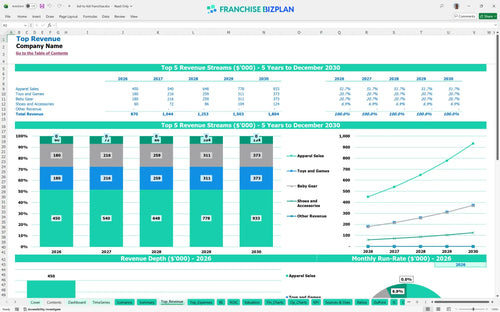
Revenue stream detailed view
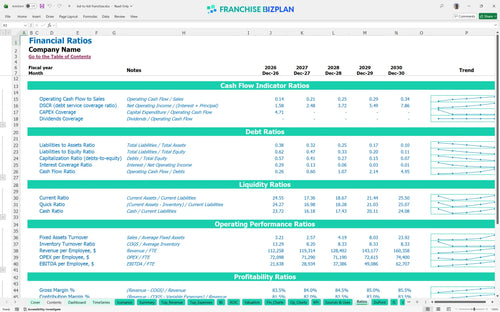
Performance metrics benchmark
We built this children's resale franchise financial model using detailed market research to help you navigate the complexities of inventory-heavy retail. The assumptions for revenue streams like apparel and baby gear, along with operating expenses and royalties, are pre-populated and fully editable. With a year one revenue target of $870,000 and an EBITDA of $168,000, this model provides a data-driven starting point for your investment analysis.
This franchise unit shows a strong upward path, starting with a $168,000 EBITDA in the first year and growing to $705,000 by year five. The model calculates net profit after accounting for the 15% inventory purchase cost and the 5.5% combined royalty and marketing fees. You can track the full franchise profit and loss statement to see how margins expand as revenue climbs.
Launching this unit requires approximately $555,000 in total initial capital. This covers the $25,000 franchise fee, $280,000 for leasehold improvements, and $75,000 for initial inventory stock. Learning how to calculate startup costs for a resale franchise is simplified here, as the model maps out every major CAPEX item from signage to POS systems.
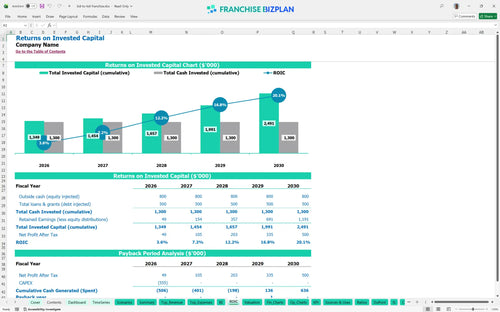
Investors can expect a 4-year payback period and an internal rate of return (IRR) of 3.51%. While the initial years focus on recovering the $555,000 investment, the long-term franchise investment returns become significant as EBITDA margins improve. Calculating ROI for children's apparel franchise units requires this level of detail to understand the true cash-on-cash potential.
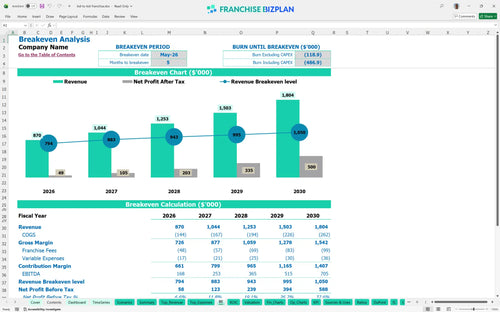
The unit is projected to reach its monthly break-even point by May 2026, just five months after launch. This quick turnaround is driven by the high demand for resale goods and a manageable fixed cost structure, including the $9,000 monthly rent. Reaching this milestone depends heavily on retail inventory turnover metrics and maintaining a steady flow of quality trade-ins.
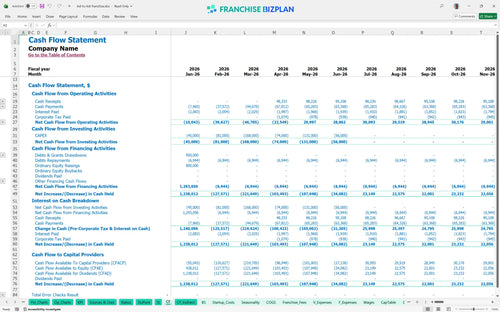
The lowest cash point occurs in June 2026 at $643,000, which includes your initial liquidity buffer. You will defintely need to monitor cash flow closely during the first six months of ramp-up to ensure you can cover the $65,000 manager salary and other fixed overhead. This financial model template for children's clothing store helps you visualize the cash dip before the store becomes self-sustaining.
The model allows you to toggle between Low, Medium, and High scenarios to see how a 10% shift in sales impacts your bottom line. In a high-performance case, aggressive local marketing and high throughput can accelerate the 4-year payback. Evaluating profitability of a kids resale franchise under various conditions is the best way to prepare for market volatility.
Finance: update unit break-even and payback model by Friday
This franchise financial model template is built in Excel to give you total control over your unit economics. You can adjust pre-filled formulas and editable assumptions to match your specific territory, whether you are looking at a single store or planning a multi-unit rollout. It serves as a comprehensive franchise business plan template that adapts to real-world shifts in labor or rent.

Planning for the long term is essential when evaluating retail franchise financial projections. This model provides a clear five-year outlook on revenue growth, scaling from $870,000 in year one to over $1.8 million by year five. You get a full view of the income statement, cash flow, and balance sheet to ensure the store remains viable as it matures.

The model accurately tracks your ongoing financial obligations to the franchisor, including the 5% royalty and 0.5% marketing fund contribution. By factoring in the initial $25,000 franchise fee and recurring brand costs, you can see exactly how much cash stays in your pocket after all corporate fees are paid. This is a critical step in any franchise unit financial feasibility study.

Use the franchise startup cost calculator to estimate your total entry price, including leasehold improvements and initial inventory. The model identifies the exact sales volume needed to cover your $9,000 monthly rent and other fixed overhead. Understanding this break-even analysis for franchises helps you manage your runway during the critical first few months of operation.

This tool includes built-in unit economics analysis based on children's resale franchise costs. You can sanity-check your projections against industry standards for inventory turnover and labor percentages. Comparing your expected store-level margin to typical retail benchmarks ensures your financial planning guide for retail franchise startups is grounded in reality rather than optimism.


Simply purchase and download the financial model template, then access it instantly using Microsoft Excel or Google Sheets. No installation or technical expertise required-just open and start working.

Enter your business-specific numbers, including revenue projections, costs, and investment details. The pre-built formulas will automatically calculate financial insights, saving you time and effort.

Leverage the investor-ready format to confidently showcase your financial projections to banks, franchise representatives, or investors. Impress stakeholders with clear, data-driven insights and professional reports.

Leverage the investor-ready format to confidently present your projections to banks, franchise representatives, or investors.