


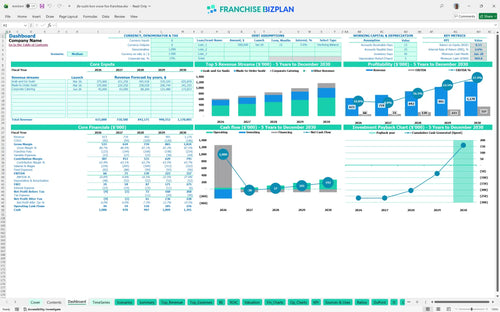
All-in-one Dashboard
Core inputs and core outputs



The franchise unit financial model template provides a complete toolkit for analyzing startup costs, five-year profitability, and cash flow requirements for a retail food kiosk.
Core inputs and core outputs
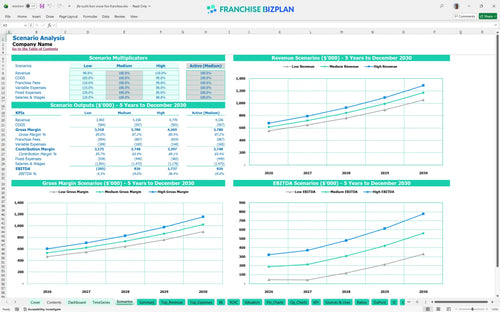
Three scenario analysis
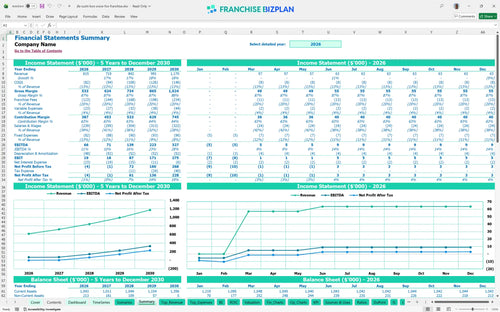
Presentation ready
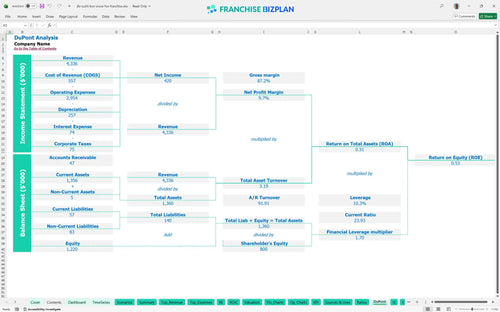
DuPont analysis
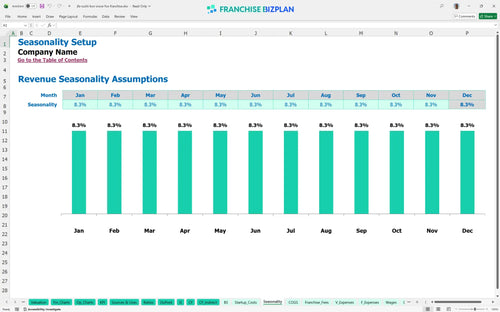
Researched revenue assumptions
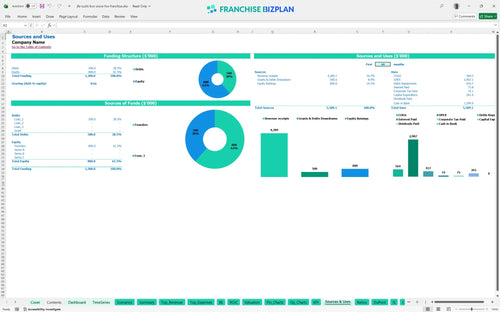
Lender-friendly financial outputs
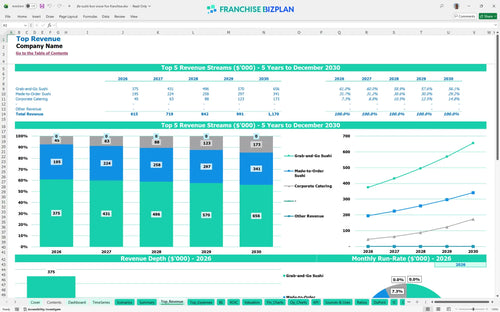
Revenue stream detailed view
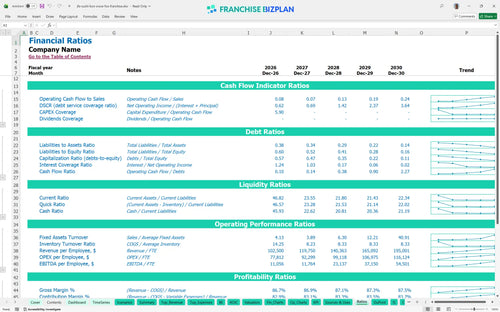
Performance metrics benchmark
We developed this JFE Sushi Box Snow Fox Franchise financial model using detailed research to ensure it reflects the actual costs of running a premium kiosk. The model comes pre-loaded with data for a $261,000 startup investment and a 20% royalty fee, but you can easily edit these to match your specific territory. It is a practical roadmap for forecasting revenue for high-traffic food kiosks and managing your store-level EBITDA.
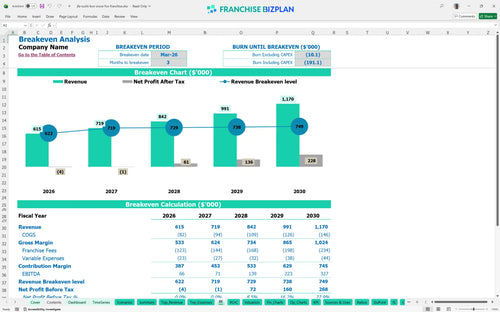
The unit hits its break-even point in March 2026, just three months after launching operations. While Year 1 EBITDA starts at $66,000, the model shows profitability scaling significantly to $327,000 by Year 5 as revenue grows. Profitability depends on managing the high 20% royalty and keeping seafood costs near the 11% target.
You will need approximately $261,000 to launch this unit, with the largest portion allocated to leasehold improvements and the kiosk build-out. This total includes the initial franchise fee, $40,000 for refrigeration, and a $10,000 initial inventory buffer. Sources of funds typically include personal equity or SBA loans to cover the equipment and display cases.
Investors can expect a 5-year payback period and an Internal Rate of Return (IRR) of 2.61% based on the current projections. The Return on Equity (ROE) stands at 0.53, reflecting the steady ramp-up of the grab-and-go and catering revenue streams. While the initial years are lean due to the 20% royalty, the Year 5 cash flow provides a much stronger exit or distribution profile.
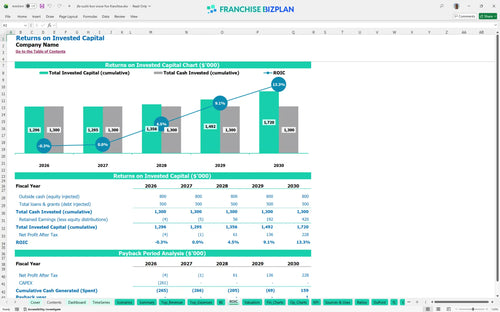
The unit reaches monthly break-even by March 2026, requiring about $51,000 in monthly revenue to cover fixed costs and the high royalty burden. Labor is the biggest hurdle, with $248,000 in annual wages for skilled chefs and managers. Efficiency in the kitchen is the primary lever for reaching this point faster.
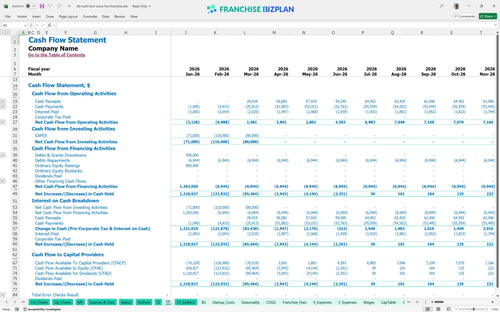
The minimum cash point occurs in January 2028, showing a balance of $970,000 which suggests a significant initial capital buffer or cumulative cash position. You should maintain a tight grip on working capital during the first 12 months to handle the timing gaps between seafood procurement and daily sales. Managing inventory levels is the best way to protect your cash flow during the ramp-up phase.
The model compares growth scenarios, showing how Year 1 revenue of $615,000 can scale to $1.17 million in a high-performance environment. A high-growth scenario driven by corporate catering contracts significantly improves the 2.61% IRR and shortens the payback period. Conversely, a low-traffic scenario makes the 20% royalty very difficult to manage without cutting labor costs.
Finance: update unit break-even and payback model by Friday.
This franchise financial model is built in Excel with fully editable assumptions, allowing you to stress-test your specific location and market conditions. You can adjust revenue drivers, labor rates, and local rent to see how store-level margins shift in real-time. It is a flexible tool designed to help you move from a generic estimate to a precise, data-driven business plan for your unit.

Planning for a sushi franchise investment requires looking beyond the first year to understand long-term viability and scaling potential. This model provides a detailed 5-year outlook, mapping out revenue growth from $615,000 in year one to over $1.1 million by year five. It defintely helps multi-unit franchise management by showing how cash flow and profitability evolve as the unit matures and gains local density.

The model specifically tracks the unique financial obligations of a franchise, including the initial fee and ongoing royalty payments. With a 20% royalty structure, understanding the impact on your bottom line is critical before signing any agreements. This tool ensures you account for every dollar paid to the brand fund and franchisor so your retail food franchise profitability remains transparent.

Knowing how to calculate startup costs for a sushi franchise is the first step toward securing funding and managing your runway. This model breaks down the $261,000 initial investment, covering everything from kiosk build-out to initial inventory. It calculates the exact sales volume needed to cover your $4,500 monthly rent and high labor costs, providing a clear path to your break-even date.

This financial model template for retail food kiosk includes industry-standard benchmarks to help you validate your operating assumptions. You can compare your projected seafood costs and labor percentages against typical sushi franchise operations to identify potential margin leaks. It is a reality check that ensures your pro forma stays grounded in the actual economics of high-traffic food service.


Simply purchase and download the financial model template, then access it instantly using Microsoft Excel or Google Sheets. No installation or technical expertise required-just open and start working.

Enter your business-specific numbers, including revenue projections, costs, and investment details. The pre-built formulas will automatically calculate financial insights, saving you time and effort.

Leverage the investor-ready format to confidently showcase your financial projections to banks, franchise representatives, or investors. Impress stakeholders with clear, data-driven insights and professional reports.

Leverage the investor-ready format to confidently present your projections to banks, franchise representatives, or investors.