


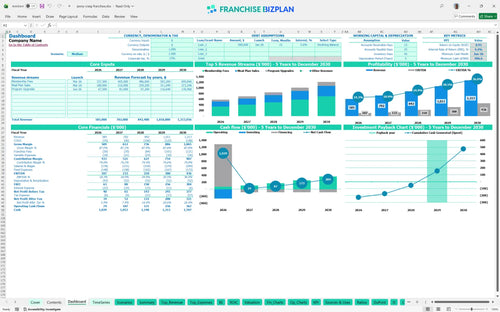
All-in-one Dashboard
Core inputs and core outputs



This franchise unit financial projection spreadsheet includes a complete set of integrated statements, from dynamic revenue drivers to detailed payroll and capital expenditure schedules.
Core inputs and core outputs
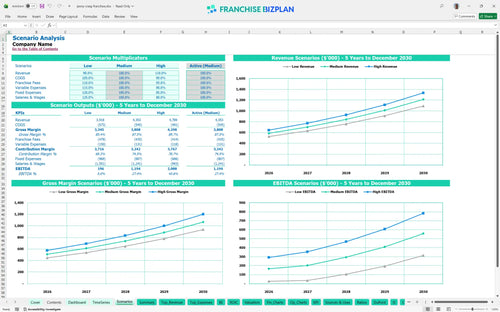
Three scenario analysis
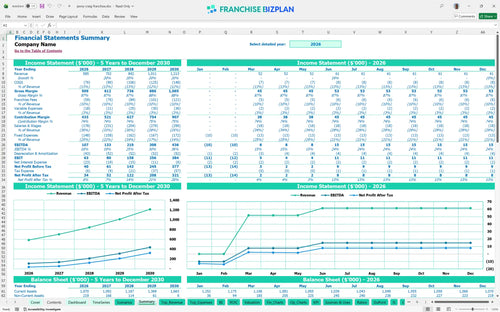
Presentation ready
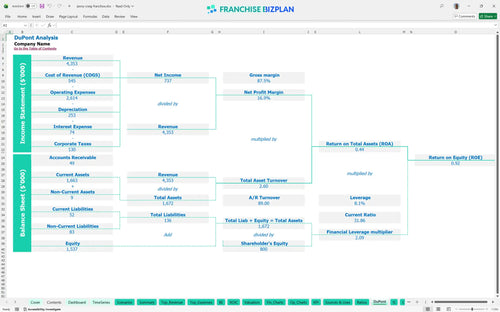
DuPont analysis
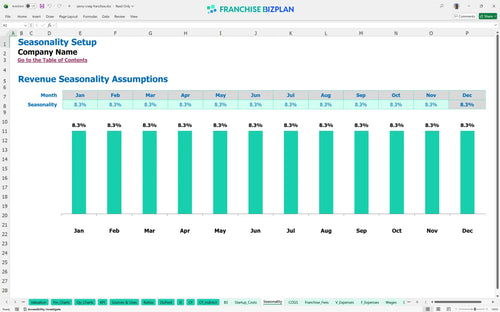
Researched revenue assumptions
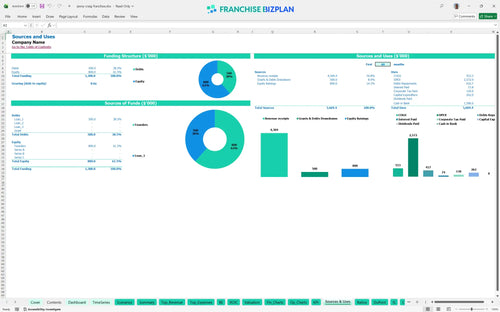
Lender-friendly financial outputs
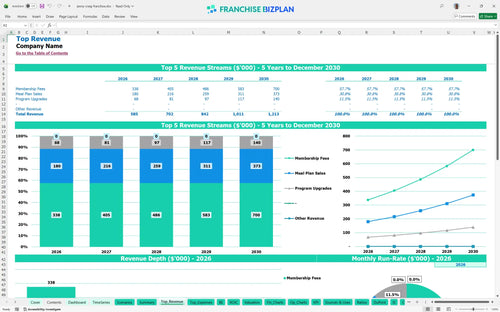
Revenue stream detailed view
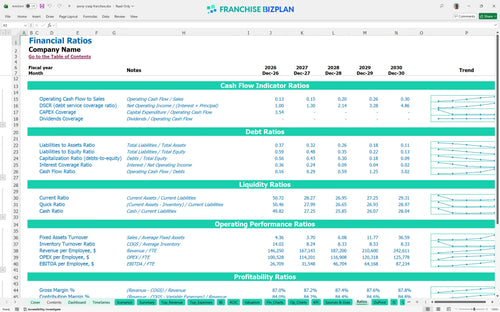
Performance metrics benchmark
We built this weight loss center financial model excel template using deep research into unit-level performance and standard brand requirements. The pre-populated data reflects a Year 1 EBITDA of $107,000 and accounts for specific costs like the $25,000 franchise fee and $120,000 in leasehold improvements, all of which are fully editable to fit your Gainey Village or local equivalent site. This model removes the guesswork from your financial planning process.
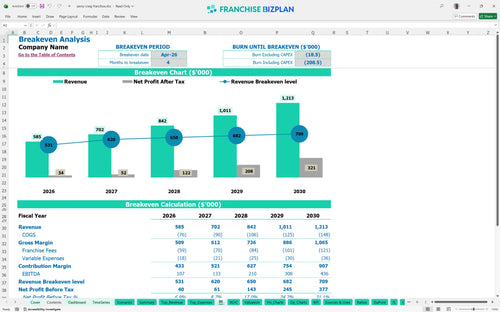
This weight loss franchise opportunity hits its stride quickly, reaching breakeven by April 2026, just four months after launch. With Year 1 EBITDA starting at $107,000 and scaling to $436,000 by Year 5, the model shows a clear path to high-margin operations once the initial member ramp-up is complete. Knowing how to evaluate a weight loss franchise opportunity starts with seeing this upward earnings curve.
You will need approximately $262,000 in total initial investment to launch this boutique wellness center, which is the core of your health and fitness franchise startup budget. This covers everything from the $25,000 franchise fee to the $30,000 initial meal inventory, ensuring you have the necessary runway to reach the minimum cash point of $997,000 in June 2026. Cash is the lifeblood of a new unit, so tracking these uses is non-negotiable.
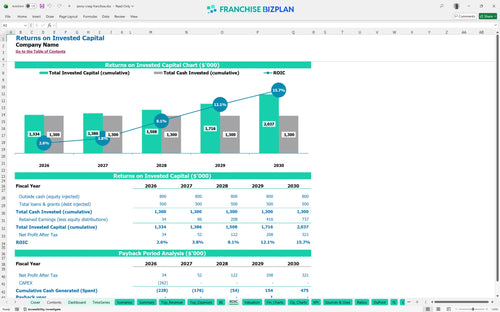
The financial planning for new franchise owners indicates a 4-year payback period and an Internal Rate of Return (IRR) of 4.2%. While the IRR appears conservative, the Return on Equity (ROE) of 0.92 suggests a stable long-term yield for operators focusing on multi-unit growth rather than a quick flip. A precise ROI calculation helps you decide if this territory meets your portfolio's performance hurdles.
The unit reaches monthly break-even in April 2026, requiring roughly $48,750 in monthly revenue to cover fixed costs like the $8,500 rent and base salaries. The primary driver for reaching this point is the membership fee volume, which provides the recurring base needed to offset high real estate premiums in affluent districts. Your franchise profit and loss statement template will show that volume is the ultimate fix for high fixed costs.
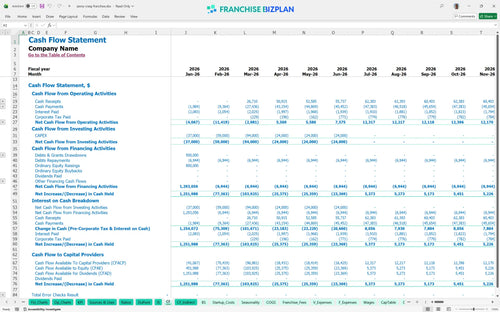
Your lowest cash point occurs in June 2026 at $997,000, assuming you start with sufficient working capital to cover the initial $262,000 outlay. This suggests you defintely need a solid cash buffer to handle the first six months of operations where marketing spend and staffing costs precede the full maturation of the membership base. Timing your cash outflows is just as important as growing your top line.
Small business franchise financial feasibility study results vary wildly between scenarios; a 10% drop in membership fees can delay payback by over a year. High-performance scenarios, driven by better local marketing execution and higher member retention, see Year 5 EBITDA climb significantly above the $436,000 baseline. Execution at the store level is what turns a medium scenario into a high-performing asset.
Finance: update unit break-even and payback model by Friday.
This franchise financial model is a flexible Excel tool designed to handle the specific franchise unit economics of a weight loss center. You can adjust every assumption, from membership pricing to meal plan margins, ensuring the projections match your specific territory and local labor market. Every point of margin matters when you are balancing high-touch service with fixed royalty obligations.

Long-term planning is vital for a boutique wellness franchise investment analysis to see beyond the initial ramp-up phase. This franchise business plan template provides a full 5-year outlook, showing how revenue projections climb from $585,000 in year one to over $1.2 million by year five as your member base matures. Stability in this model comes from recurring membership fees and consistent meal product turnover.

Managing the 7% royalty and 3% marketing fund contribution is built directly into the cash flow logic of this franchise pro forma. By automating these calculations, the model ensures you see exactly how much cash stays in the unit after the brand takes its cut from your gross sales. Understanding the impact of these fees on your bottom line is essential for any multi-unit operator.

Knowing how to calculate startup costs for a weight loss franchise is the first step to avoiding a pre-opening cash crunch. This tool aggregates leasehold improvements, equipment, and initial inventory to show you the exact sales volume needed to cover your $8,500 monthly rent and fixed overhead. A clear break-even target keeps your team focused on the membership numbers that actually move the needle.

We include benchmarks for operational expenses like labor and COGS to help you perform a professional profitability analysis. For instance, if your nutritional meal products run significantly higher than the 11.2% target, the model flags the margin leak so you can adjust your local health service franchise operations. Calculating ROI for a local health service franchise requires comparing your actuals against these researched standards.


Simply purchase and download the financial model template, then access it instantly using Microsoft Excel or Google Sheets. No installation or technical expertise required-just open and start working.

Enter your business-specific numbers, including revenue projections, costs, and investment details. The pre-built formulas will automatically calculate financial insights, saving you time and effort.

Leverage the investor-ready format to confidently showcase your financial projections to banks, franchise representatives, or investors. Impress stakeholders with clear, data-driven insights and professional reports.

Leverage the investor-ready format to confidently present your projections to banks, franchise representatives, or investors.