


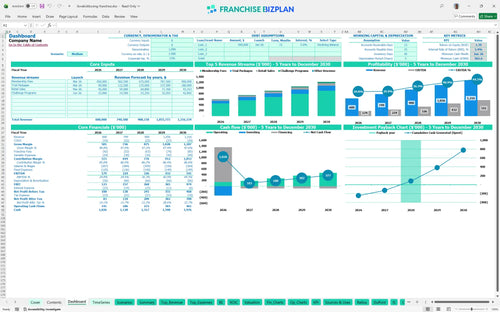
All-in-one Dashboard
Core inputs and core outputs



This franchise unit financial model template provides a complete roadmap for forecasting revenue, managing expenses, and calculating total investment returns for a kickboxing studio.
Core inputs and core outputs
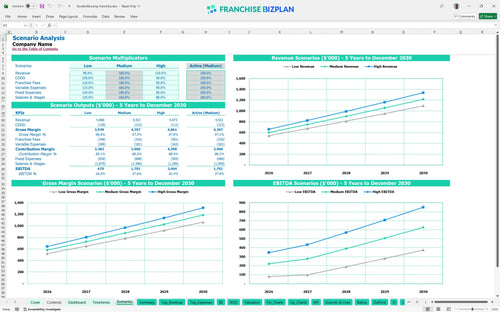
Three scenario analysis
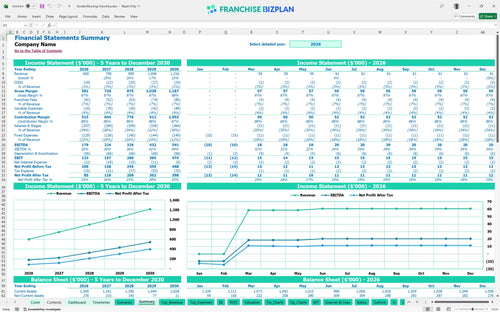
Presentation ready
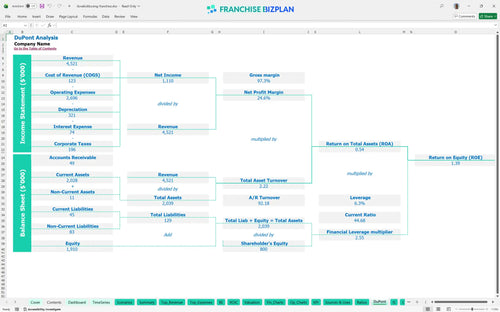
DuPont analysis
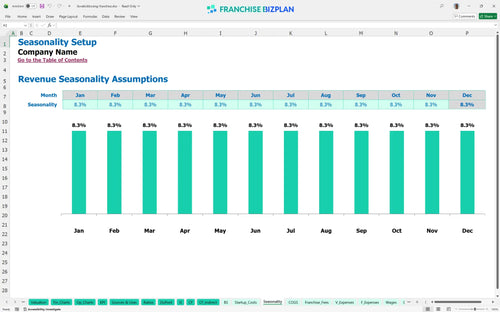
Researched revenue assumptions
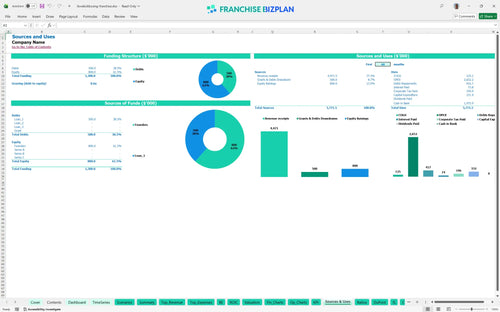
Lender-friendly financial outputs
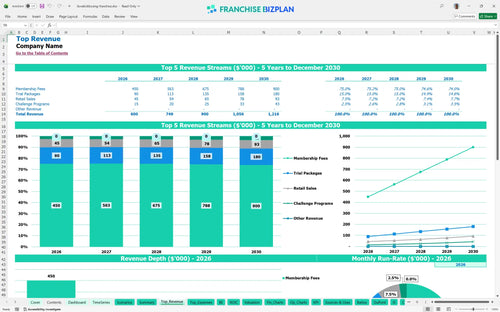
Revenue stream detailed view
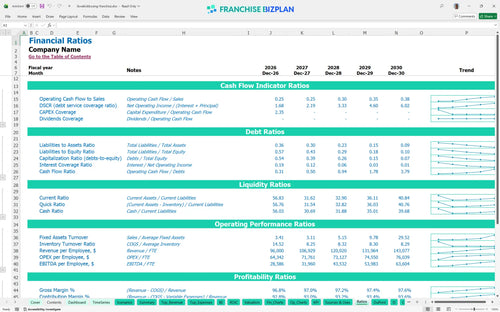
Performance metrics benchmark
We built this small business financial model for kickboxing studios using detailed research on unit-level economics and typical boutique gym overhead. The model comes pre-populated with data like $300,000 in first-year membership fees and $179,000 in Year 1 EBITDA, but you can easily edit every line to match your specific territory. It covers everything from initial franchise fees to recurring software costs, giving you a credible look at the $966,000 minimum cash needed to navigate the ramp-up phase.
The studio is projected to hit profitability quickly, reaching a positive EBITDA of $179,000 in its first full year of operation. By year five, as membership scales and retail sales grow, annual EBITDA is expected to reach $541,000 after accounting for all royalties and fixed costs. How to forecast revenue for a fitness studio franchise depends on these membership tiers, and this model shows a clear upward path as you move past the initial three-month break-even window.
You will need a total initial investment of approximately $331,900 to cover the core startup costs, not including the cash buffer for the first few months. The largest capital expenditure items include $150,000 for leasehold improvements and $60,000 for specialized fitness equipment. This franchise investment calculator also accounts for the $24,900 franchise fee and $40,000 for mirrors and flooring to meet brand standards. Most funds are used for the physical build-out and essential studio infrastructure.
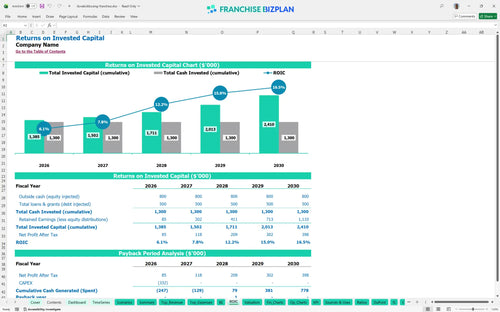
Investors can expect an Internal Rate of Return (IRR) of 5.37% and a Return on Equity (ROE) of 1.39 over the five-year period. The payback period is estimated at 3 years, which is typical for a boutique fitness center with high initial build-out costs. Calculating ROI for new fitness franchise locations requires looking at this multi-year window where margins improve as the member base matures. This franchise unit pro forma financial statement shows a healthy balance between initial risk and long-term cash flow.
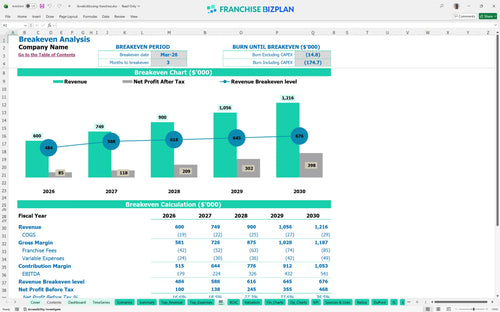
The studio is projected to reach its monthly break-even point in March 2026, just 3 months after opening for classes. This fast timeline is driven by the aggressive pre-sale of trial packages and membership fees that quickly cover the $7,500 monthly rent. Your gym franchise business plan should focus on hitting a membership volume of roughly 250 active members to stay above the fixed cost line. Controlling labor costs for instructors is the biggest lever for maintaining this break-even status.
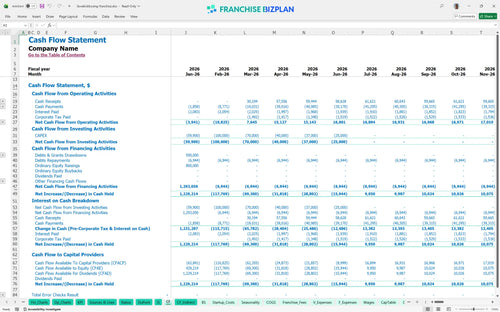
The lowest cash point occurs in June 2026, with a minimum cash balance of $966,000, suggesting a significant capital buffer is needed to handle the initial ramp-up. You need enough runway to cover the $11,000+ in monthly fixed expenses before the membership revenue fully scales. To protect your cash flow, you should phase in your exterior signage and sound system payments where possible. Managing the timing of your $150,000 leasehold spend is the most critical factor in preserving your liquidity during construction.
The high-case scenario assumes revenue climbs to $1.2M by year five, significantly shortening the payback period and boosting the Year 1 margin. In a low-case scenario, where membership growth is 20% slower, the peak cash need increases and the break-even point could push out by several months. This startup cost breakdown for boutique gym franchise shows that even small changes in membership retention can swing annual EBITDA by $50,000 or more. Execution on local marketing is what separates the high-performers from the rest.
Finance: update unit break-even and payback model by Friday
This fitness franchise financial model is built in Excel with fully editable assumptions, allowing you to swap out local rent or labor rates in seconds. All formulas are pre-filled so you can focus on the strategy of your kickboxing studio rather than building spreadsheets from scratch. It is a defintely a plug-and-play tool for any serious operator. Using an Excel template for fitness franchise startup costs ensures your numbers stay grounded in reality as you scout locations.

Planning for a boutique fitness business requires a long-term view that accounts for membership growth and churn over several years. This model provides detailed 5-year revenue projections, starting at $600,000 in year one and scaling to over $1.2M by year five. You get a full profitability analysis that maps out how your studio matures from a single-unit startup into a high-performing asset. Plus, the balance sheet and cash flow views help you manage the timing of tax payments and reinvestment.

Estimating royalty fees and marketing funds for franchises is critical because these costs come right off the top of your gross sales. This tool tracks the 6% royalty and 1% marketing fund contributions automatically based on your monthly revenue streams. By factoring in the initial $24,900 franchise fee, you can see exactly how much capital stays in your pocket versus what goes to the franchisor. It is the best way to see the real store-level margin after all brand obligations are met.

Launching a new studio involves significant capital, from $150,000 in leasehold improvements to $60,000 in fitness equipment. This model includes a break-even analysis for gym franchise locations to help you identify the exact month your membership dues cover your $7,500 monthly rent and payroll. Understanding your boutique fitness startup costs upfront prevents cash crunches during the critical first six months of operation. We focus on the margin and contribution view so you know which classes are most profitable.

We have integrated industry-standard benchmarks to help you sanity-check your operating expenses, such as keeping studio supplies around 1% of sales. This financial feasibility study for fitness center investment compares your projected labor costs against typical boutique fitness ranges to ensure you aren't overstaffing. If your utilities or insurance costs drift too far from the norm, the model flags it for review. It is a data-driven way to ensure your pro forma stays competitive and realistic for the US market.


Simply purchase and download the financial model template, then access it instantly using Microsoft Excel or Google Sheets. No installation or technical expertise required-just open and start working.

Enter your business-specific numbers, including revenue projections, costs, and investment details. The pre-built formulas will automatically calculate financial insights, saving you time and effort.

Leverage the investor-ready format to confidently showcase your financial projections to banks, franchise representatives, or investors. Impress stakeholders with clear, data-driven insights and professional reports.

Leverage the investor-ready format to confidently present your projections to banks, franchise representatives, or investors.