


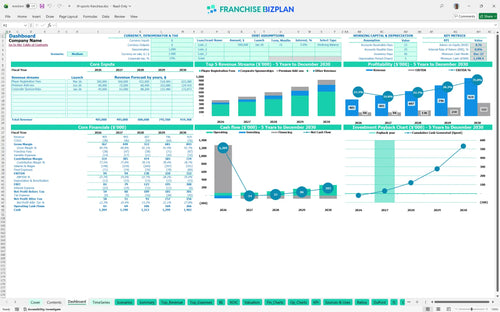
All-in-one Dashboard
Core inputs and core outputs



This comprehensive excel spreadsheet for franchise unit financial projections includes detailed revenue drivers, staffing plans, and cash flow statements designed for the youth sports sector.
Core inputs and core outputs
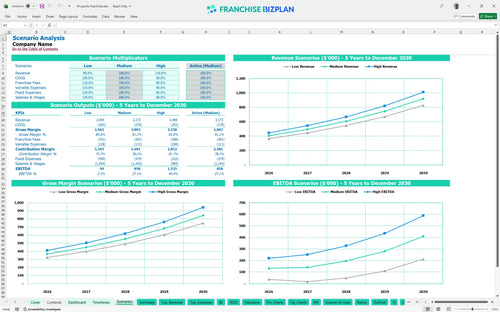
Three scenario analysis
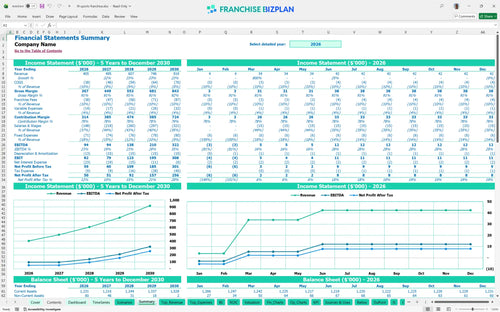
Presentation ready
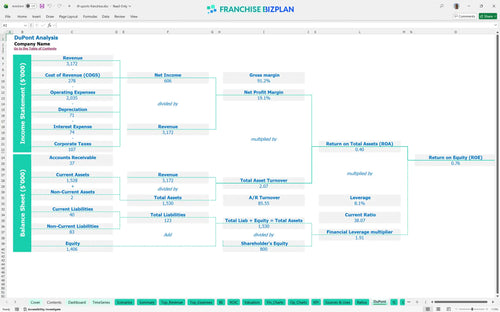
DuPont analysis
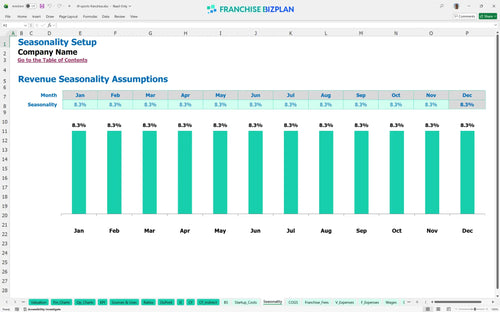
Researched revenue assumptions
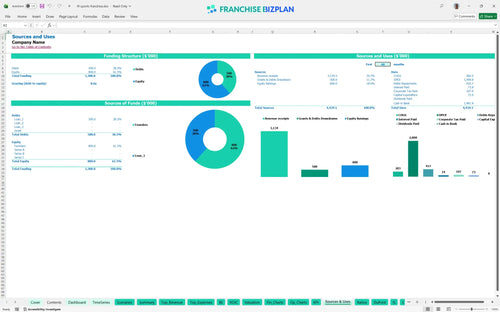
Lender-friendly financial outputs
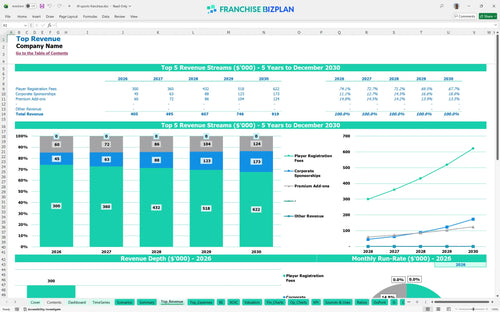
Revenue stream detailed view
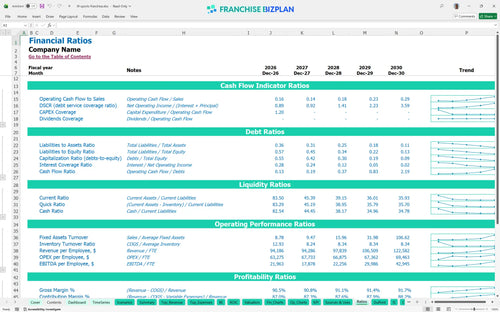
Performance metrics benchmark
We built this franchise unit financial model using our own research into the youth sports sector. Key assumptions like the $200,000 initial player registration revenue and the $55,000 site manager salary are pre-populated and fully editable to match your specific territory. With a projected 2-year payback period and $94,000 in year-one EBITDA, this model defintely helps you visualize the path to a mature, cash-flowing operation.
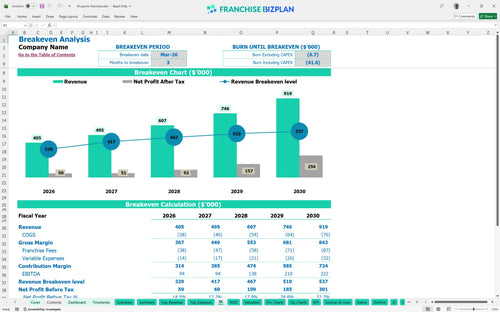
Based on the data, this unit hits its stride quickly, with a break-even date of March 2026, just three months after launch. By year five, EBITDA is projected to reach $322,000 as you scale corporate sponsorships and premium add-ons. To be fair, is owning a youth sports franchise profitable? Only if you manage the 7.5% royalty burden against your local field rental costs.
You will need approximately $72,900 in initial capital to cover the core startup costs for this youth sports franchise. This includes the $24,900 franchise fee, $15,000 for essential sports equipment, and $12,000 for a vehicle purchase to get your first season off the ground. Still, you should keep a cash buffer for the first few months of operational expense budgeting.
The model shows an internal rate of return (IRR) of 8.76% and a return on equity (ROE) of 0.76. With a 2-year payback period, the initial investment is recovered relatively fast compared to many brick-and-mortar concepts. This return on investment analysis assumes you hit your year-one revenue target of $405,000 through aggressive local marketing.
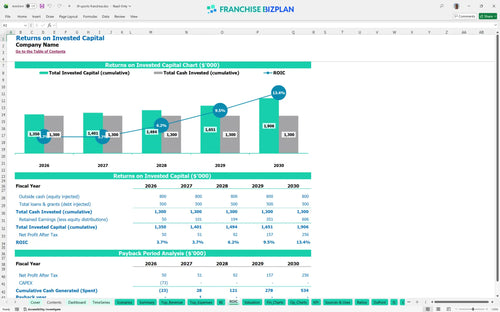
The unit reaches break-even in month 3, driven largely by the $200,000 in first-year registration fees. Your biggest hurdle is managing the $5,950 in monthly fixed costs, including rent and insurance, against seasonal registration cycles. Calculating net profit for youth athletic franchises requires a sharp eye on these recurring monthly outflows.
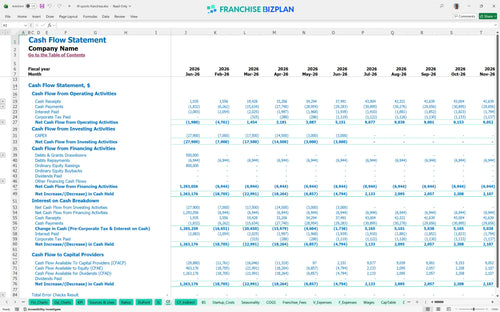
The minimum cash point is projected at $1,190,000 in December 2027, though this includes accumulated earnings. Honestly, the real pressure is in the first 90 days when you are out-laying $72,900 before the first registration check clears. This small business cash flow model helps you track that gap to ensure you never run dry during the ramp-up.
Moving from a medium to a high-growth scenario can push year-5 revenue toward the $919,000 mark, significantly boosting your 8.76% IRR. The model allows you to test how a 10% drop in registration fees affects your ability to cover the 7.5% royalty. This financial model template for independent sports leagues or franchises is built for this kind of stress-testing.
Finance: update unit break-even and payback model by Friday.
This franchise financial model template is built in Excel, meaning you can tweak every variable to fit your specific territory. Whether you are adjusting player registration fees or local field rental rates, the pre-filled formulas handle the heavy lifting so you can focus on your youth sports franchise business plan. It is a plug-and-play tool for any serious operator.

Long-term planning is non-negotiable for a sports league financial forecasting tool. This model provides a clear view of your trajectory from year one through year five, helping you visualize how scaling from $405,000 to $919,000 in annual revenue impacts your bottom line. You can see exactly how the jump in corporate sponsorships from $30,000 to $115,248 changes your cash position.

Understanding the franchise royalty fee calculation is vital for maintaining store-level margins. This tool automatically calculates the 7.5% royalty and 2% marketing fund contributions based on your projected player registration fees and sponsorship income. It ensures you never overlook the $68,000+ that might go to the franchisor as you scale toward mature-unit volumes.

Use the franchise startup cost spreadsheet to account for everything from the $24,900 initial fee to the $15,000 needed for sports equipment. By mapping out these day-one expenses, you can accurately identify the break-even sales level required to cover your $5,950 monthly fixed costs. Knowing how to calculate startup costs for a youth sports franchise is the first step to avoiding a cash crunch.

This franchise unit profitability analysis includes built-in benchmarks to ensure your labor and facility costs stay within healthy ranges. If your field rentals exceed the 7% target, the model flags the variance, helping you maintain a competitive edge in the local market. It is the best way to sanity-check your budget planning for local sports league operations.


Simply purchase and download the financial model template, then access it instantly using Microsoft Excel or Google Sheets. No installation or technical expertise required-just open and start working.

Enter your business-specific numbers, including revenue projections, costs, and investment details. The pre-built formulas will automatically calculate financial insights, saving you time and effort.

Leverage the investor-ready format to confidently showcase your financial projections to banks, franchise representatives, or investors. Impress stakeholders with clear, data-driven insights and professional reports.

Leverage the investor-ready format to confidently present your projections to banks, franchise representatives, or investors.