


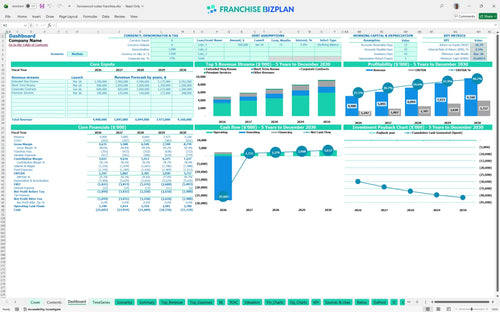
All-in-one Dashboard
Core inputs and core outputs



This comprehensive template includes a dynamic dashboard, detailed 5-year pro formas, CAPEX schedules, and a specialized labor module for hospitality staffing.
Core inputs and core outputs
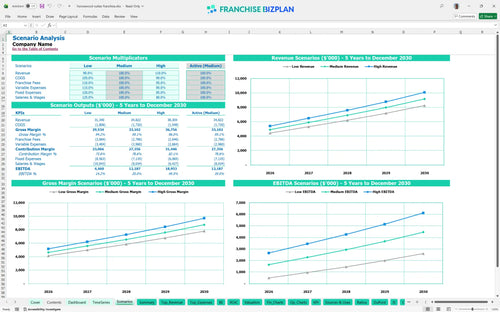
Three scenario analysis
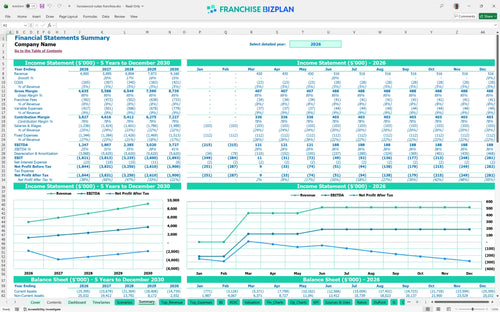
Presentation ready
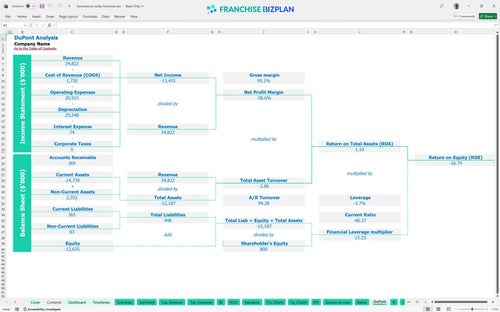
DuPont analysis
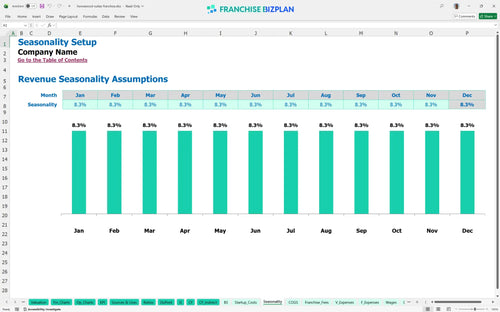
Researched revenue assumptions
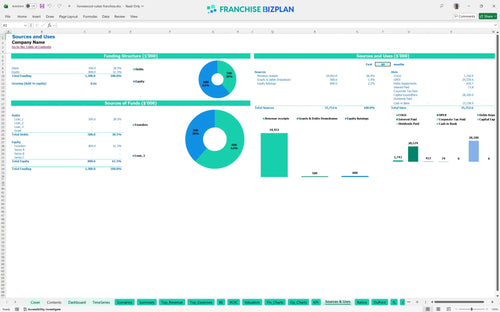
Lender-friendly financial outputs
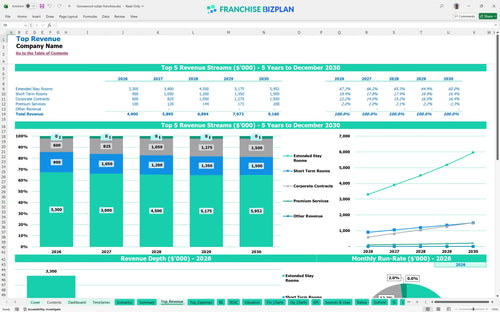
Revenue stream detailed view
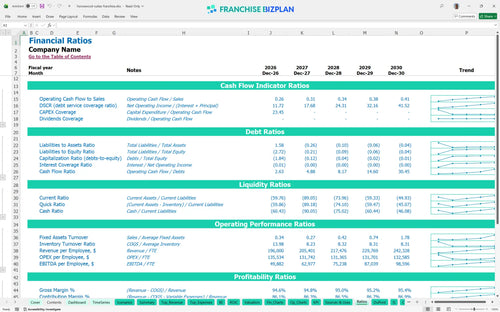
Performance metrics benchmark
We developed this extended-stay franchise business plan model using rigorous research into the hospitality sector's cost structures and revenue patterns. The pre-populated data covers everything from $2.2 million in suite kitchen equipment to specific 4% royalty tiers, providing a Year 1 EBITDA target of $1.247 million. All inputs are fully editable so you can adjust for your specific market conditions and labor rates.
The unit shows a strong upward trend, starting with a $1.247 million EBITDA in the first year and climbing to $3.727 million by year five. While initial net profit is pressured by heavy depreciation and interest on the $28 million investment, the operating margin expands as revenue scales toward $9.16 million. EBITDA growth is the engine, but debt service is the driver.
Launching this unit requires a massive capital injection, totaling over $28 million when factoring in all construction and pre-opening needs. This hospitality investment analysis shows that the bulk of funds goes into the physical asset, which is typical for upscale extended-stay properties in high-growth corridors. A commercial real estate feasibility study should confirm these values against local construction costs.
Calculating return on investment for hotel property of this scale requires patience, as the model shows a payback period extending beyond the first five years. With an IRR of -2.5% and a ROE of -16.79% in this specific projection, the value proposition relies heavily on long-term asset appreciation and tax benefits like depreciation. This is a long-game play for institutional-grade investors.
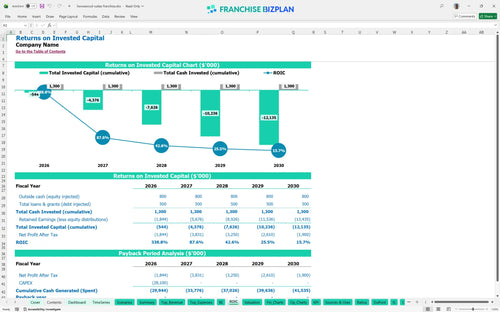
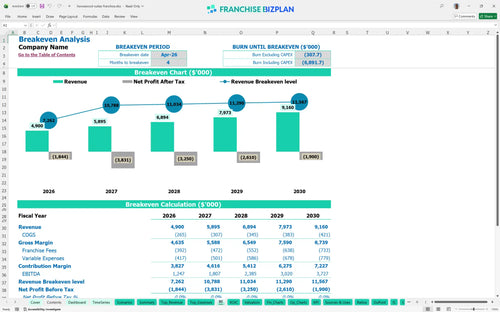
The unit is projected to reach its operational break-even point by April 2026, just four months after the initial launch phase. This quick operational break-even is defintely driven by the high average ticket of extended-stay rooms, though it does not account for the full recovery of the $28 million CAPEX. Break-even is a milestone, not a destination.
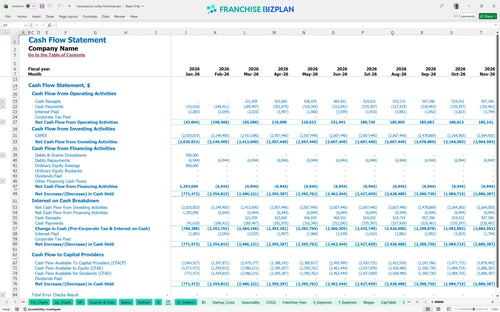
The operating budget template for extended-stay hotels identifies a significant cash dip, reaching a minimum point of -$25.68 million in December 2026. This reflects the massive construction spend before the revenue ramp-up fully offsets the debt and operating costs. You need a significant credit facility or equity reserve to bridge this gap safely.
The hotel franchise unit financial analysis guide allows you to toggle between performance tiers to see how a 10% drop in RevPAR affects your ability to service debt. In the high case, aggressive corporate contract capture can push Year 1 revenue past the $4.9 million mark, significantly improving the IRR. Small shifts in occupancy have outsized effects on the $1.247 million base EBITDA.
This hotel franchise financial model is a professional-grade Excel tool designed for high-stakes hospitality planning. It features fully editable assumptions and pre-filled formulas, serving as a hotel franchise financial model template for investors who need to stress-test specific locations or occupancy rates. Excel shouldn't be a black box; it should be your roadmap.

Success in the hospitality sector requires looking past the grand opening to see how the asset matures over time. These hotel development financial projections provide a clear view of revenue scaling from $4.9 million in year one to over $9.1 million by year five. Five years is the minimum horizon for a $28 million asset.

Operating under a major brand involves specific recurring costs that can significantly impact your bottom line if not modeled correctly. This tool applies a precise franchise royalty fee structure, including a 4% royalty and a 4% marketing fund contribution, calculated automatically against your gross room revenue. Honest math on brand costs prevents margin surprises later.

Launching a large-scale hospitality project requires a deep dive into how to calculate startup costs for an extended-stay hotel. Our model accounts for everything from the $100,000 initial fee to the $18 million in leasehold improvements, ensuring your feasability study is grounded in reality. Knowing your exact entry cost is the only way to manage your debt-to-equity ratio effectively.

We have integrated standard hospitality metrics to help you validate your RevPAR forecasting and staffing levels against industry norms. The hotel operating expense breakdown includes realistic targets for housekeeping supplies and guest amenities, which typically range between 1.8% and 3.2% of revenue. If your numbers stray too far from these benchmarks, you need to know why before you sign the lease.


Simply purchase and download the financial model template, then access it instantly using Microsoft Excel or Google Sheets. No installation or technical expertise required-just open and start working.

Enter your business-specific numbers, including revenue projections, costs, and investment details. The pre-built formulas will automatically calculate financial insights, saving you time and effort.

Leverage the investor-ready format to confidently showcase your financial projections to banks, franchise representatives, or investors. Impress stakeholders with clear, data-driven insights and professional reports.

Leverage the investor-ready format to confidently present your projections to banks, franchise representatives, or investors.