


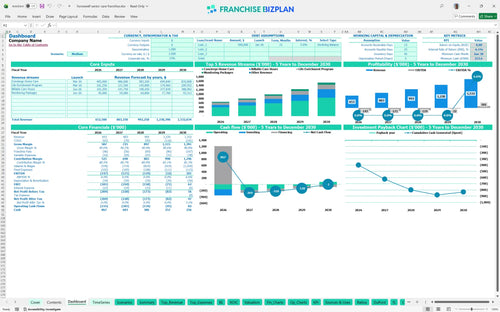
All-in-one Dashboard
Core inputs and core outputs



This comprehensive toolkit includes a detailed franchise P&L template, cash flow projections, and a startup budget for independent senior care franchise location planning.
Core inputs and core outputs
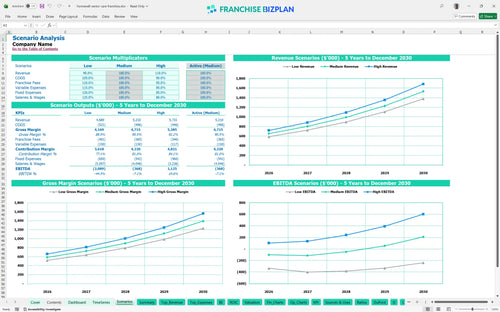
Three scenario analysis
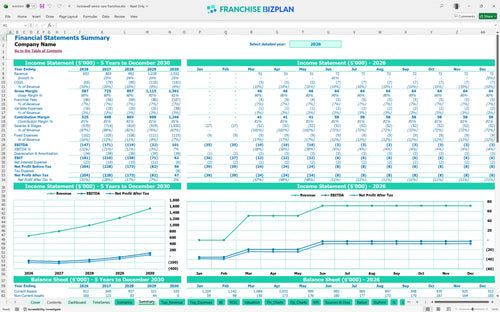
Presentation ready
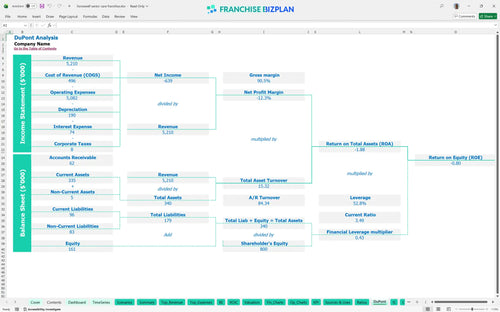
DuPont analysis
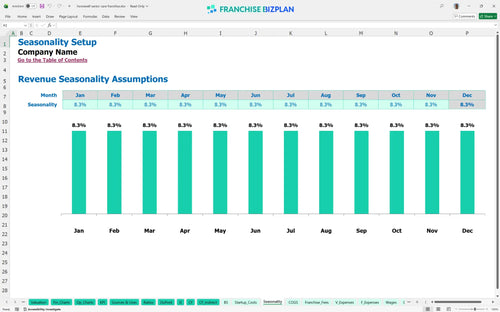
Researched revenue assumptions
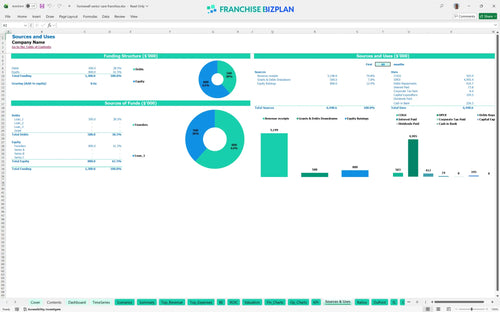
Lender-friendly financial outputs
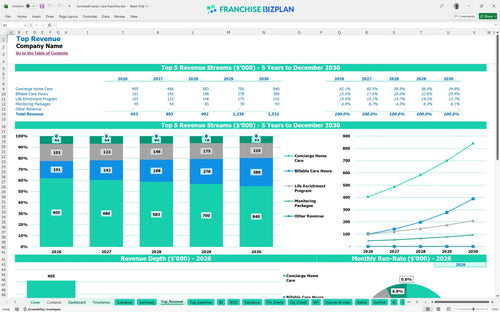
Revenue stream detailed view
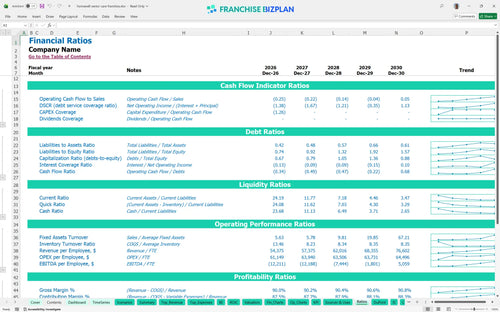
Performance metrics benchmark
We built this home care business financial projections tool using deep research into the senior care sector. The pre-filled data includes four distinct revenue streams and a caregiver-heavy staffing plan, with Year 1 revenue starting at $653,000. You can use this as a plug-and-play Excel template for home care franchise financial planning or tweak every line to fit your specific Scottsdale or Maricopa County site selection.
Based on the current ramp-up, this unit reaches positive EBITDA in Year 5 with $101,000 in annual earnings. The early years are capital-intensive due to the high fixed costs of an RN supervisor and GM, but the 49-month path to profitability is typical for high-touch medical home care units. To be fair, your speed to profit depends entirely on how fast you scale billable care hours.
You will need approximately $194,500 for initial CAPEX, including the $49,500 franchise fee and $30,000 for service vehicles. However, the total investment is higher because you must cover the $254,000 minimum cash requirement to handle the four-year ramp-up period. This financial model for private pay home care business ensures you don't run out of gas before the revenue catches up.
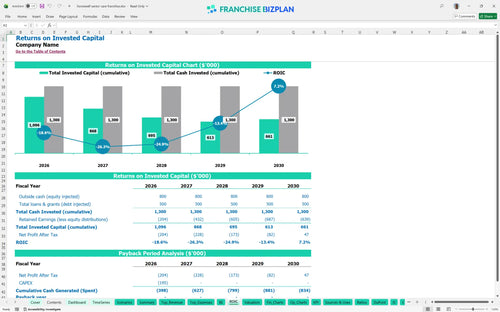
The ROI analysis for home health care franchise investment shows a payback period occurring after Year 5, with a five-year IRR of -6.09%. This reflects a long-term play where value is built through a large, recurring client base rather than a quick flip. Still, the scaling revenue suggests that Year 6 and beyond are where the real equity value is captured for a multi-unit operator.
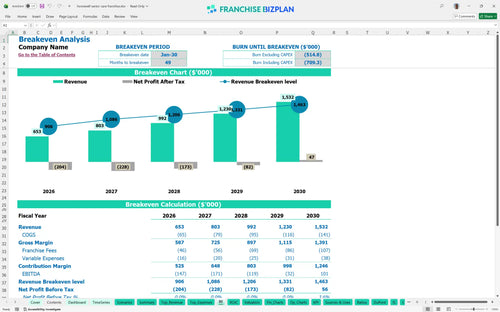
The monthly break-even point is projected for January 2030, exactly 49 months after launch. The biggest driver for this is the heavy fixed-cost load of $8,500 in monthly rent and utilities plus a $280,000 annual management payroll. You need to hit roughly $1.5 million in annual revenue to consistently clear all operating expenses and franchise fees.
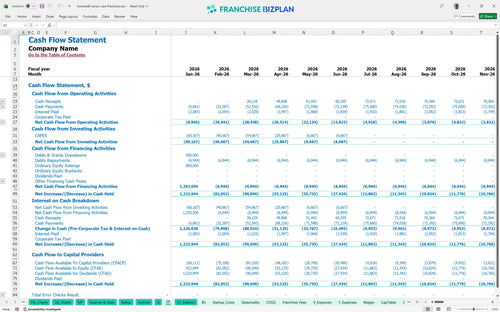
Your lowest cash point occurs in January 2030, requiring a liquidity buffer of at least $254,000. This financial forecast template for medical home care unit highlights a long 'valley of death' where staffing costs lead revenue growth. If your caregiver hiring gets ahead of your client intake, that cash buffer will disappear much faster than planned.
In the High scenario, increasing your concierge care volume by 15% can pull the break-even date forward by nearly a year. Conversely, if estimating caregiver payroll costs for franchise operations is off by even 5%, your Year 5 profit could vanish. Evaluating profitability of concierge senior care franchise units requires looking at these Low, Medium, and High cases to understand your real risk floor.
Finance: update unit break-even and payback model by Friday. Owner: Franchisee.
This home care franchise financial model is a flexible Excel-based tool designed for real-world planning. You can adjust every assumption from billable hours to caregiver wages, ensuring the senior care franchise startup costs reflect your specific territory and local labor market. It is defintely the most efficient way to stress-test your numbers before signing a lease or hiring your first RN supervisor.

Mapping out a five-year horizon is critical for a senior care franchise profitability analysis, especially since this model shows revenue scaling from $653,000 in Year 1 to over $1.5 million by Year 5. You get a clear view of how your P&L (profit and loss) evolves as you move from early customer acquisition to a mature, high-volume agency. Long-term planning helps you see past the initial burn to the $101,000 EBITDA potential in the fifth year.

Understanding franchise royalty and marketing fees in financial models is vital for protecting your store-level margin. This template automatically calculates the 5% royalty and 2% marketing fund contribution based on your projected revenue streams like concierge care and monitoring packages. By baking these 'brand taxes' into your daily cash flow forecasting, you avoid surprises when the franchisor drafts your account each month.

Knowing how to calculate startup costs for a senior care franchise is the difference between success and a mid-ramp cash crunch. This model aggregates your $49,500 franchise fee, $40,000 in leasehold improvements, and $30,000 for service vehicles to show the total mountain you need to climb. The break-even analysis identifies exactly when your billable hours cover both your $4,500 monthly rent and your heavy administrative payroll.

We have integrated healthcare franchise investment analysis standards to help you sanity-check your caregiver payroll. If your care supplies exceed the 7.5% benchmark or your $85,000 GM salary is too high for your territory's volume, the model will show the strain on your bottom line. These benchmarks act as a guardrail, keeping your franchise unit economic template aligned with successful multi-unit operators.


Simply purchase and download the financial model template, then access it instantly using Microsoft Excel or Google Sheets. No installation or technical expertise required-just open and start working.

Enter your business-specific numbers, including revenue projections, costs, and investment details. The pre-built formulas will automatically calculate financial insights, saving you time and effort.

Leverage the investor-ready format to confidently showcase your financial projections to banks, franchise representatives, or investors. Impress stakeholders with clear, data-driven insights and professional reports.

Leverage the investor-ready format to confidently present your projections to banks, franchise representatives, or investors.