


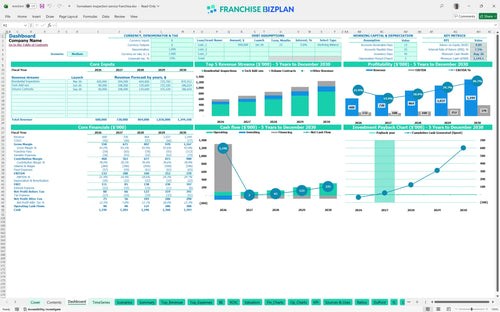
All-in-one Dashboard
Core inputs and core outputs



This comprehensive financial model provides everything a prospective owner needs to forecast revenue, manage expenses, and calculate the total return on investment for a new property inspection territory.
Core inputs and core outputs
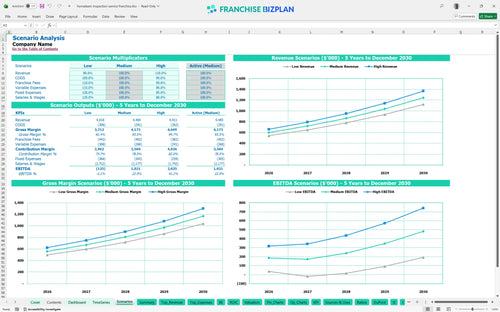
Three scenario analysis
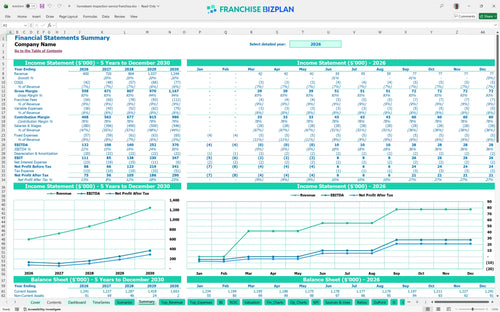
Presentation ready
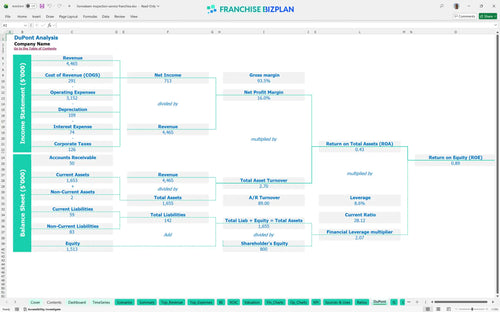
DuPont analysis
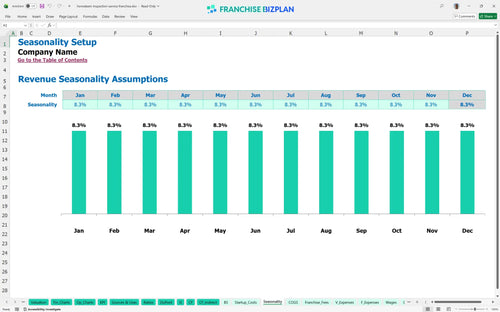
Researched revenue assumptions
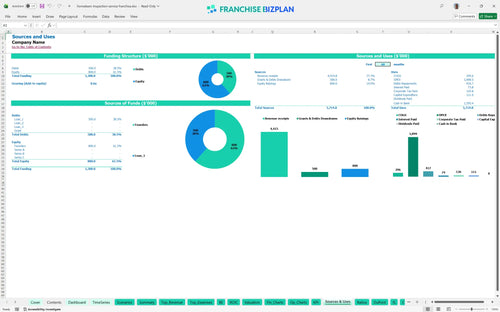
Lender-friendly financial outputs
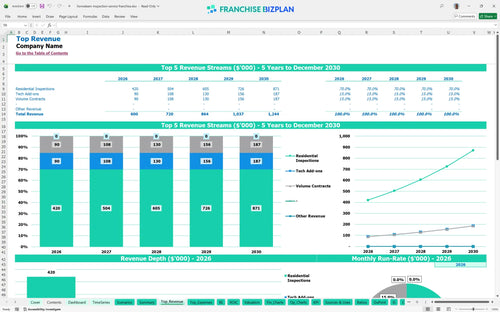
Revenue stream detailed view
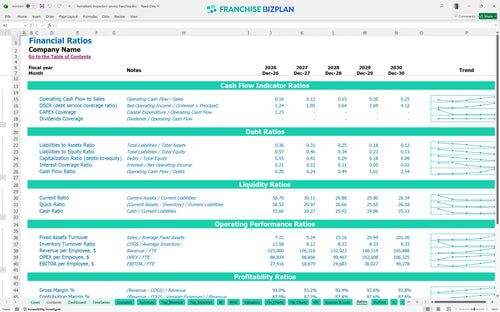
Performance metrics benchmark
We built this home inspection franchise financial model using detailed research to help you navigate the property inspection business plan process. The model comes pre-populated with researched data, including a $600,000 year-one revenue target and $111,000 in initial capital requirements, all of which are fully editable to match your specific market. This tool defintely simplifies the complex math of royalties, team-based labor, and tech-heavy equipment costs so you can focus on growth.
The franchise unit becomes profitable very quickly, generating a positive EBITDA of $132,000 in the first year. By year five, the net profit scales significantly to $370,000 as you leverage the team-based model to handle higher volume without a linear increase in fixed overhead. This franchise profitability analysis shows that early focus on volume contracts is the fastest path to black ink.
To launch this franchise unit in the US, you need $111,000 in total startup capital. This covers the $45,000 franchise fee and the essential gear needed to deliver the brand's tech-forward value proposition. How to calculate startup costs for a home inspection franchise becomes simple when you see the breakdown of vehicles, drones, and office setup costs in one view.
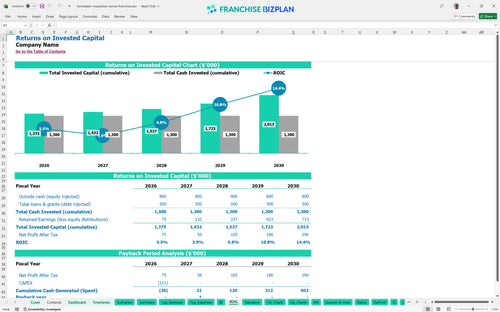
The ROI calculation for this unit shows a 2-year payback period, which is quite aggressive for the service sector. With an Internal Rate of Return (IRR) of 7.5% and a Return on Equity (ROE) of 0.89, the business valuation model suggests a strong, stable return for an owner-operator or a multi-unit investor. The high efficiency of the multi-inspector team model drives these results.
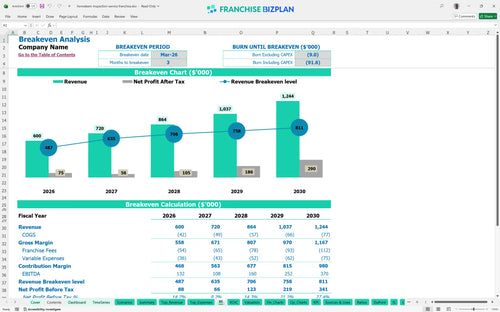
Estimating profitability for a new franchise unit requires finding the break-even point, which occurs in March 2026, just 3 months after launch. The primary driver for reaching this point is the volume of residential inspections, which must cover the $4,800 in monthly fixed costs. Speed to market is your biggest ally here.
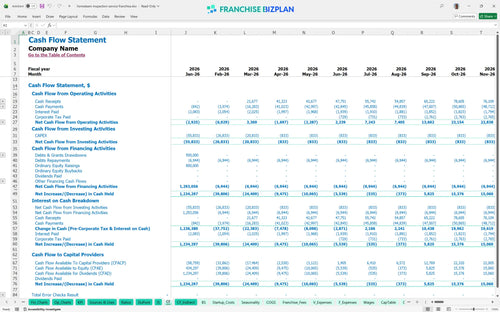
The lowest cash point occurs in August 2026, with a minimum cash balance of $1,144,000. While the model shows a healthy buffer, your cash runway depends on how quickly you ramp up your team of inspectors. A successful financial feasibility study for home inspection business always accounts for the timing gap between performing the work and receiving payment from high-volume contracts.
Comparing scenarios shows that hitting the high-growth case moves revenue from $600,000 to $1.244,000 by year five. Analyzing operating expenses for a property inspection franchise reveals that labor is your biggest variable; in a low-growth scenario, you must be ready to trim the inspector headcount to protect your 22% year-one EBITDA margin. Learning how to forecast revenue for a home inspection franchise under different market conditions is essential for long-term survival.
Finance: update unit break-even and payback model by Friday
This home inspection business financial template is built in Excel with fully editable formulas and assumptions. You can quickly adjust the model to fit your specific territory, whether you are looking at North Austin or a different high-growth corridor. It allows you to swap out local rent, adjust inspector pay scales, and modify service pricing to see how different operating scenarios impact your bottom line. Flexibility is the key to a realistic property inspection business plan.

Planning for the long term is vital when evaluating a franchise unit profit and loss statement. This franchise financial projection spreadsheet provides a clear 5-year outlook, showing revenue climbing from $600,000 in year one to over $1,244,000 by year five. By mapping out revenue forecasting alongside escalating labor needs, you can visualize the transition from a startup phase to a mature, high-volume operation. It gives you the full picture of your balance sheet and long-term cash flow health.

Operating as part of a national brand involves specific franchise operational expenses that can squeeze margins if not managed tightly. This model specifically tracks the 6% royalty and 3% marketing fund contributions required by the franchisor. By automating these calculations based on your gross sales, the model ensures you always know exactly how much is leaving the business before you cover your local overhead. It is the most accurate way to analyze the real-world cost of brand support.

Understanding your franchise unit startup costs is the first step toward a successful launch. This tool includes a detailed franchise unit break-even analysis template that identifies the $111,000 needed for the initial build-out, including the $45,000 franchise fee and specialized equipment. You will see exactly how many residential inspections or tech add-ons you need to sell each month to cover your fixed costs like the $1,800 monthly rent and $1,600 in total insurance premiums. Knowing your floor helps you manage risk from day one.

We follow best practices for home inspection business financial planning by including industry-standard benchmarks for labor and supply costs. The model helps you sanity-check your assumptions, such as keeping inspection supplies around 4% of revenue and travel costs at 3%. If your projected labor for the general manager and lead inspector deviates too far from the $160,000 combined annual baseline, the model flags it. This ensures your financial feasibility study for home inspection business stays grounded in reality.


Simply purchase and download the financial model template, then access it instantly using Microsoft Excel or Google Sheets. No installation or technical expertise required-just open and start working.

Enter your business-specific numbers, including revenue projections, costs, and investment details. The pre-built formulas will automatically calculate financial insights, saving you time and effort.

Leverage the investor-ready format to confidently showcase your financial projections to banks, franchise representatives, or investors. Impress stakeholders with clear, data-driven insights and professional reports.

Leverage the investor-ready format to confidently present your projections to banks, franchise representatives, or investors.