


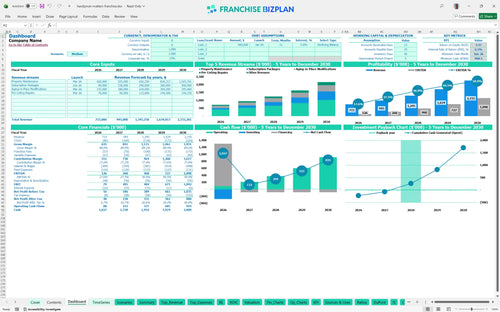
All-in-one Dashboard
Core inputs and core outputs



This franchise unit business plan template includes a detailed Excel workbook with integrated revenue drivers, payroll calculators, and full financial statements for a 5-year period.
Core inputs and core outputs
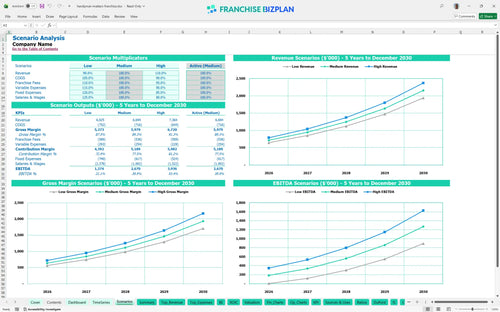
Three scenario analysis
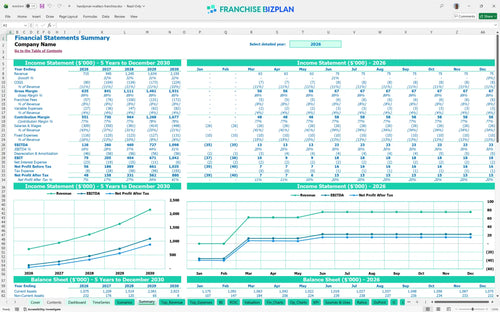
Presentation ready
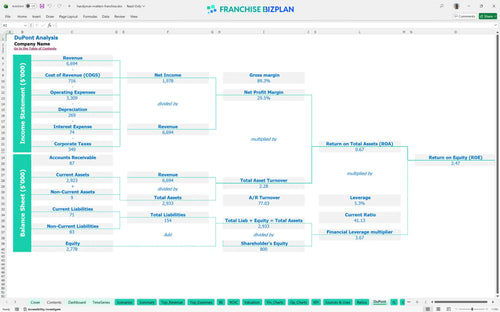
DuPont analysis
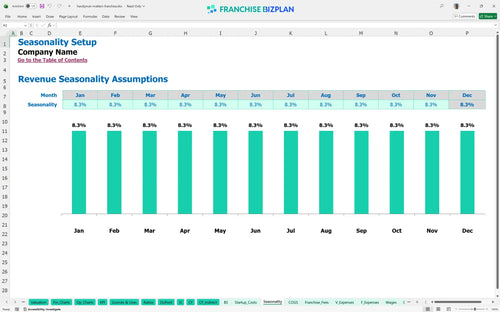
Researched revenue assumptions
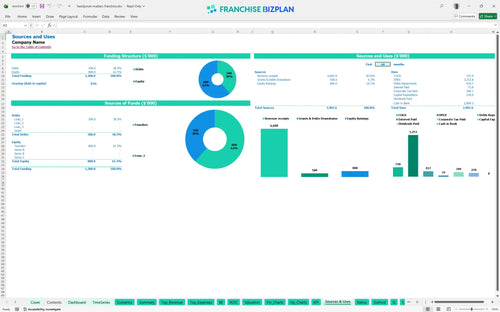
Lender-friendly financial outputs
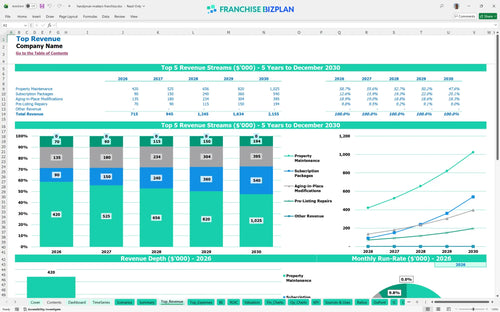
Revenue stream detailed view
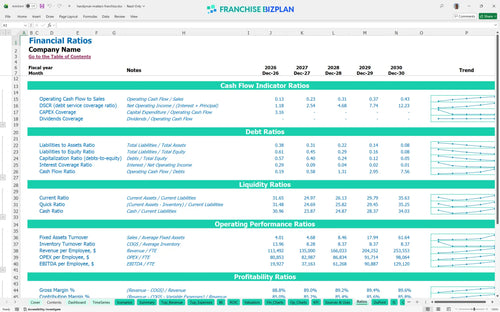
Performance metrics benchmark
We built this handyman franchise financial model using deep research into the home repair sector to provide a turnkey planning tool. Key assumptions like the $715,000 year-one revenue and the 4-month break-even timeline are pre-populated with researched data but remain fully editable. This ensures you have a credible starting point for estimating ROI for home maintenance service franchises while keeping the flexibility to adjust for your specific Austin or local market costs.
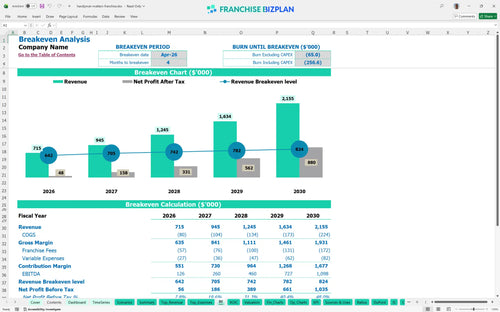
This unit reaches profitability quickly, hitting its break-even point in April 2026, just four months after launch. With EBITDA growing from $126,000 in the first year to over $1 million by year five, the model shows a strong upward curve as you scale. You will defintely see the impact of subscription packages as they grow from $60,000 to $360,000 over the five-year period.
You need approximately $278,000 in initial capital to cover the franchise startup cost breakdown. This includes the $70,000 franchise fee and $100,000 for branded service vehicles, which are your biggest upfront 'uses' of cash. The model assumes a healthy cash position to navigate the ramp-up phase before the unit becomes self-sustaining.
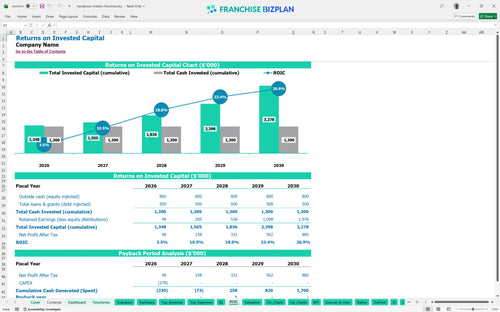
The model projects a 3-year payback period and an Internal Rate of Return (IRR) of 6.46%. While the Return on Equity (ROE) is 2.47%, the significant jump in EBITDA from $126,000 to $1,098,000 by year five suggests strong long-term value. This Excel template for franchise unit financial forecasting helps you see how project-based fees and aging-in-place modifications drive these returns.
Your monthly break-even is achieved when revenue covers the $8,530 in monthly fixed costs plus variable expenses like labor and royalties. The primary driver for reaching this point by month four is technician throughput and managing variable labor costs in home service franchises. If your technicians aren't billing enough hours, the break-even date will slide right.
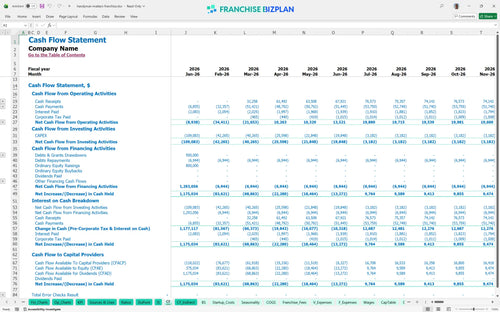
The lowest cash point occurs in June 2026, where the minimum cash balance sits at $969,000 based on the initial funding structure. You have a solid runway, but you must monitor fuel and vehicle maintenance, which stays at 2.5% of revenue, to ensure cash isn't leaking. Still, having a buffer is smart because property maintenance franchise units often face seasonal fluctuations.
In a high-growth scenario, pushing aging-in-place modifications can accelerate revenue beyond the $715,000 year-one target. Small business financial forecasting shows that even a 10% dip in property maintenance revenue can be offset by increasing subscription package sales. The model helps you see how these shifts impact your year-1 EBITDA margin and peak cash needs.
Finance: update unit break-even and payback model by Friday
This handyman franchise financial model is built in Excel, allowing you to tweak every variable from technician pay to local rent. Pre-filled formulas handle the heavy lifting so you can focus on testing different growth scenarios for your home service franchise. It is a flexible tool designed to adapt as your territory expands or market conditions shift.

Mapping out a 5-year horizon is vital for a home maintenance business model to ensure long-term viability. This tool projects revenue climbing from $715,000 in year one to over $2.1 million by year five, giving you a clear view of long-term cash flow and balance sheet health. It helps you visualize the transition from a single-van operation to a multi-vehicle fleet.

Calculating ongoing franchise royalty and marketing fees is automated here to reflect the true cost of brand affiliation. With a 6% royalty and 2% marketing fund, the model ensures these off-the-top costs are baked into your unit economics so you see the real net profit. This transparency is essential for a realistic financial feasibility study for home service franchises.

Use this franchise unit break-even analysis spreadsheet to pinpoint exactly when your doors pay for themselves. It tracks everything from the $70,000 initial fee to branded vehicles, helping you manage the total startup investment against monthly fixed costs. Knowing your break-even point helps you plan your marketing spend and hiring timeline with confidence.

We've integrated home service franchise financial projections with realistic benchmarks to keep your planning grounded. Whether it is the 9.5% materials cost or the $3,800 monthly rent, these numbers help you sanity-check your local market data. This makes it easier for you to explain your numbers to lenders or partners using standard industry expectations.


Simply purchase and download the financial model template, then access it instantly using Microsoft Excel or Google Sheets. No installation or technical expertise required-just open and start working.

Enter your business-specific numbers, including revenue projections, costs, and investment details. The pre-built formulas will automatically calculate financial insights, saving you time and effort.

Leverage the investor-ready format to confidently showcase your financial projections to banks, franchise representatives, or investors. Impress stakeholders with clear, data-driven insights and professional reports.

Leverage the investor-ready format to confidently present your projections to banks, franchise representatives, or investors.