


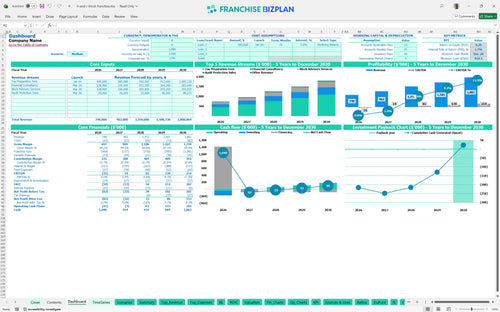
All-in-one Dashboard
Core inputs and core outputs



This comprehensive tool includes dynamic revenue drivers, seasonal staffing modules, and detailed CapEx tracking to provide a complete financial picture of your tax office operations.
Core inputs and core outputs
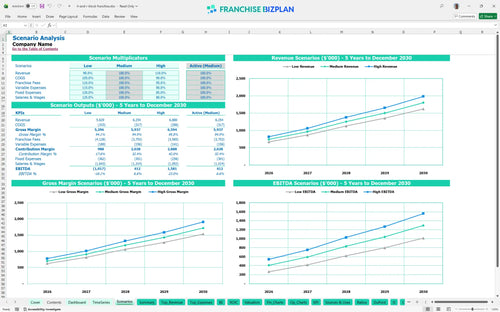
Three scenario analysis
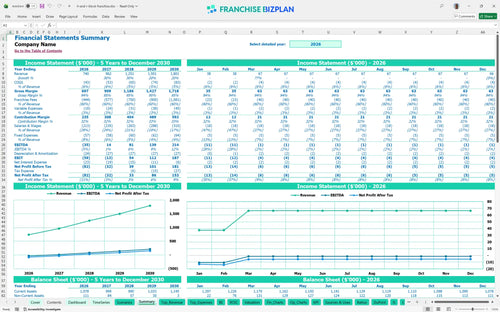
Presentation ready
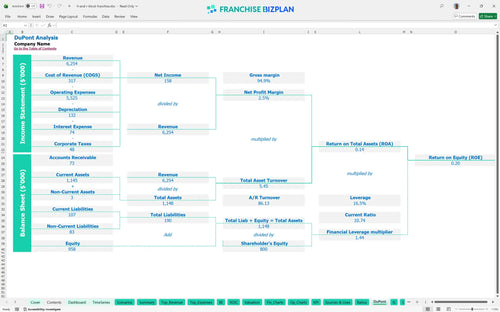
DuPont analysis
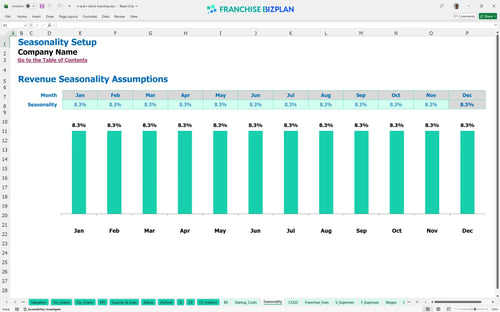
Researched revenue assumptions
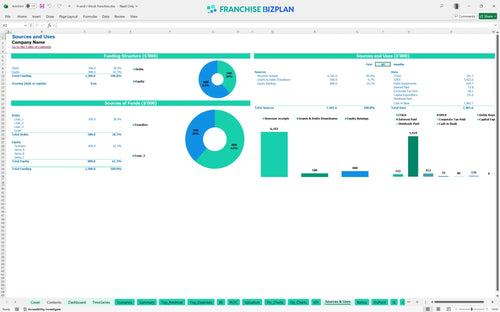
Lender-friendly financial outputs
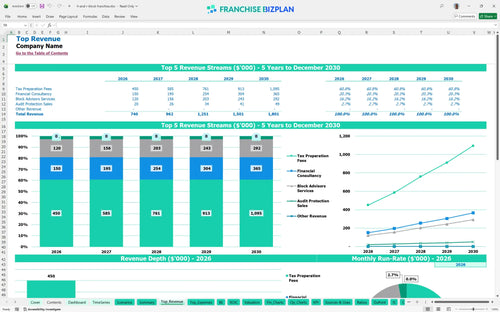
Revenue stream detailed view
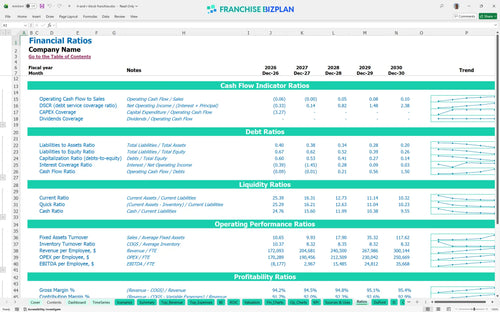
Performance metrics benchmark
We built this franchise unit financial model using intensive research into tax service unit economics and seasonal demand cycles. Key assumptions like the $300,000 year-one tax prep revenue and the 60% royalty structure are pre-populated and fully editable to match your specific location. This model defintely gives you the data-driven confidence to evaluate year-one EBITDA of -$35,000 against long-term growth.
The unit reaches positive EBITDA in year two, generating approximately $14,000 after a ramp-up period. This small business franchise profitability analysis shows that while year one is an investment, the model scales to $214,000 in EBITDA by year five as revenue hits $1.8 million. Year two is where the math starts to actually make sense.
You will need to plan for startup capital requirements totaling roughly $135,000 to cover the franchise fee, $60,000 in leasehold improvements, and $25,000 in technology. This is how to calculate startup costs for a tax preparation franchise: you must account for everything from the $12,000 signage to the $4,500 initial training. Leaseholds are your biggest check, so negotiate that TI allowance hard.
Based on the tax service franchise ROI analysis spreadsheet, you can expect an Internal Rate of Return (IRR) of 1.66% and a 5-year payback period. Using the franchise investment calculator, the Return on Equity (ROE) sits at 0.2, reflecting a stable but long-term capital recovery. A 1.66% IRR means you are playing a long game for equity, not a quick flip.
The model shows a break-even date of January 2026, which is just one month after launch, provided you time your opening with the peak tax season. This financial feasibility study for tax consulting franchise indicates that calculating break-even point for tax preparation franchises depends heavily on hitting the $300,000 year-one tax prep target. One month to breakeven is fast, but it assumes you hit the ground running in January.
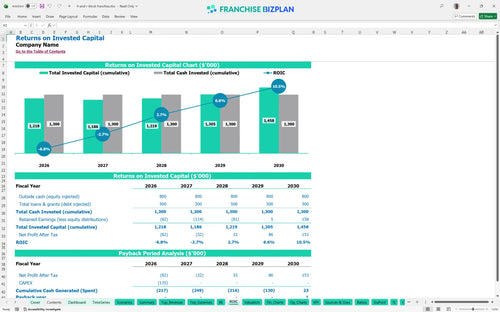
The operating expense budget shows a minimum cash position of $932,000 in December 2028, suggesting a significant capital reserve is maintained throughout the growth phase. When estimating operating expenses for a small business franchise, you must account for the $3,200 monthly rent even during the off-season. Cash is king, but in tax prep, timing is the king's boss.
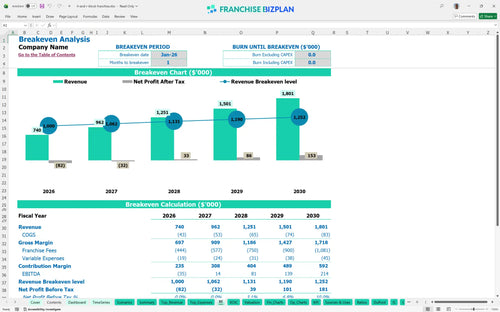
The franchise unit economic projections template allows for revenue and expense modeling for independent tax offices across low, medium, and high cases. A high-performance scenario accelerates the $214,000 EBITDA target, while a low-revenue year could extend the 5-year payback period significantly. High-case scenarios are won in the local community, not the spreadsheet.
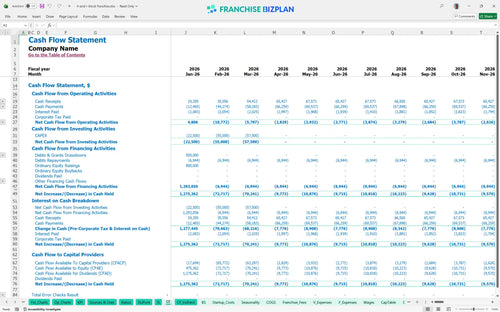
Success in this model requires aggressive local lead generation to offset the high royalty burden. Focus on the Mueller district's young professionals to drive the $300,000 year-one tax prep goal. Still, watch your labor costs during the off-season to protect your year-two profitability pivot. Finance: update unit break-even and payback model by Friday.
This tax franchise financial model is built in Excel with fully editable assumptions, allowing you to swap our researched data for your specific territory reality. Whether you are adjusting for Austin's labor market or local rent, the pre-filled formulas and Excel template for franchise unit business planning ensure your financial model template for new franchise locations remains accurate and flexible. If you can't break the model in Excel, you shouldn't sign the FDD.

Plan your multi-unit expansion or single-office growth with a franchise business plan template that scales from a $740,000 year-one start to $1.8 million in year five. This franchise financial projection spreadsheet provides a clear franchise P&L statement and revenue forecasting models to track how your margins evolve as you add services like audit protection. Five years is a lifetime in tax law, but your cash flow needs a north star.

The model handles the heavy lifting of calculating a 60% royalty fee and managing the $2,500 initial franchise fee to show the true cost of the brand's support. By mapping these ongoing obligations against your gross revenue, you can see exactly how much cash stays in the unit after the franchisor takes their share. At a 60% royalty, you aren't just a partner; you're a high-volume distribution arm.

Accurately project your tax preparation franchise startup costs, including the $60,000 for leasehold improvements and $25,000 for computer systems, to ensure you are capitalized from day one. This analysis helps you identify the exact volume of tax returns needed to cover your $3,200 monthly rent and fixed overhead. Breakeven isn't a goal; it's the point where you stop bleeding.

Use our best practices for franchise unit financial forecasting to compare your projected $55,000 office manager salary and 1.3% processing fees against industry norms. These benchmarks help you sanity-check your small business economics and ensure your staffing levels for tax preparers match your seasonal volume. Benchmarks keep your ego in check when the pro forma looks too good.


Simply purchase and download the financial model template, then access it instantly using Microsoft Excel or Google Sheets. No installation or technical expertise required-just open and start working.

Enter your business-specific numbers, including revenue projections, costs, and investment details. The pre-built formulas will automatically calculate financial insights, saving you time and effort.

Leverage the investor-ready format to confidently showcase your financial projections to banks, franchise representatives, or investors. Impress stakeholders with clear, data-driven insights and professional reports.

Leverage the investor-ready format to confidently present your projections to banks, franchise representatives, or investors.