


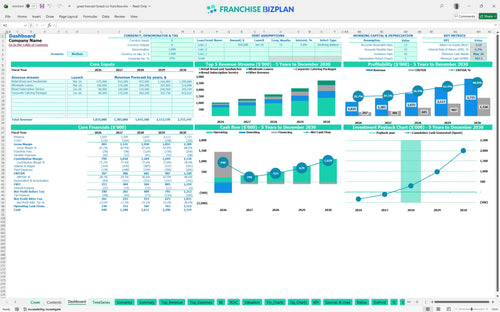
All-in-one Dashboard
Core inputs and core outputs



This comprehensive financial tool includes automated five-year projections, a startup cost tracker, and detailed revenue drivers for retail, wholesale, and catering operations.
Core inputs and core outputs
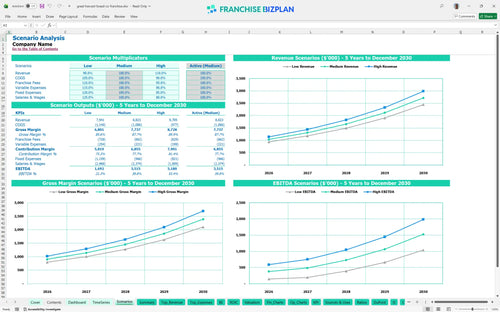
Three scenario analysis
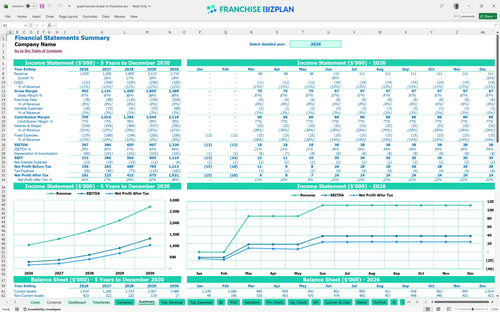
Presentation ready
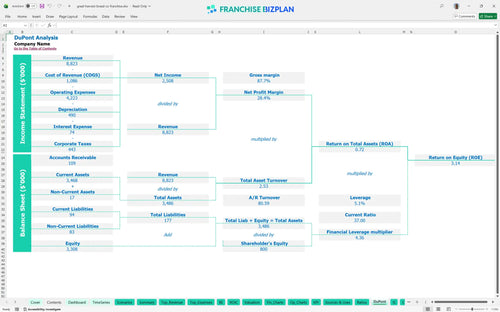
DuPont analysis
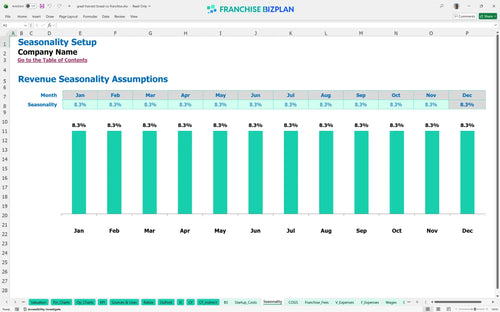
Researched revenue assumptions
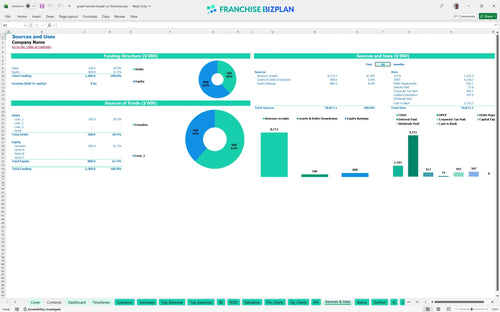
Lender-friendly financial outputs
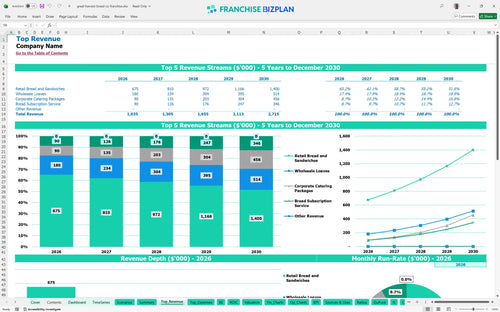
Revenue stream detailed view
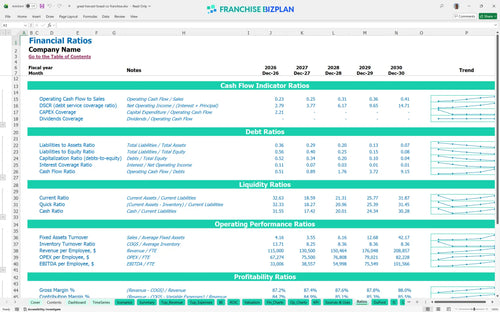
Performance metrics benchmark
We built this franchise unit financial model using intensive research into the artisanal bakery sector. Key assumptions for revenue streams, operating expenses, and capital expenditure planning are pre-populated with data specific to this bakery concept and are fully editable. With a year-one EBITDA of $297,000 and a 3-month break-even, this model provides a practical look at the unit economics of on-site milling and scratch baking.
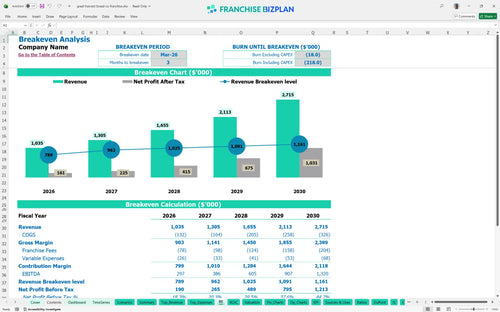
Profitability arrives almost immediately, with the unit reaching its break-even point in March 2026. After accounting for COGS, the 5% royalty, and marketing fees, the model shows a strong retail franchise investment analysis with a year-one EBITDA of $297,000. Profitability isn't just about sales; it's about managing the dough.
You will need significant capital to launch, totaling over $500,000 in hard costs. This includes the $35,000 franchise fee, $200,000 for leasehold improvements, and $180,000 for specialized milling and baking equipment. You can't bake bread without a solid financial foundation.
The financial feasibility study for an artisanal bakery shows a 3-year payback period and an internal rate of return (IRR) of 6.27%. While the initial ROE of 3.14% is conservative, the cash flow growth is aggressive, with EBITDA projected to reach $1.32 million by year five. Returns take time, but the cash flow is worth the wait.
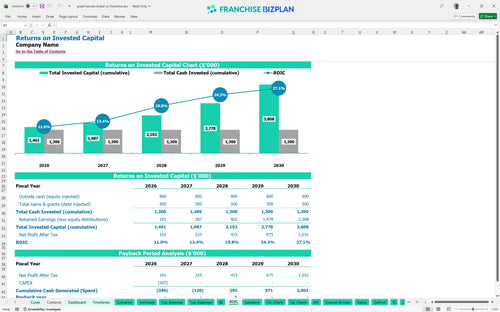
The unit reaches its break-even point in just 3 months, specifically by March 2026. This rapid ramp-up depends on achieving the $1,035,000 year-one revenue target through a mix of retail bread, sandwiches, and wholesale contracts. Breakeven is the first real milestone of freedom.
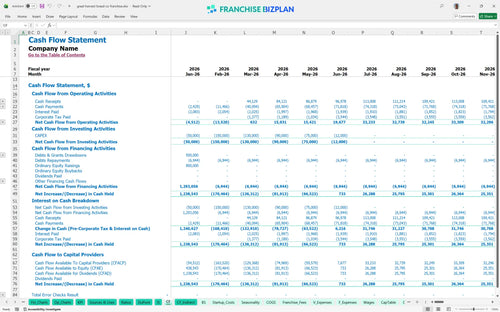
The lowest cash point is projected at $783,000 in May 2026, which is the 'danger zone' during the initial ramp-up. This financial planning guide for new franchise owners suggests you need a solid liquidity cushion to cover the $10,500 monthly rent. Cash is more than king; it's your oxygen.
In a high-growth scenario, learning how to forecast revenue for a bakery catering business can push your year-five revenue to $2.7 million. A 10% swing in labor or ingredient costs will shift your year-one margin, so testing these scenarios is vital. Planning for the worst helps you achieve the best.
This franchise financial model template is built in Excel to give you total control over your unit economics. You can easily adjust the pre-filled formulas and editable assumptions to match your specific territory, whether you are looking at a high-traffic retail hub or a smaller neighborhood spot. It allows you to plug in your own local data while keeping the underlying logic of a professional-grade model.

Success in the bakery business requires a long-term view, and this bakery franchise business plan provides a detailed 5-year roadmap. You can track your growth from a year-one revenue of $1,035,000 up to a projected $2,715,000 by year five. This is the best financial model for small business expansion because it maps out the transition from a single startup unit to a mature, high-volume operation with clear small business financial projections.

Managing the ongoing costs of a brand partnership is critical for estimating profitability for a retail food franchise. This model automatically calculates the 5% royalty fee and 2.5% marketing fund contribution based on your monthly sales. By integrating these franchise-specific obligations, you get a realistic view of your store-level margin after the franchisor takes their cut, which is essential for any franchise profitability analysis.

Our franchise startup cost calculator helps you plan for every dollar needed before you open your doors. It includes a detailed franchise P&L statement that accounts for the $35,000 initial fee and heavy equipment costs. You will know exactly how to calculate startup costs for a bakery franchise, including leasehold improvements and pre-opening labor, so you can identify the exact month your sales will cover your fixed and variable expenses.

We have integrated bakery franchise financial performance benchmarks to help you sanity-check your numbers. The model includes a franchise unit operating expense spreadsheet that tracks bakery operational costs like the $10,500 monthly rent and ingredient costs for flour. Comparing your projections against these industry standards ensures your plan is grounded in the reality of the current US retail market.


Simply purchase and download the financial model template, then access it instantly using Microsoft Excel or Google Sheets. No installation or technical expertise required-just open and start working.

Enter your business-specific numbers, including revenue projections, costs, and investment details. The pre-built formulas will automatically calculate financial insights, saving you time and effort.

Leverage the investor-ready format to confidently showcase your financial projections to banks, franchise representatives, or investors. Impress stakeholders with clear, data-driven insights and professional reports.

Leverage the investor-ready format to confidently present your projections to banks, franchise representatives, or investors.