


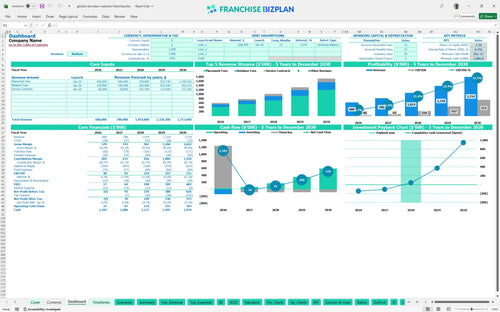
All-in-one Dashboard
Core inputs and core outputs



This Excel spreadsheet for franchise business planning includes a recruitment agency business plan framework with automated 5-year pro formas, CAPEX schedules, and detailed staffing modules.
Core inputs and core outputs
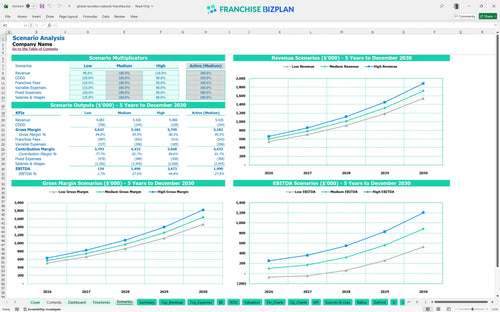
Three scenario analysis
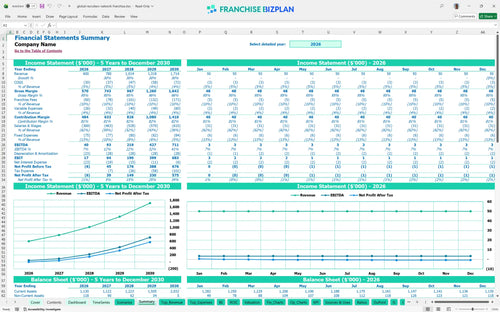
Presentation ready
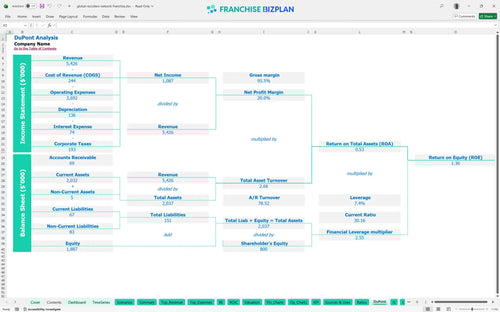
DuPont analysis
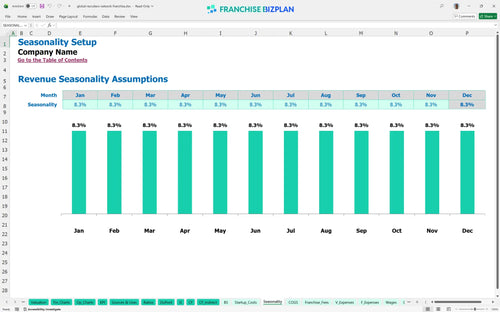
Researched revenue assumptions
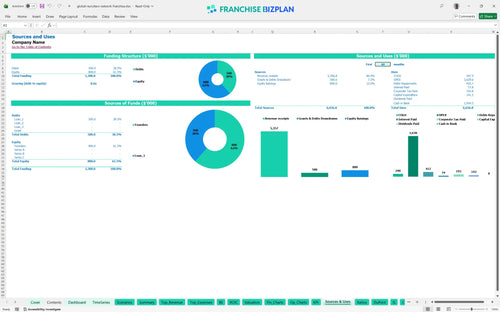
Lender-friendly financial outputs
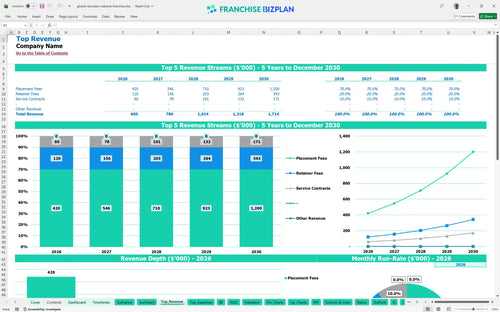
Revenue stream detailed view
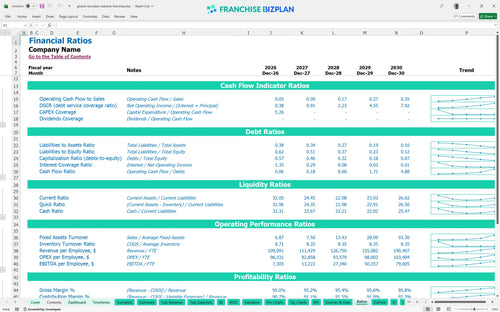
Performance metrics benchmark
We developed this financial model using deep research into the executive search and professional staffing sector. All key assumptions, including placement fee structures and the 10% royalty rate, are pre-populated but fully adjustable to your specific market. With a year-one revenue target of $600,000 and a 3-year payback period, this tool provides a realistic roadmap for your new office.
This recruitment unit reaches profitability almost immediately, hitting its break-even point in January 2026. By year one, you can expect an EBITDA of $40,000, which scales significantly to $711,000 by year five as your team of five recruiters matures. This franchise profitability analysis shows that once you cover the base salaries and $6,550 in monthly fixed costs, the high margins on placement fees drive rapid bottom-line growth.
You need a total initial investment of $141,500 to launch this franchise unit in the US market. This franchise investment breakdown for staffing agencies covers the $50,000 brand fee and $30,000 for your office fit-out in a tech-hub location. The model also accounts for $18,000 in IT infrastructure and a $10,000 launch marketing budget to ensure you have the tools and visibility to attract high-value candidates from day one.
An owner can expect an internal rate of return (IRR) of 6.33% and a return on equity (ROE) of 1.36 over the initial five-year period. The ROI calculation indicates a three-year payback period, which is standard for service-based models with moderate upfront CAPEX. As revenue grows from $600,000 to $1.7 million, the net margin improves, making the unit a defintely strong candidate for multi-unit expansion.
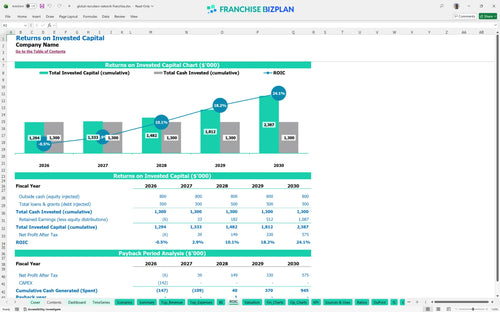
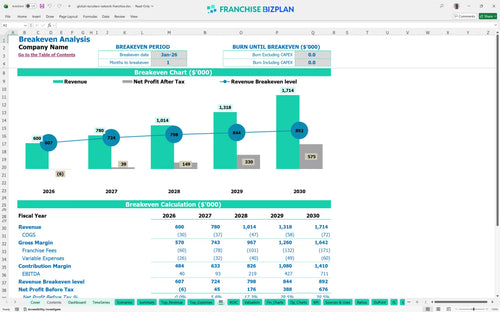
The unit breaks even in January 2026, requiring roughly $50,000 in monthly revenue to cover its initial operating structure. The primary driver for reaching this point is placement fee volume, as the 10% royalty is your only major variable franchise cost. Since there is no brand marketing fee, your contribution margin remains high, allowing you to cover the $4,200 monthly rent and staff salaries with just two or three mid-level executive placements.
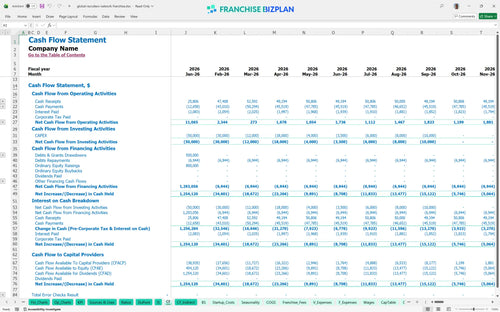
The lowest cash point occurs in December 2027, with a minimum cash balance of $1,086, indicating a very lean period during the second year of growth. You should maintain a working capital buffer to handle the timing gap between successful placements and actual fee collection from corporate clients. This startup budget template for service-based franchises suggests that while the model is efficient, managing the ramp-up of three additional recruiters requires careful cash monitoring.
In a high-growth scenario, hitting the $1.7 million revenue mark by year five results in a massive EBITDA jump to $711,000. Conversely, a low-performance scenario where revenue stays near $600,000 would significantly compress margins due to the $300,000+ annual payroll for your core team. Best practices for recruitment franchise financial forecasting suggest that your year-one margin of 6.6% is the critical testing ground for your local market demand.
Finance: update unit break-even and payback model by Friday.
This franchise financial model template provides a flexible Excel environment where you can adjust every driver of your recruitment business. You can modify pre-filled formulas for placement fees and retainer structures to see how different commission rates impact your bottom line. It is built to handle specific territory nuances, allowing you to swap out default values for your actual local rent or specific recruiter commission tiers.

Planning for long-term growth is essential when building staffing agency financial projections that scale from a solo desk to a full team. This model forecasts performance through 2030, showing a revenue climb from $600,000 in year one to over $1.7 million by year five. You get a clear view of how EBITDA (earnings before interest, taxes, depreciation, and amortization) expands as you add more recruiters to your office.

Managing the ongoing costs of a brand partnership requires precision, especially when estimating royalty payments in franchise financial models. This tool automatically calculates the 10% royalty fee against your monthly placement and retainer revenue, ensuring you always know your net contribution. By factoring in the $50,000 initial fee and zero-percent marketing fund, you can see exactly how much cash stays in your local pocket.

Knowing how to calculate startup costs for a recruitment franchise is the first step to avoiding early cash crunches. This model aggregates your $30,000 office fit-out, $18,000 IT budget, and $10,000 launch marketing into a single investment view. It identifies the exact month when your placement volume covers your fixed monthly overhead of roughly $6,500 plus payroll, giving you a clear target for your first 90 days.

Understanding franchise unit economics for staffing firms is easier when you can compare your projections against researched standards. The model includes benchmarks for recruiter salaries, ranging from $42,000 for juniors to $70,000 for lead roles, and software costs typically around 3.5% of revenue. These guardrails help you verify if your projected $4,200 monthly rent or your 1.5% database access fee aligns with a healthy executive search operation.


Simply purchase and download the financial model template, then access it instantly using Microsoft Excel or Google Sheets. No installation or technical expertise required-just open and start working.

Enter your business-specific numbers, including revenue projections, costs, and investment details. The pre-built formulas will automatically calculate financial insights, saving you time and effort.

Leverage the investor-ready format to confidently showcase your financial projections to banks, franchise representatives, or investors. Impress stakeholders with clear, data-driven insights and professional reports.

Leverage the investor-ready format to confidently present your projections to banks, franchise representatives, or investors.