


All-in-one Dashboard
Core inputs and core outputs



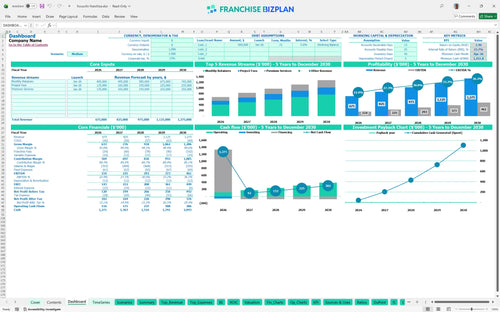
This small business franchise financial projection tool provides a comprehensive framework for modeling professional service revenue, executive staffing, and franchise-specific fee structures.
Core inputs and core outputs
Three scenario analysis
Presentation ready
DuPont analysis
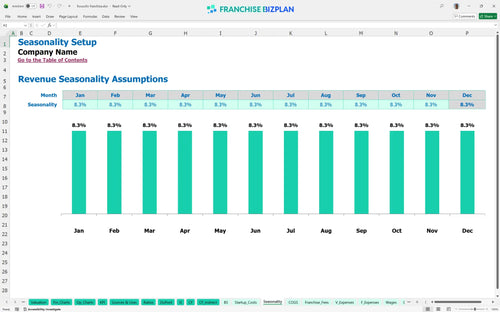
Researched revenue assumptions
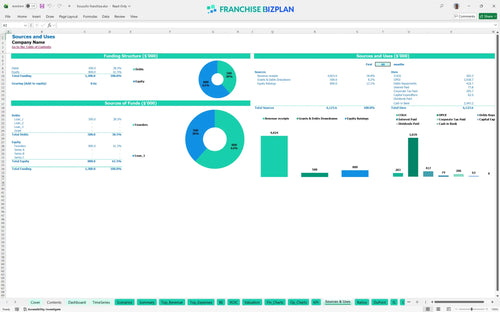
Lender-friendly financial outputs
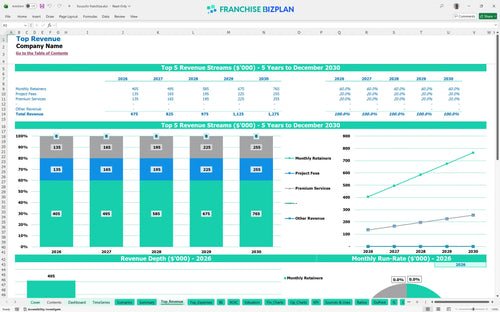
Revenue stream detailed view
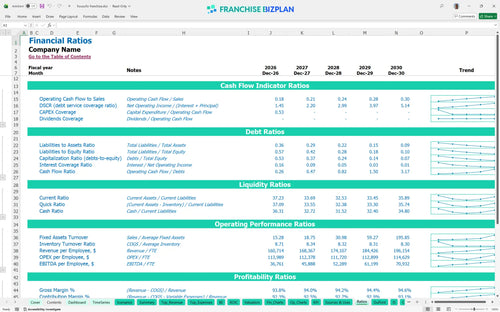
Performance metrics benchmark
We built this franchise unit financial model using our own research into the fractional executive space and professional service standards. Key assumptions, including recurring monthly retainers starting at $270,000 annually and a 7% royalty structure, are pre-populated and fully editable to match your specific territory. This model provides a clear view of how EBITDA can scale from $154,000 to $461,000 over five years based on researched performance data.
Your fractional CFO business model shows immediate traction, reaching profitability in January 2026. With Year 1 EBITDA projected at $154,000 and growing to $461,000 by Year 5, the trajectory is defintely strong. Here's the quick math: recurring retainers provide the floor, while premium services and project fees drive the margin expansion. High-margin advisory work is the engine here.
To launch this unit, you need to understand how to calculate startup costs for a fractional consulting franchise effectively. The total initial investment is anchored by a $35,000 franchise fee and approximately $27,000 in other startup costs like IT, office fit-out, and website development. Most of your capital goes into professional positioning and infrastructure rather than heavy inventory. Cash is king in the first quarter.
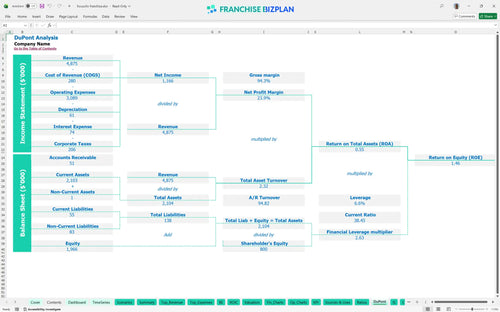
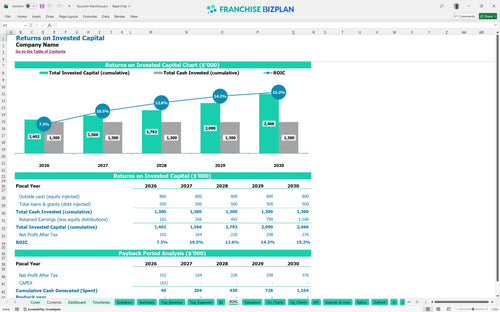
Financial modeling for B2B professional service franchises requires looking past simple margins to long-term equity value. You are looking at an Internal Rate of Return (IRR) of 23.73% and a Return on Equity (ROE) of 1.46. While the payback period extends after Year 5, the steady climb in EBITDA suggests a valuable exit or a strong passive income stream for a multi-unit operator. Patience pays off in advisory.
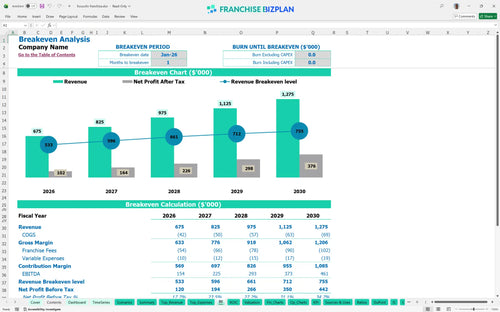
The break-even point occurs almost immediately in January 2026, just one month after launch. This speed is possible because fixed costs like the $2,800 monthly rent and staff salaries are offset by the $270,000 in Year 1 retainer revenue. Best practices for managing franchise unit cash flow suggest keeping a close eye on your lead CFO and consultant utilization rates to maintain this pace. Efficiency is your best friend.
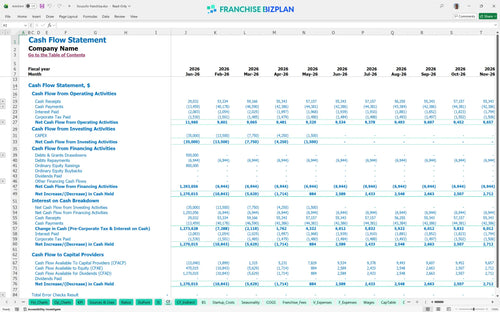
Your revenue forecasting Excel sheet for advisory services shows a minimum cash balance of $1,252,000 in April 2026. This indicates a very healthy buffer, but you must still watch the timing of your $110,000 Lead CFO salary and other fixed overheads. If client payments lag by 30 days, that 'paper' profit won't pay the rent. Watch your aging reports.
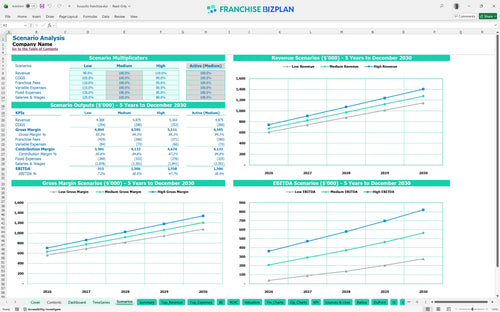
Scaling a fractional CFO business with financial modeling means testing how sensitive your $461,000 Year 5 EBITDA is to market shifts. In a high-growth scenario, increasing project fee volume by even 10% significantly boosts the bottom line because your fixed office costs stay flat. Conversely, a low-growth case might delay your ability to hire that second Junior Analyst. Scenario planning prevents surprises.
This franchise financial model template is built in Excel with a focus on usability and deep customization. You can adjust every lever-from revenue drivers to specific local labor rates-to see how changes impact your bottom line in real-time. Pre-filled formulas handle the heavy lifting so you can focus on the strategy of the business rather than troubleshooting spreadsheets. It is a living document for your unit.

Success in professional services requires looking beyond the first year, which is why this financial forecasting Excel template provides a full 5-year outlook. We mapped out revenue growth from $675,000 in Year 1 to $1,275,000 by Year 5, allowing you to visualize the scaling process. This long-term view helps you time your hiring and capital reinvestment perfectly. Plan for the marathon, not just the sprint.

Estimating royalty and fee impact on franchise profitability is critical for protecting your margins in a service-based model. This tool specifically tracks the 7% royalty and 1% marketing fund contribution against your gross revenue streams. By accounting for these off-the-top costs early, you get a realistic view of the store-level EBITDA before you even sign the agreement. Know exactly what you owe the brand.

Our franchise startup cost breakdown covers everything from the initial $35,000 fee to office fit-out and IT equipment. The model helps you calculate the exact amount of liquidity needed to reach a stable operating state without running out of runway. It separates one-time capital expenditures from your ongoing monthly fixed costs to clarify your total 'all-in' number. Avoid the mid-launch cash crunch.

This franchise unit profitability analysis incorporates professional services franchise metrics to help you sanity-check your projections. We include data points for labor costs-like the $110,000 Lead CFO salary-and occupancy expenses to ensure your model reflects the reality of the North Austin business corridor or similar premium markets. Comparing your plan to industry norms keeps your goals grounded. Benchmarks turn guesses into data.


Simply purchase and download the financial model template, then access it instantly using Microsoft Excel or Google Sheets. No installation or technical expertise required-just open and start working.

Enter your business-specific numbers, including revenue projections, costs, and investment details. The pre-built formulas will automatically calculate financial insights, saving you time and effort.

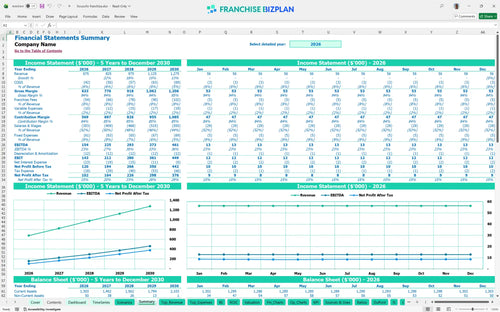
Leverage the investor-ready format to confidently showcase your financial projections to banks, franchise representatives, or investors. Impress stakeholders with clear, data-driven insights and professional reports.

Leverage the investor-ready format to confidently present your projections to banks, franchise representatives, or investors.