


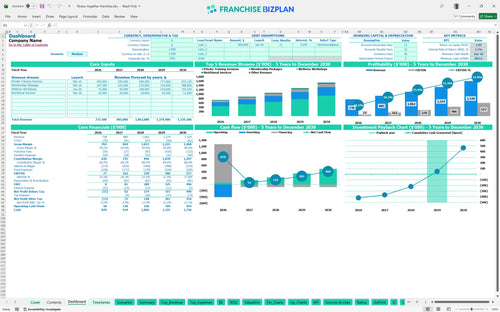
All-in-one Dashboard
Core inputs and core outputs



This personal training studio financial model provides a comprehensive framework for forecasting revenue, managing expenses, and calculating long-term investment returns for a boutique fitness unit.
Core inputs and core outputs
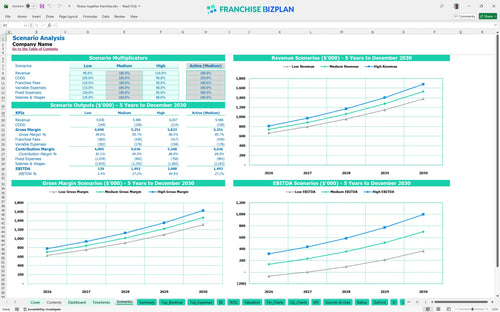
Three scenario analysis
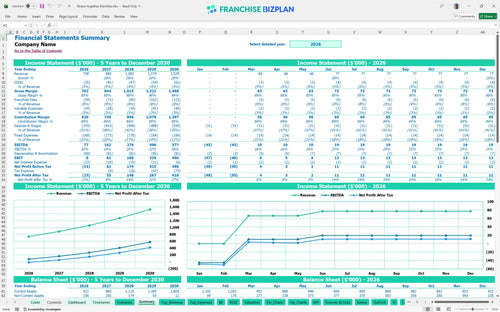
Presentation ready
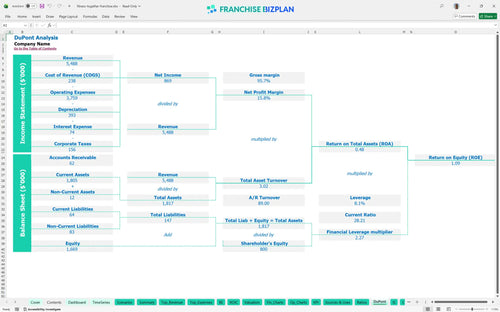
DuPont analysis
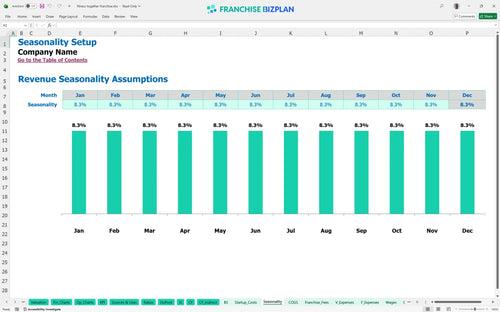
Researched revenue assumptions
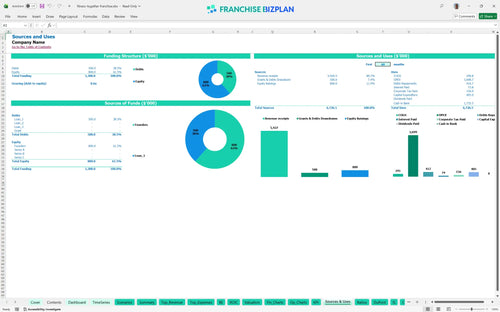
Lender-friendly financial outputs
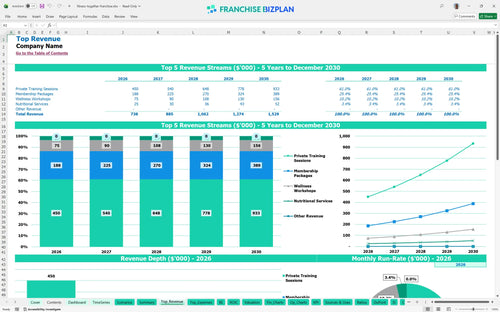
Revenue stream detailed view
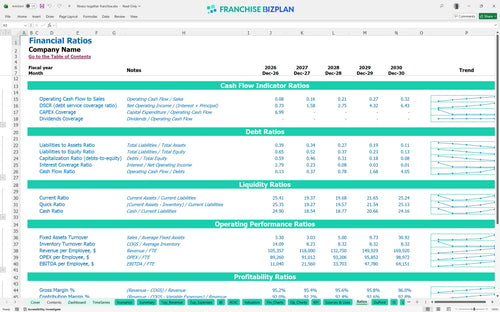
Performance metrics benchmark
Based on the data, this unit hits an EBITDA of $77,000 in Year 1 and scales to $577,000 by Year 5. You reach operational profitability quickly after the April 2026 breakeven date, provided you maintain the 2.2% payment processing and 1% booking platform fee structure. Calculating recurring revenue for personal training businesses shows that session volume is the primary engine for this growth. Profitability follows the ramp-up of your certified trainer team.
You need approximately $405,000 in startup capital for the initial launch, covering the $40,000 franchise fee and $150,000 in leasehold improvements. This detailed financial forecasting for boutique fitness studios assumes you have a cash buffer to handle the $806,000 minimum cash need during the ramp-up phase. The biggest chunk of your capital goes into the suites and equipment to ensure a premium experience. Capital allocation determines your studio quality.
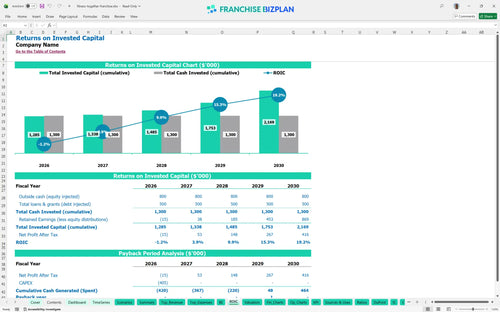
The franchise investment spreadsheet for prospective owners shows a 3.23% IRR and a 4-year payback period. While the initial return on equity (ROE) is 1.09, the long-term value lies in the scaling revenue which grows from $738,000 to over $1.5 million by year five. This ROI calculation accounts for all royalties and the $68,000 studio manager salary. Patience is required as the model matures over the first 48 months.
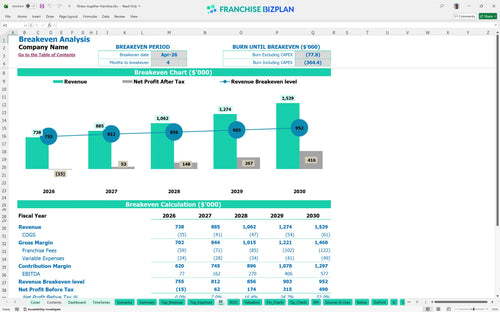
The studio reaches its break-even point in April 2026, just four months after the March launch. Reaching this milestone depends heavily on hitting the $300,000 Year 1 target for private training sessions while managing the $9,000 monthly rent. Your break-even analysis shows that labor is the biggest variable, so managing the five-trainer headcount is critical. Speed to break-even preserves your initial working capital.
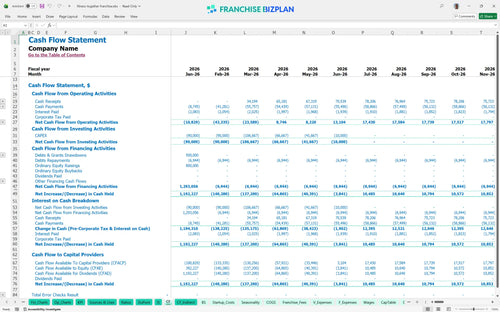
Your lowest cash point occurs in June 2026 with a $806,000 requirement, suggesting you need significant liquidity beyond just the startup costs. This franchise unit cash flow projection spreadsheet helps you monitor the gap between the March launch and the April breakeven to avoid a liquidity crunch. Honestly, the ramp-up period is where most owners feel the most pressure. Cash is more important than paper profit early on.
Evaluating the profitability of a personal training franchise requires looking at Low, Medium, and High cases. A High case scenario, driven by better local marketing execution and higher session volume, could significantly improve the 3.23% IRR and shorten the 4-year payback period. If revenue lags by 10%, your EBITDA of $77,000 in year one could vanish quickly. Scenarios prepare you for the reality of the Scottsdale market.
We built this fitness franchise business plan and financial model using our own research into boutique fitness economics. Key assumptions like the 6% royalty, $150,000 build-out, and $42,000 trainer salaries are pre-populated and fully editable, so you can defintely test how your specific location will perform. This financial planning guide for luxury wellness franchises ensures you are prepared for the $806,000 peak cash need. Use this to move from a business idea to a funded reality. Finance: update unit break-even and payback model by Friday.
This franchise financial model template is fully customizable in Excel, featuring pre-filled formulas and editable assumptions. You can easily adjust inputs for your specific territory, local rent, and staffing needs to see how different scenarios impact your bottom line. Every cell is open, so you can tweak the logic to match your exact market conditions. Control your numbers before you sign the lease.

Map your growth with detailed 5-year revenue projections and cash flow statements. This tool provides a clear view of your path from a single-unit startup to a mature studio, helping you plan for scaling and long-term franchise unit profitability analysis. It covers everything from initial hiring to year-five exit planning. Growth is a math problem, not a guessing game.

The model captures essential financial obligations like the $40,000 initial franchise fee and ongoing 6% royalty payments. By estimating royalty and marketing fees for fitness franchises accurately, you can see the impact of these brand costs on your monthly store-level margin. We include the 2% marketing fund contribution to ensure your net profit is realistic. Brand support has a cost, so track it closely.

Use the franchise startup cost calculator to estimate your total initial investment, including build-out and equipment. The break-even analysis identifies the exact sales volume needed to cover your fixed costs like the $9,000 monthly rent and $1,500 utilities. It helps you understand the startup capital requirements for fitness studio ownership before you commit. Know your nut before you open the doors.

This model uses built-in benchmarks to sanity-check your operating expenses and labor costs. Comparing your projections against industry standards ensures your franchise investment feasibility remains realistic and grounded in actual boutique fitness performance data. We include typical ranges for gross margins and revenue drivers to keep your plan honest. Don't build a plan on best-case outliers.


Simply purchase and download the financial model template, then access it instantly using Microsoft Excel or Google Sheets. No installation or technical expertise required-just open and start working.

Enter your business-specific numbers, including revenue projections, costs, and investment details. The pre-built formulas will automatically calculate financial insights, saving you time and effort.

Leverage the investor-ready format to confidently showcase your financial projections to banks, franchise representatives, or investors. Impress stakeholders with clear, data-driven insights and professional reports.

Leverage the investor-ready format to confidently present your projections to banks, franchise representatives, or investors.