


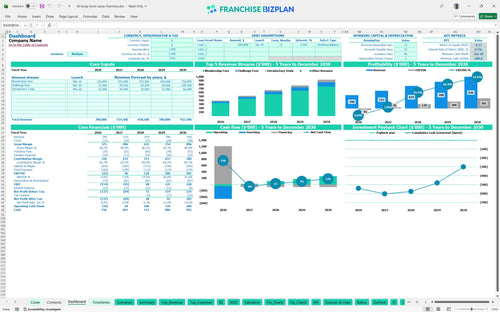
All-in-one Dashboard
Core inputs and core outputs



This franchise unit financial model template for Excel includes everything from CAPEX scheduling to a sample P&L for a group fitness studio.
Core inputs and core outputs
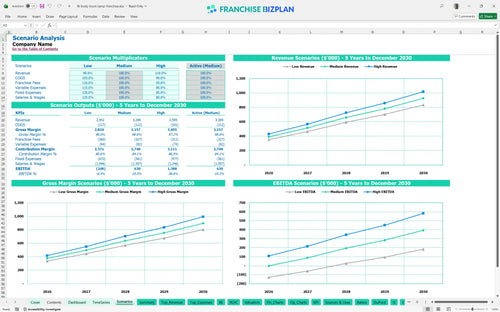
Three scenario analysis
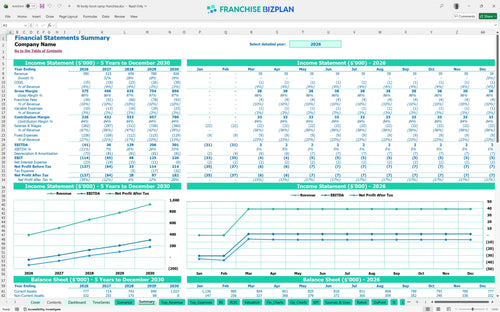
Presentation ready
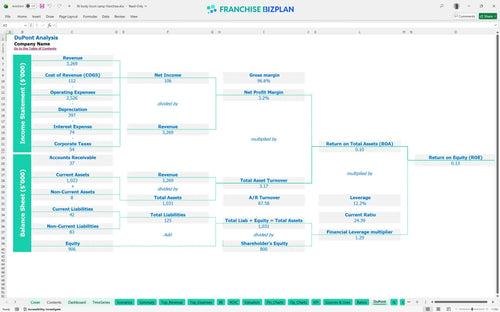
DuPont analysis
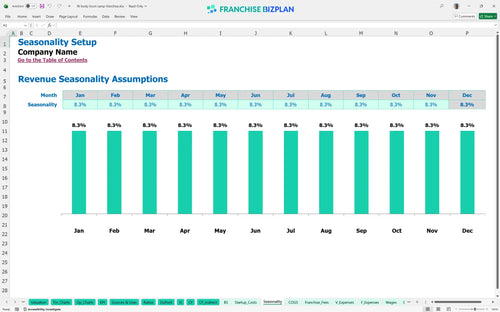
Researched revenue assumptions
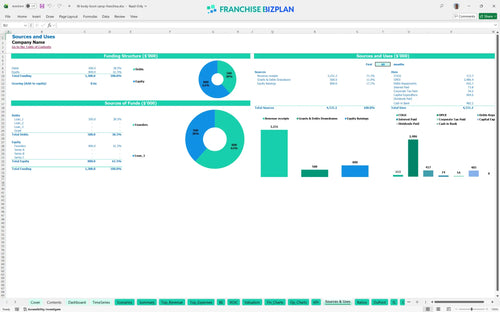
Lender-friendly financial outputs
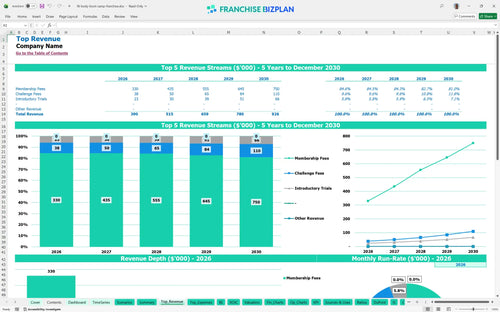
Revenue stream detailed view
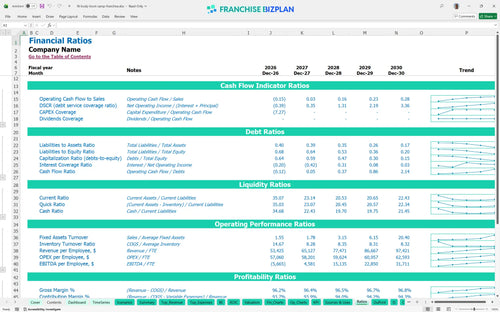
Performance metrics benchmark
We built this franchise unit financial model using our own research into boutique fitness economics. Key assumptions, including membership fees starting at $220,000 and a 5% royalty structure, are pre-populated and fully editable. This tool helps you see how a $390,000 year-one revenue target translates to actual cash in your pocket.
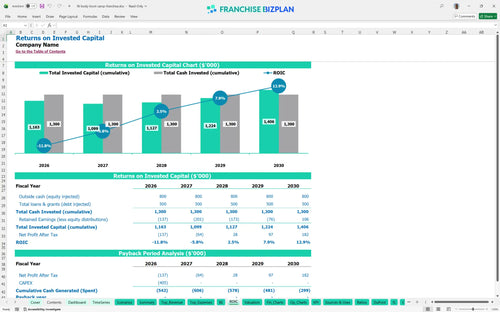
Based on our research, the unit hits its stride in year two with a $36,000 EBITDA after a $41,000 loss in the first year. By year five, the model projects a net profit of $301,000 as membership fees scale to $500,000 annually. Profit margin analysis for boutique gym franchise units shows that scaling the member base is the only way to offset the high fixed labor costs.
You will need roughly $404,600 to get the doors open, covering the $54,600 franchise fee and $95,000 for cardio and strength equipment. This fitness business plan assumes you have the liquidity to handle a $690,000 minimum cash requirement during the ramp-up phase. How to calculate startup costs for a fitness franchise becomes simple once you plug in these researched CAPEX figures.
The model shows a healthy 46% internal rate of return (IRR) and a 13% return on equity. While the initial investment is high, the cash flow matures significantly by year five, though full payback on the initial outlay defintely extends past the five-year mark. When you evaluate a fitness franchise investment, these long-term yields matter more than the first-year struggle.
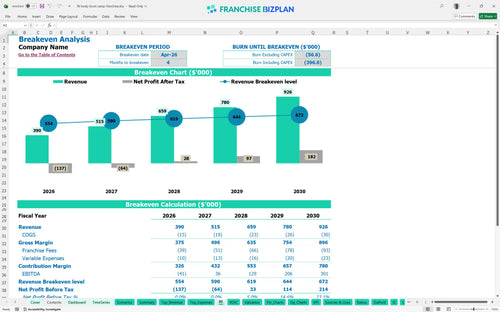
This unit is projected to reach its break-even date in April 2026, just 4 months after launch. The primary driver is membership volume, as fixed costs like the $5,500 prime location rent and $55,000 GM salary remain constant regardless of class size. A gym franchise revenue projection template helps you visualize how many members you need to cover that $1,100 utility bill.
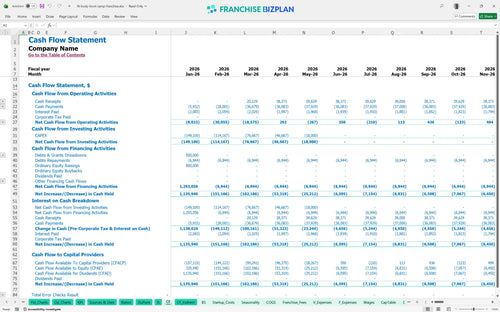
The lowest cash point occurs in January 2028, showing a need for $690,000 in total liquidity to weather the initial growth cycles. You need to maintain a solid buffer to handle the $10,400 monthly fixed overhead before the membership base fully matures. Startup budget for a HIIT studio franchise must account for these timing gaps between opening and peak enrollment.
Financial forecasting for new franchise owners must include variance; a 10% drop in membership fees can delay profitability by a full year. Conversely, hitting the high case through better local marketing execution can push year-5 revenue well past the $926,000 target and improve the 13% ROE. Still, the medium case remains the most realistic anchor for your bank loan application.
This fitness franchise financial model is built in Excel, giving you total control over every variable. You can swap out the pre-filled Mueller-specific rent or adjust the instructor headcount as your HIIT studio scales. It is a flexible tool designed to handle the messy reality of gym operations by allowing you to tweak every assumption to fit your specific territory.

Planning for a boutique gym requires looking past the grand opening. This model provides a 5-year roadmap, showing how revenue climbs from $390,000 in year one to $926,000 by year five. It maps out the transition from early-stage losses to a mature $301,000 EBITDA so you can plan for future equipment upgrades or territory expansion.

Fixed costs are only half the story; you need to account for the 5% royalty and 5% marketing fee taken right off the top. This template automates those calculations so you see the impact on your net margin. It defintely helps to know exactly how much goes to corporate before you pay your own light bill or payroll.

Launching a HIIT studio involves significant upfront capital, from the $54,600 franchise fee to $130,000 in leasehold improvements. This model includes a detailed break-even analysis to show you exactly when your membership dues cover these monthly obligations. Knowing your zero day is the best way to manage early-stage stress and investor expectations.

We have baked in realistic benchmarks for things like cleaning supplies (starting at 2.8% of revenue) and payment processing fees (1.3%). These numbers let you compare your performance against industry standards for boutique fitness. If your utility bill hits $1,100, you will know if that is on par with other high-traffic urban locations.


Simply purchase and download the financial model template, then access it instantly using Microsoft Excel or Google Sheets. No installation or technical expertise required-just open and start working.

Enter your business-specific numbers, including revenue projections, costs, and investment details. The pre-built formulas will automatically calculate financial insights, saving you time and effort.

Leverage the investor-ready format to confidently showcase your financial projections to banks, franchise representatives, or investors. Impress stakeholders with clear, data-driven insights and professional reports.

Leverage the investor-ready format to confidently present your projections to banks, franchise representatives, or investors.