


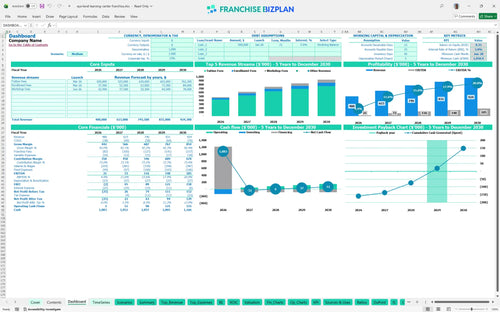
All-in-one Dashboard
Core inputs and core outputs



This comprehensive toolkit provides a professional-grade business valuation model and franchise unit operating budget template to help you navigate the financial complexities of a supplemental education business.
Core inputs and core outputs
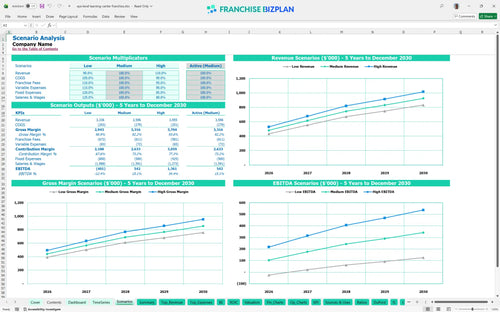
Three scenario analysis
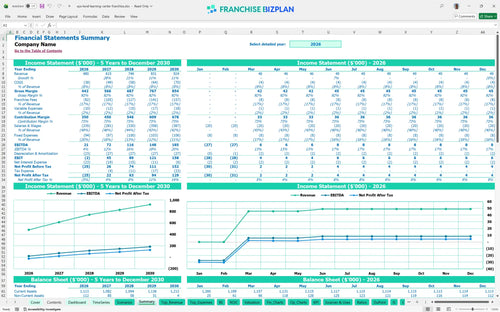
Presentation ready
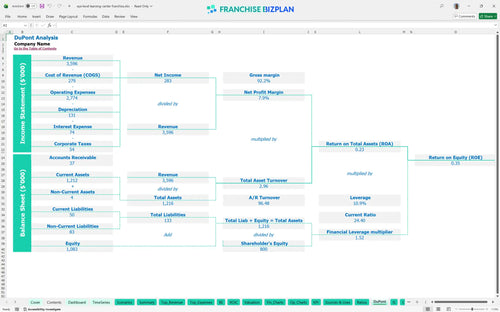
DuPont analysis
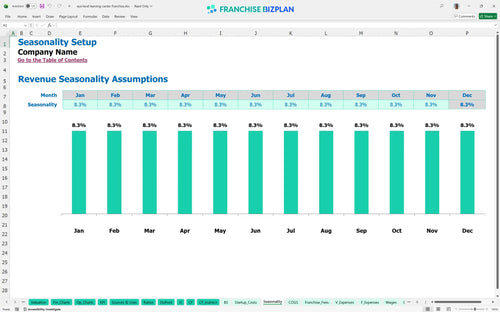
Researched revenue assumptions
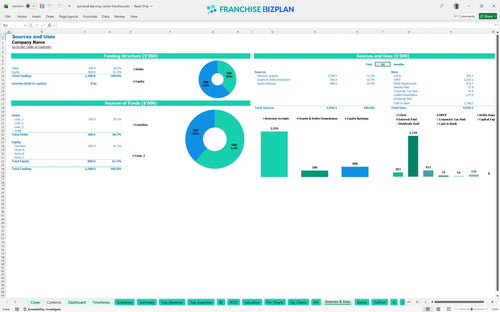
Lender-friendly financial outputs
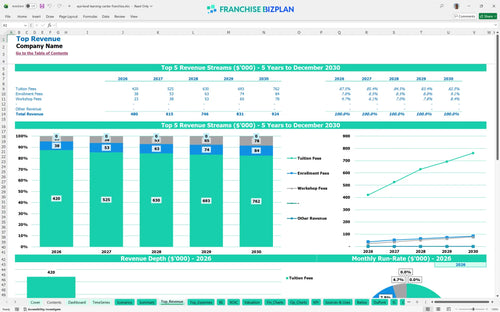
Revenue stream detailed view
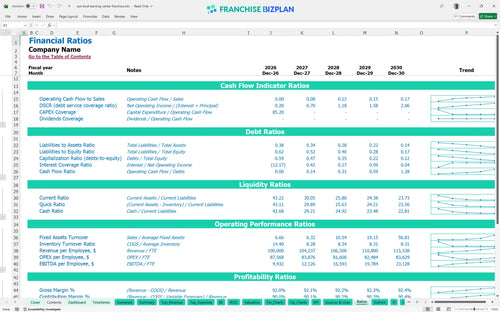
Performance metrics benchmark
We built this franchise unit financial model using our own research into the supplemental education sector. Key assumptions like the $280,000 initial tuition revenue and the 15% royalty are pre-populated with researched data specific to this tutoring center franchise unit and are fully editable. This model helps you visualize how a Year 5 EBITDA (earnings before interest, taxes, depreciation, and amortization) of $185,000 is achievable through disciplined local marketing and staff management.
The unit reaches profitability in its first year, showing an EBITDA of $21,000. By Year 3, net profit scales significantly to $116,000 as enrollment fees and workshop revenue grow. Honestly, the trajectory depends on maintaining high student retention to offset the 15% royalty burden. High retention is the engine of this model.
You will need approximately $135,000 to launch, covering the franchise fee and significant leasehold improvements. This excludes the minimum cash buffer of $1,051 required to maintain operations during the ramp-up phase. Here's the quick math: leasehold and equipment alone account for nearly $80,000 of your startup capital requirements. Don't underestimate the cost of a distraction-free environment.
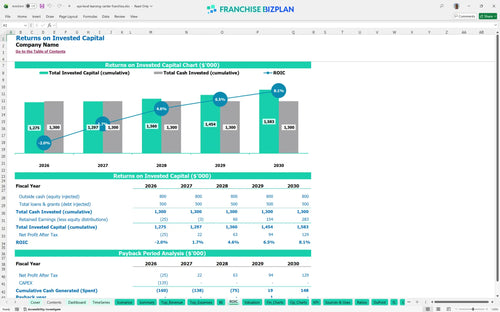
The model projects a 3.02% IRR (internal rate of return) and a return on equity of 0.35. The total payback period is estimated at 4 years, which is standard for a brick-and-mortar educational service business. Still, your return on investment calculation for learning center franchise depends heavily on Year 4 and 5 performance. Patience is a requirement for this asset class.
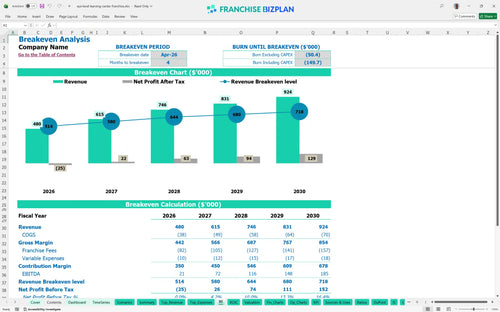
The center hits its monthly break-even point in April 2026, just 4 months after launch. The primary driver for this is reaching a critical mass of monthly tuition fees to cover the $5,200 rent and over $16,000 in monthly base salaries. A monthly operating expense tracker for tutoring business will help you keep these fixed costs in check. Speed to break-even determines your ultimate survival.
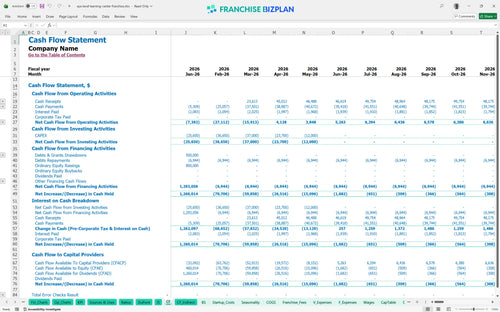
The lowest cash point occurs in January 2028, suggesting you need a solid working capital reserve. While the model shows a minimum cash of $1,051, we recommend a larger buffer to handle slower-than-expected enrollment. If opening takes 90+ days longer than planned, working capital pressure rises fast. Cash is your only safety net during the ramp-up.
Moving from a medium to a high scenario significantly boosts the Year 1 margin and shortens the payback period. How to create a business plan for a supplemental education center becomes much easier when you can toggle between these cases. It's about local execution and throughput at the center. Small wins in retention lead to big gains in equity.
Finance: update unit break-even and payback model by Friday.
This franchise financial model template is fully customizable in Excel, with pre-filled formulas and editable assumptions that make it easy to adapt to your specific territory. You can adjust tuition fees, enrollment numbers, and staffing levels to see how they impact your bottom line. It defintely helps you build a solid educational franchise business plan without starting from scratch. One-point margin shifts in labor or supplies can change everything.

Planning for the long term is vital when estimating revenue for a new learning center. This model provides a detailed 5-year franchise P&L statement (profit and loss), balance sheet, and cash flow view. With Year 1 revenue starting at $480,000 and scaling to $924,000 by Year 5, you can track how operational expenses analysis impacts your long-term wealth. Growth depends on steady enrollment, not just a big launch.

This tool handles the heavy lifting of calculating a 15% royalty and 2% marketing fund contribution. These ongoing costs are baked into the tutoring center franchise profitability analysis so you see the net cash remaining after corporate obligations. Understanding these fees is key to a realistic tutoring business financial projections. The franchisor takes their cut before you pay your rent.

Use this franchise investment calculator to determine how to calculate startup costs for a tutoring franchise. It covers everything from the $10,000 franchise fee to the $60,000 leasehold improvements required for a premium facility. The model shows you exactly when you hit the break-even point, which is projected for April 2026 in this scenario. Knowing your total cash out the door prevents mid-project stalls.

We included benchmarks for things like instructional materials at 6% of revenue and monthly rent at $5,200. This allows you to compare your spreadsheet for franchise unit financial planning against typical education center standards. It ensures your financial forecasting for education franchise owners stays grounded in reality. If your labor costs exceed 30%, your margin will disappear quickly.


Simply purchase and download the financial model template, then access it instantly using Microsoft Excel or Google Sheets. No installation or technical expertise required-just open and start working.

Enter your business-specific numbers, including revenue projections, costs, and investment details. The pre-built formulas will automatically calculate financial insights, saving you time and effort.

Leverage the investor-ready format to confidently showcase your financial projections to banks, franchise representatives, or investors. Impress stakeholders with clear, data-driven insights and professional reports.

Leverage the investor-ready format to confidently present your projections to banks, franchise representatives, or investors.