


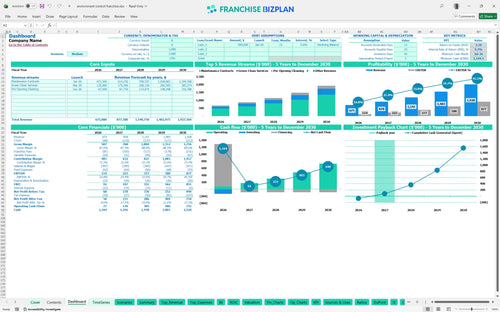
All-in-one Dashboard
Core inputs and core outputs



This Excel template for franchise unit financial planning provides a complete roadmap for a cleaning unit, covering everything from initial van purchases to five-year EBITDA projections and cash flow management.
Core inputs and core outputs
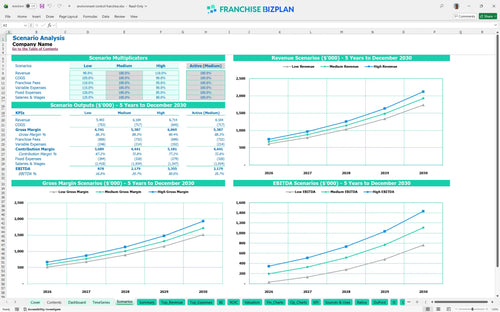
Three scenario analysis
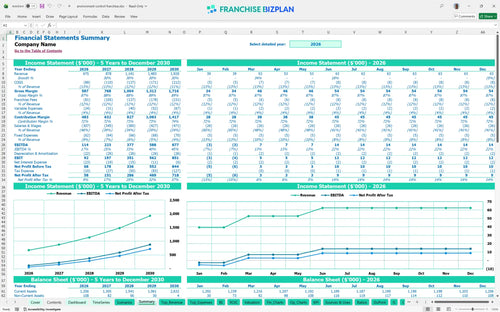
Presentation ready
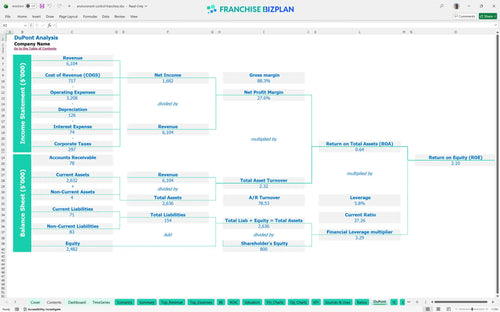
DuPont analysis
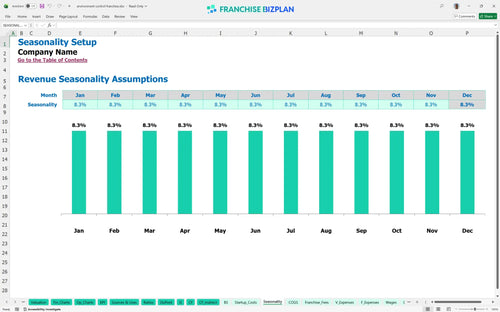
Researched revenue assumptions
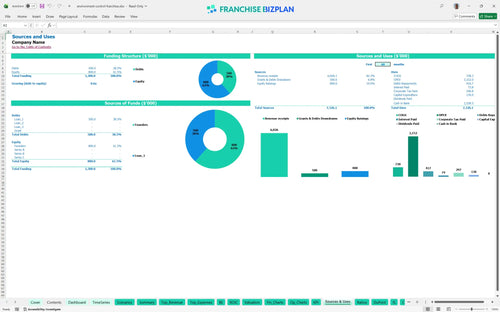
Lender-friendly financial outputs
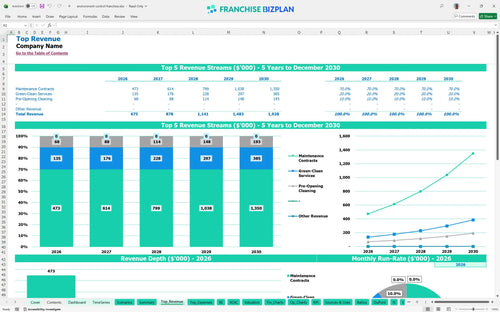
Revenue stream detailed view
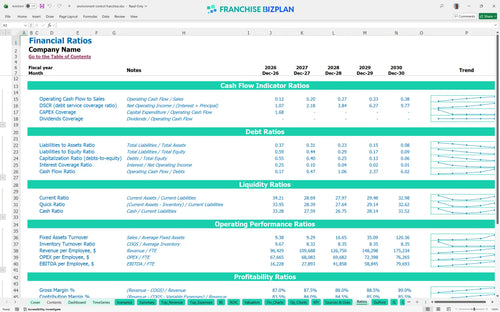
Performance metrics benchmark
We built this financial model using our own research into the commercial cleaning sector to provide accurate financial projections for commercial janitorial services. Key assumptions like the $315,000 starting revenue for maintenance contracts and the 12% total royalty burden are pre-populated and fully editable. With a projected year-two EBITDA of $223,000, this model gives you a realistic look at how the numbers actually move in a high-demand market.
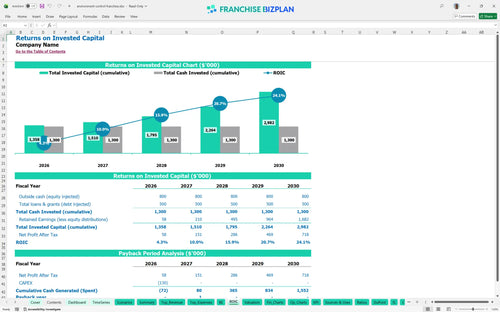
This unit hits profitability almost immediately, reaching break-even in January 2026, just one month after launch. By year two, net profit grows significantly as revenue climbs to $878,000 while assessing profitability of a franchise unit involves managing chemicals and supplies at 12.5% of sales. With a 2-year payback period, you are recovering your initial $130,000 investment faster than many retail concepts.
You need $130,000 in startup capital requirements to cover the initial build-out and equipment for this cleaning concept. This includes the $30,000 franchise fee and $45,000 for your fleet of commercial vans, plus startup costs for a LEED-certified cleaning franchise often require extra for specialized equipment. You will also need to account for the $1.145 million minimum cash requirement to handle the ramp-up and working capital needs.
Investors can expect an Internal Rate of Return (IRR) of 9.7% and a Return on Equity (ROE) of 2.1 based on this franchise unit financial feasibility study. The franchise ROI calculation shows a solid 2-year payback period, which is quite strong for a service business. What this estimate hides is the potential for higher returns if you can scale the cleaning crew faster than the projected one-person-per-year increase.
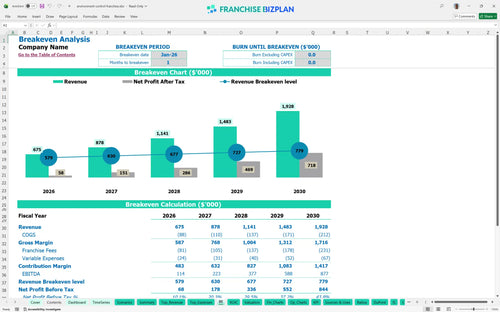
The unit reaches break-even in its very first month, January 2026, due to revenue forecasting for commercial maintenance contracts starting at $315,000. This provides a steady base of recurring revenue to cover the $5,700 monthly management salary burden and the 12% combined royalty and marketing fees. You must manage these fixed costs tightly to ensure the first-month break-even target is met.
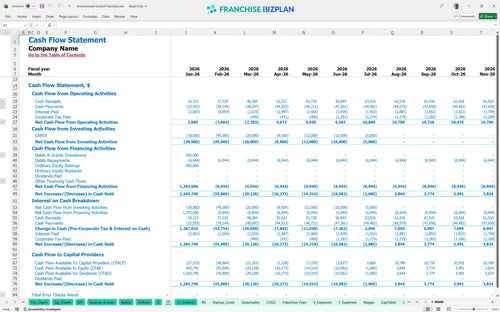
Your small business cash flow projection shows the lowest cash point occurs in July 2026, with a minimum cash balance of $1,145,000. This suggests you need a significant capital cushion to navigate the first six months of operations as you scale the cleaning crew and office setup. If hiring the sales manager or operations director happens sooner than planned, your working capital pressure will rise.
When learning how to create a financial model for a cleaning franchise, you see that hitting $1.9 million in revenue by year five pushes EBITDA to $877,000. A low scenario would likely see the 2-year payback period stretch out if maintenance contract growth slows or if operating expense forecasting for fuel exceeds the 2.5% estimate. Still, the model shows the unit remains viable if you maintain high labor productivity.
Finance: update unit break-even and payback model by Friday.
This franchise financial model template lives in Excel, so you can tweak every assumption to fit your specific territory. It comes with pre-filled formulas for three revenue streams-maintenance contracts, green-clean services, and pre-opening agreements-allowing you to adjust pricing and volume as you scale. Honestly, the best part is that the math is already done; you just need to plug in your local market data.

Planning for commercial cleaning franchise startup costs requires a long-term view of how margins shift as you grow from $675,000 in year one to over $1.9 million by year five. This model tracks your total janitorial franchise business plan, including EBITDA growth from $114,000 to $877,000. It defintely helps you see the impact of scaling your cleaning crew from 4 to 8 full-time employees over the five-year period.

This tool handles the heavy lifting of calculating your franchise royalty fee structure, which totals 12% of gross sales between the 6% royalty and 6% marketing fee. At $1.14 million in year three revenue, that is $136,920 leaving the business before you pay for labor or rent. Tracking these obligations ensures your franchise investment financial analysis reflects the real cash remaining for the owner.

Calculating break-even point for a service-based franchise is simpler when you map out the $130,000 in initial capital needs, including the $30,000 franchise fee and $45,000 for commercial vans. With fixed costs like $2,800 for warehouse rent and $5,700 in monthly management salaries, you need to know exactly when the cash starts flowing back. The model shows a fast break-even by January 2026 if you hit your targets.

We included benchmarks for cleaning service franchise profitability to help you sanity-check your cleaning chemical costs, which start at 11% of revenue. Financial planning for new franchise owners is risky without knowing if your 2.5% fuel expense or 1% subcontractor fee is in line with industry standards. These guardrails help you spot margin leaks before they become permanent problems in your unit economics.


Simply purchase and download the financial model template, then access it instantly using Microsoft Excel or Google Sheets. No installation or technical expertise required-just open and start working.

Enter your business-specific numbers, including revenue projections, costs, and investment details. The pre-built formulas will automatically calculate financial insights, saving you time and effort.

Leverage the investor-ready format to confidently showcase your financial projections to banks, franchise representatives, or investors. Impress stakeholders with clear, data-driven insights and professional reports.

Leverage the investor-ready format to confidently present your projections to banks, franchise representatives, or investors.