


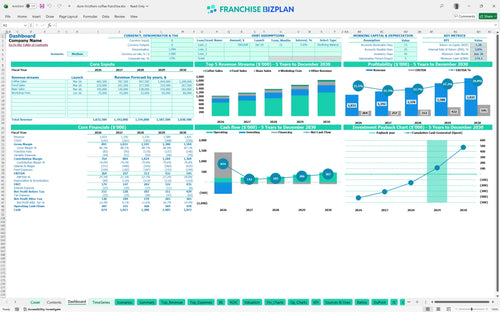
All-in-one Dashboard
Core inputs and core outputs



This template provides a comprehensive coffee franchise unit operating cost breakdown, covering everything from roasting equipment depreciation to multi-lane labor scheduling.
Core inputs and core outputs
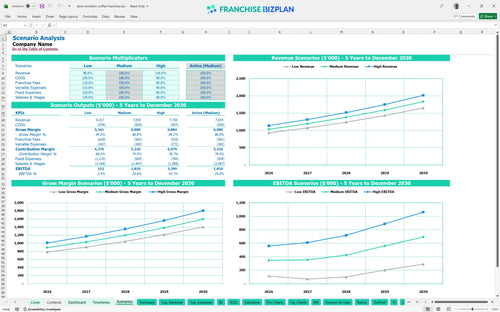
Three scenario analysis
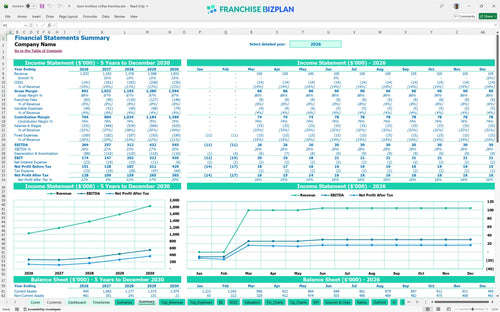
Presentation ready
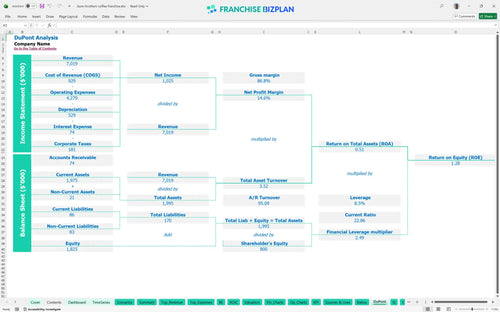
DuPont analysis
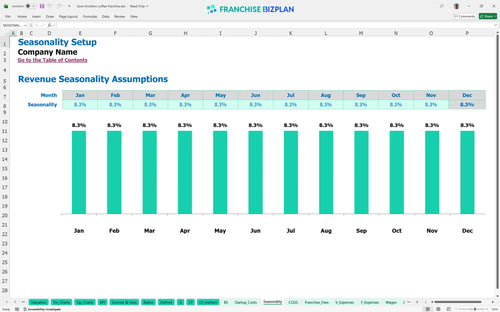
Researched revenue assumptions
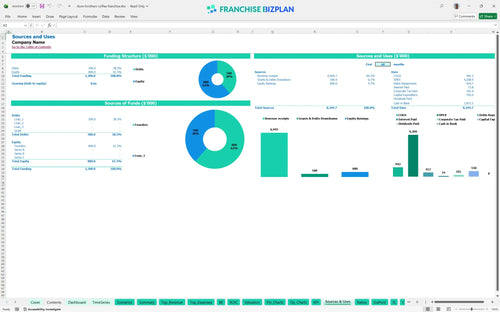
Lender-friendly financial outputs
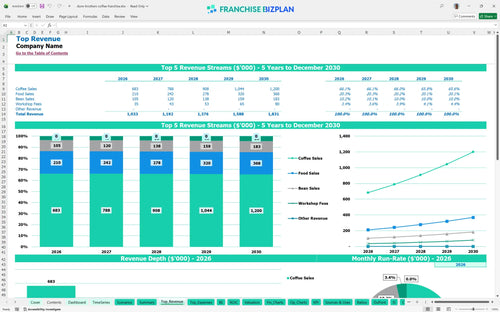
Revenue stream detailed view
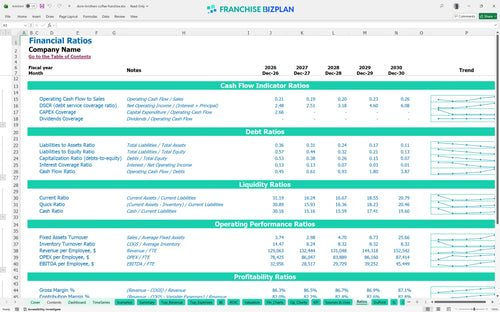
Performance metrics benchmark
We built this financial model for a specialty coffee shop franchise using detailed research into unit-level performance and roasting economics. The model comes pre-populated with a $1.03M year-one revenue target and a $264,000 EBITDA estimate, all of which you can edit to fit your specific site. It covers everything from the $95,000 roasting station investment to the 8% total brand fee burden.
The unit reaches profitability in Year 1, specifically hitting its monthly break-even point by March 2026. After accounting for the 5% royalty, 3% marketing fee, and $9,500 monthly rent, the model shows an EBITDA of $264,000 in the first full year. Here's the quick math: with small business coffee roasting equipment costs already factored in, your margin improves as you scale bean sales and workshop fees.
You will need approximately $550,000 in total CAPEX to launch this unit in the US, plus a working capital buffer. The budget is heavily weighted toward leasehold improvements at $220,000 and specialized roasting equipment at $95,000. This detailed startup budget for premium coffee cafe franchise units ensures you don't overlook the $40,000 initial fee or the $35,000 signage costs.
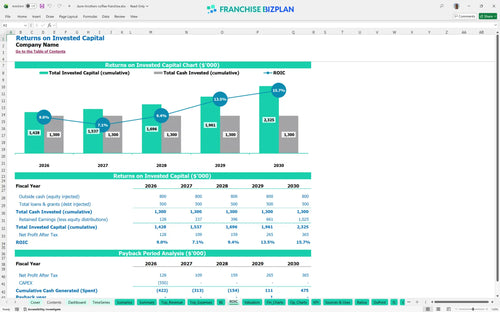
Investors can expect a 4-year payback period and an Internal Rate of Return (IRR) of 3.81% based on the current growth trajectory. The Return on Equity (ROE) sits at 1.28, which is defintely a solid baseline for a single-unit operator. This coffee franchise ROI assessment for new locations shows that while the initial spend is high, the cash flow matures significantly by year four.
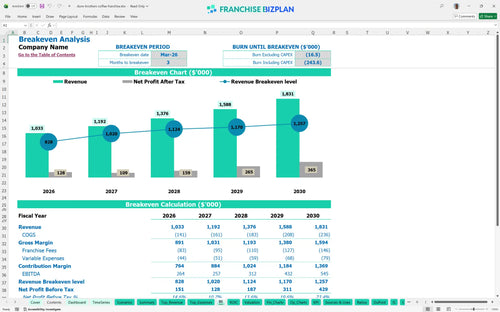
The monthly break-even point is achieved just 3 months after the March 2026 launch. The biggest pressure on your break-even is the franchise unit lease and labor cost budgeting, specifically the $9,500 rent and the $237,000 initial annual management payroll. To hit this faster, you must maximize the $455,000 projected year-one coffee sales through high-traffic periods.
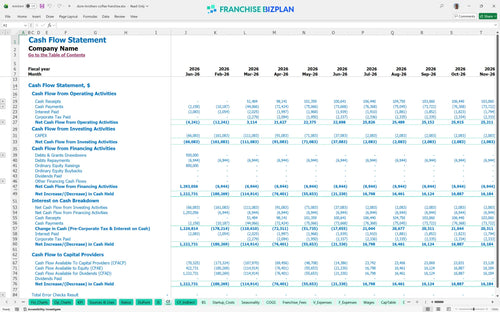
The lowest cash point occurs in June 2026 at $774,000, which includes your initial investment and early operating losses. Predicting coffee shop revenue from mobile pickup windows is vital here to ensure you don't dip below your minimum cash requirements during the ramp-up. You need at least six months of runway to handle the timing gaps between opening and mature-unit performance.
Financial planning for independent coffee roasting franchise units requires looking at Low, Medium, and High cases. A 10% drop in coffee sales significantly delays the 4-year payback, while the High case sees year-one EBITDA climb well above $264,000. Managing your labor-to-revenue ratio is the most effective way to shift from a Medium to a High performance scenario.
Finance: update unit break-even and payback model by Friday.
This coffee franchise financial model is built in Excel with a focus on user control. You can adjust every driver, from daily transaction counts to specific bean costs, ensuring the tool matches your specific territory and local market conditions. It is a fully editable franchise unit business plan template that removes the guesswork from complex spreadsheet logic.

Planning for a single unit requires a multi-year view to understand when you can actually take cash out of the business. This model provides 5-year projections for revenue, expenses, and cash flow, helping you see the jump from $1.03M in year one to over $1.83M by year five. It is the standard for any coffee shop startup costs Excel tool used by serious operators.

Franchise-specific costs like the 5% royalty and 3% marketing fund are hardcoded into the logic to ensure your store-level EBITDA is realistic. At $1.03M in annual sales, these fees total over $82,000, which is a significant chunk of your operating margin. This franchise investment analysis ensures you see the net profit after all brand obligations are met. Every 1-point margin leak matters fast in this model.

The model breaks down the $550,000 initial capital requirement, including the $40,000 franchise fee and $220,000 for leasehold improvements. By mapping these coffee shop startup costs Excel against your projected ramp-up, the tool identifies exactly when your monthly sales cover both fixed and variable costs. Knowing your break-even point is the difference between a controlled launch and a cash crisis.

We have integrated coffee franchise profitability calculator benchmarks for labor, rent, and COGS (Cost of Goods Sold) to keep your plan grounded. For instance, if your rent at $9,500 a month exceeds 10% of your revenue, the model flags the potential strain on your bottom line. These benchmarks help you sanity-check your Boise or local market assumptions against national averages.


Simply purchase and download the financial model template, then access it instantly using Microsoft Excel or Google Sheets. No installation or technical expertise required-just open and start working.

Enter your business-specific numbers, including revenue projections, costs, and investment details. The pre-built formulas will automatically calculate financial insights, saving you time and effort.

Leverage the investor-ready format to confidently showcase your financial projections to banks, franchise representatives, or investors. Impress stakeholders with clear, data-driven insights and professional reports.

Leverage the investor-ready format to confidently present your projections to banks, franchise representatives, or investors.