


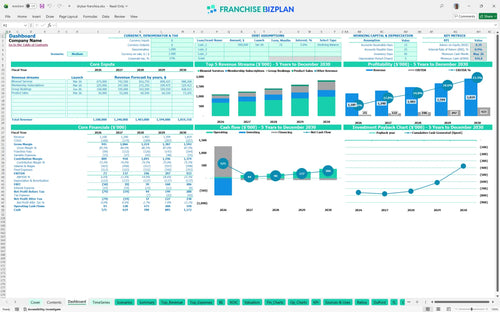
All-in-one Dashboard
Core inputs and core outputs



This Excel template for franchise unit financial forecasting provides a complete toolkit for projecting revenue, expenses, and cash flow for a premium salon.
Core inputs and core outputs
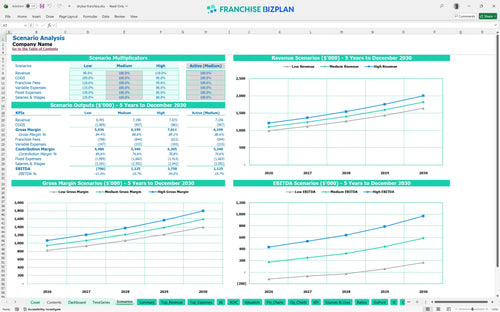
Three scenario analysis
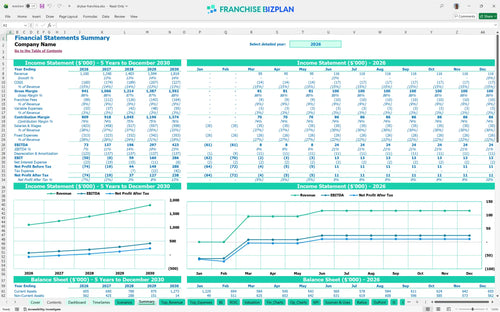
Presentation ready
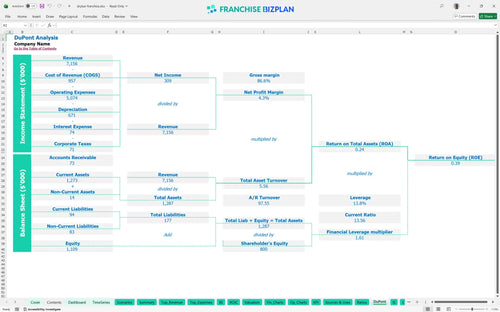
DuPont analysis
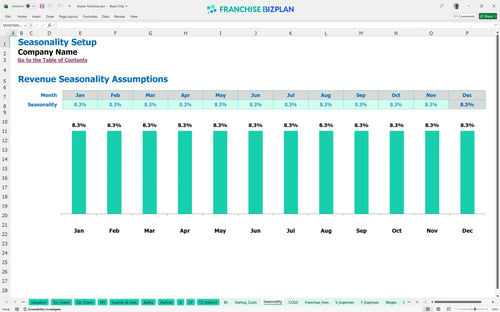
Researched revenue assumptions
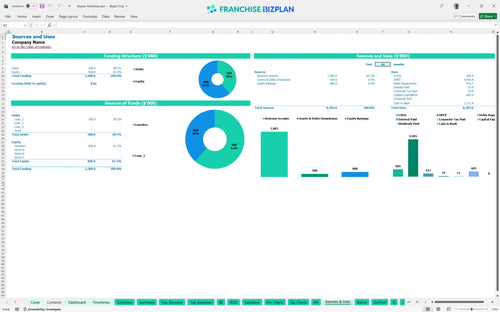
Lender-friendly financial outputs
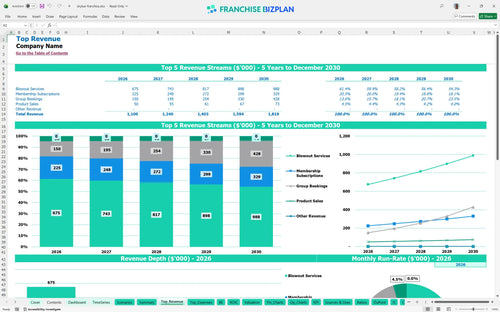
Revenue stream detailed view
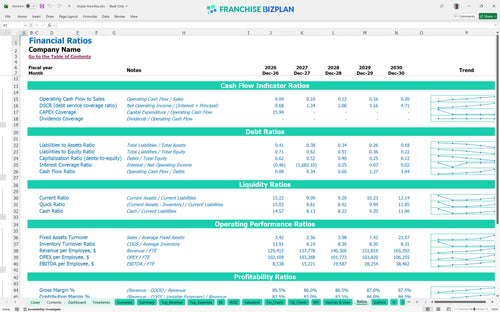
Performance metrics benchmark
We built this franchise unit financial model using our own research into premium blowout salon economics. Key assumptions like the $1.1M year-one revenue target and the $18,000 monthly rent are pre-populated but fully editable to fit your specific market. This tool helps you move past the pro-forma fluff and see the actual cash flow mechanics of a high-end service unit.
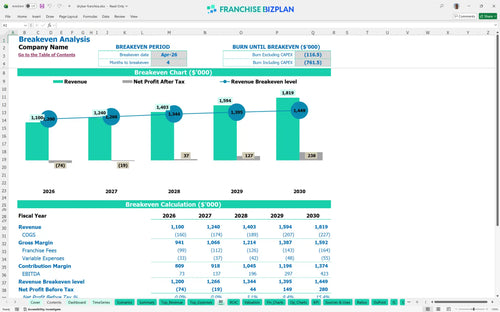
You can expect the unit to hit monthly break-even by April 2026, roughly four months after launch. While year-one EBITDA is modest at $73,000, the model shows a steep climb to $423,000 by year five as membership subscriptions and group bookings scale. Net profit accounts for the 7% royalty and 2% marketing fees, plus the heavy $18,000 monthly rent burden. Profitability in this model is defintely tied to maximizing stylist utilization during peak weekend hours.
Launching this unit requires a total initial investment of approximately $685,000 based on the CAPEX and pre-opening needs. This covers the $50,000 franchise fee, $300,000 for leasehold improvements, and $175,000 for chairs and styling equipment. You also need to account for $30,000 in initial inventory and a healthy cash buffer to handle the first few months of operations. Sources usually include a mix of personal equity and SBA financing to cover these heavy upfront costs.
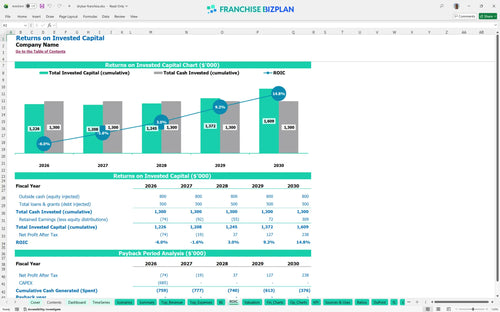
The model projects an Internal Rate of Return (IRR) of 0.93 and a Return on Equity (ROE) of 0.39. While the cash flow is strong by year three, the high initial build-out costs mean the full payback period extends past the five-year mark. This is a long-term play focused on building a monthly recurring revenue model for salon franchises rather than a quick flip. Investors should focus on the growing EBITDA margin, which climbs from 6.6% in year one to over 23% by year five.
Your monthly break-even sits around $85,000 in revenue to cover fixed costs like the $18,000 rent and the $23,000+ monthly management and stylist payroll. The biggest lever here is blowout volume; since labor is your largest variable cost, keeping chairs full is the only way to outrun the high occupancy expense. If you can't hit 20+ blowouts per day per station, the margin gets thin very fast. Every empty chair hour is a permanent loss of high-margin service revenue.
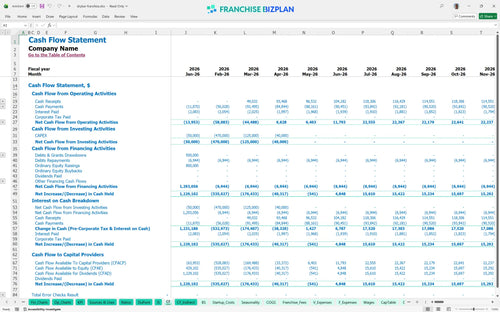
The lowest cash point occurs in May 2026, with a minimum cash balance of $477,000 projected if you start with full funding. This indicates you need a significant working capital cushion to survive the build-out and the first 60 days of slow traffic. If your leasehold improvements go $50,000 over budget or the city delays your permits, that runway disappears quickly. Still, the retail franchise cash flow projection template shows the business becomes self-sustaining shortly after the break-even date.
Evaluating franchise unit economic viability requires looking at more than just the sunny day forecast. A High scenario-driven by better local marketing execution and higher average tickets-can pull the payback period into year four. Conversely, a Low scenario where labor costs spike or membership churn is high could see year-one EBITDA turn negative. The model allows you to stress-test your salon franchise startup cost breakdown against a 10-15% drop in volume. Honestly, the downside case is where you learn if the business is actually resilient.
Finance: update unit break-even and payback model by Friday
This franchise financial model template is built in Excel, allowing you to swap out every assumption to match your specific territory. Whether you are adjusting for local labor rates or high-traffic mall rent, the pre-filled formulas handle the heavy lifting. You can edit everything from stylist commission structures to local marketing spend to see how it hits your bottom line. It's basically a sandbox for your business plan.

Long-term planning is about more than just surviving year one; it's about mapping out a salon franchise business plan that scales. This model provides a detailed 5-year outlook on revenue, cash flow, and net profit. By year five, the data suggests potential revenue reaching $1.8M, but getting there requires managing the ramp-up phase carefully. You'll see exactly how your balance sheet evolves as you pay down initial debt and build equity. Success here is a marathon, not a sprint.

Operating within a system means you have non-negotiable costs like a 7% royalty fee structure and a 2% brand marketing fund. This model bakes those into your monthly franchise P&L statement (Profit and Loss statement) so there are no surprises. At $1.1M in year-one sales, you are looking at roughly $99,000 in total fees paid back to the franchisor. Understanding these recurring costs is vital for evaluating franchise unit economic viability before you sign the agreement.

Planning startup capital for a premium salon franchise requires a deep dive into leasehold improvements and equipment. With a $50,000 initial fee and $300,000 for build-out, your upfront capital expenditure budget is significant. The model helps you find the exact month where your blowout volume covers your $18,000 monthly rent and $30,000+ in monthly wages. Knowing your break-even sales level helps you manage the 'valley of death' during the first few months of operation.

Don't guess if your 12% hair product cost is too high; use the built-in industry benchmarks to verify your beauty franchise startup costs. The model includes typical ranges for labor, rent, and COGS (Cost of Goods Sold) so you can spot margin leaks early. If your stylist wages exceed 35% of revenue, you know you have a scheduling or productivity issue. It's a reality check that ensures your franchise investment analysis spreadsheet stays grounded in real-world salon data.


Simply purchase and download the financial model template, then access it instantly using Microsoft Excel or Google Sheets. No installation or technical expertise required-just open and start working.

Enter your business-specific numbers, including revenue projections, costs, and investment details. The pre-built formulas will automatically calculate financial insights, saving you time and effort.

Leverage the investor-ready format to confidently showcase your financial projections to banks, franchise representatives, or investors. Impress stakeholders with clear, data-driven insights and professional reports.

Leverage the investor-ready format to confidently present your projections to banks, franchise representatives, or investors.