


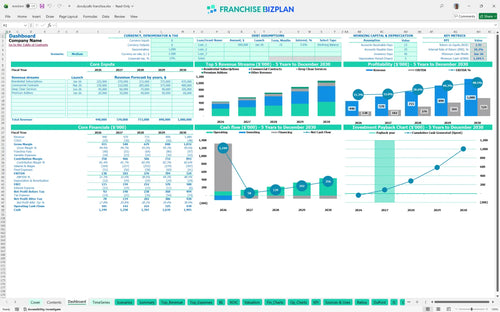
All-in-one Dashboard
Core inputs and core outputs



This comprehensive Excel template provides a complete financial roadmap for a pet waste removal franchise, covering everything from initial vehicle acquisition to five-year EBITDA projections.
Core inputs and core outputs
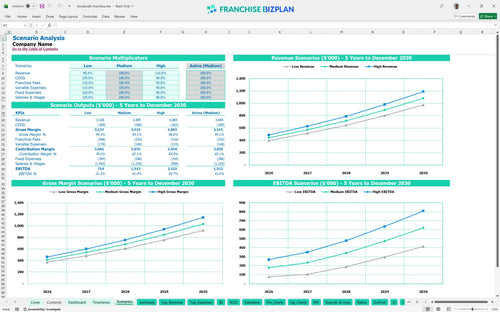
Three scenario analysis
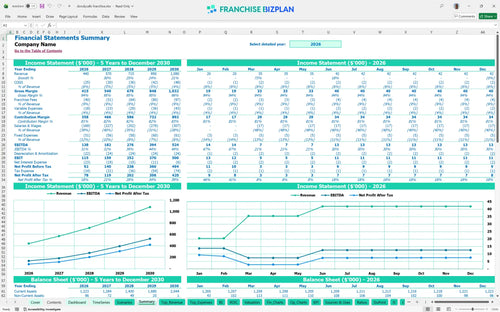
Presentation ready
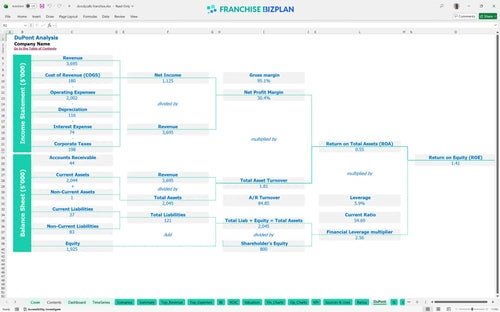
DuPont analysis
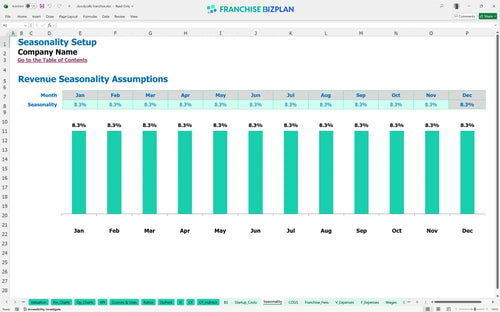
Researched revenue assumptions
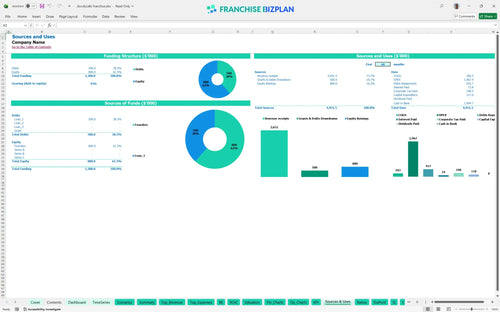
Lender-friendly financial outputs
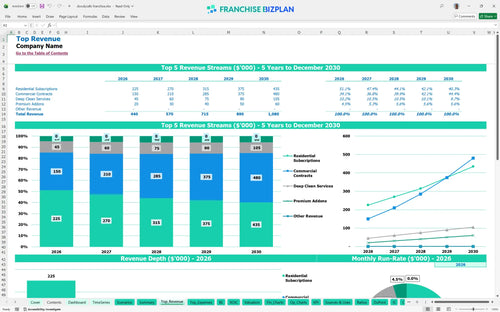
Revenue stream detailed view
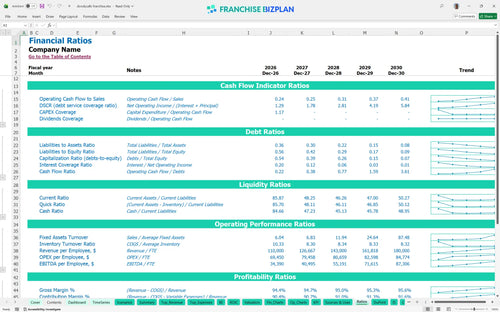
Performance metrics benchmark
We built this pet waste removal franchise financial model using our own research to ensure every assumption is grounded in reality. Key drivers like residential subscriptions, commercial contracts, and vehicle expenses are pre-populated with researched data and are fully editable to fit your market. With a projected year-one revenue of $440,000 and an EBITDA of $138,000, this model gives you a professional starting point for your business planning.
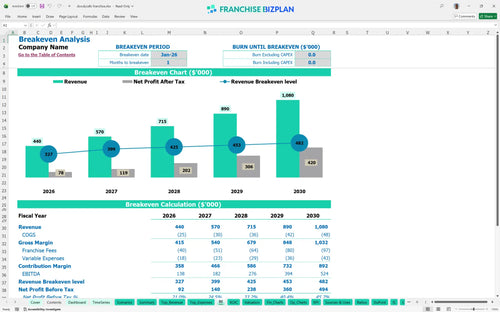
You can expect this unit to hit its stride quickly, with the franchise profitability analysis Excel showing a break-even date as early as January 2026. By year three, EBITDA is projected to reach $276,000 after accounting for all royalties and the 1.5% marketing fee. Profitability depends on scaling your residential subscriptions and keeping a tight lid on fuel and vehicle costs.
Launching this unit requires an initial investment covering the $39,900 franchise fee and $56,000 for the first two service vehicles. You also need to account for tools, office setup, and an initial marketing push of $5,000 to build local density. This pet waste removal business financial plan ensures you have enough capital to cover all pre-opening costs and initial working capital.
Investors can look forward to an Internal Rate of Return (IRR) of 10.17% and a Return on Equity (ROE) of 1.41. Calculating ROI for mobile pet service franchises is simple here, with a payback period estimated at 2 years. These metrics reflect a healthy recurring revenue stream that builds significant value over a five-year period for new franchise owners.
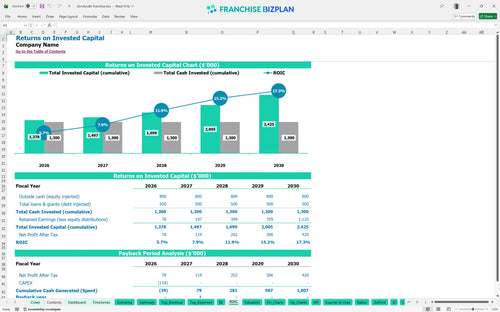
The small business financial model for waste management services indicates a 1-month path to break-even, meaning your revenue covers fixed costs almost immediately. This is driven by the low overhead of a mobile model, though your $2,000 monthly rent and $60,000 manager salary are the biggest hurdles. Success relies on hitting your initial residential subscription targets of $150,000 in the first year.
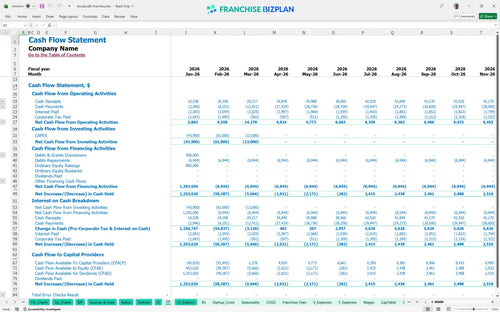
Your lowest cash point is projected to be $1,184,000 in June 2026, suggesting a significant need for a large initial reserve. While the business breaks even fast, the timing of vehicle payments and staffing hires creates a dip in liquidity. You should defintely keep a close eye on your small business cash flow statement to avoid a squeeze during the ramp-up phase.
Moving to a high-growth scenario can push your year-5 revenue well past the $1.08 million mark using this recurring revenue business model. In a low-growth case, your EBITDA might dip, but the 7.5% royalty remains a fixed percentage of whatever you bring in. Operating expense forecasting helps you see how a 10% drop in residential demand affects your ability to fund the next service vehicle.
This pet waste removal franchise financial model lives in Excel, so you can tweak every variable to match your specific territory. Whether you are adjusting the number of service technicians or changing disposal supply costs, the pre-filled formulas handle the heavy lifting. It is a living document that grows with your multi-unit ambitions or single-territory focus, making it the perfect Excel template for franchise financial forecasting.

Mapping out a five-year horizon is essential for understanding how your franchise unit financial projections template scales from $440,000 in year one to over $1 million by year five. This model tracks your climb, accounting for the ramp-up in commercial contracts and estimating recurring revenue for residential pet services. You get a clear view of how your balance sheet and cash flow evolve as you add more service vehicles to the fleet.

Operating under a brand means managing specific obligations like a 7.5% royalty and a 1.5% marketing fund contribution. This franchise business plan financial spreadsheet automatically calculates these fees against your projected revenue streams so you know exactly what hits the bottom line. It covers the initial $39,900 fee and ongoing franchise royalty fee calculation to ensure your store-level margin remains healthy after brand contributions.

Starting a mobile service business requires upfront capital for vehicles, equipment, and initial marketing. With a two-year payback period, you need to see how pet services franchise startup costs like $2,000 for office rent and $750 for vehicle insurance impact your early days. This analysis shows how to estimate startup costs for a pet waste removal franchise and the exact sales volume needed to cover your monthly overhead.

Use built-in benchmarks to see if your 3.8% waste disposal supply cost or your labor spend aligns with typical service-based franchise unit economics. These markers help you identify margin leaks early, such as fuel costs running higher than the projected 2.8%. It is a pet waste removal service profit margin analysis that ensures your financial plan stays grounded in the actual experience of successful operators.


Simply purchase and download the financial model template, then access it instantly using Microsoft Excel or Google Sheets. No installation or technical expertise required-just open and start working.

Enter your business-specific numbers, including revenue projections, costs, and investment details. The pre-built formulas will automatically calculate financial insights, saving you time and effort.

Leverage the investor-ready format to confidently showcase your financial projections to banks, franchise representatives, or investors. Impress stakeholders with clear, data-driven insights and professional reports.

Leverage the investor-ready format to confidently present your projections to banks, franchise representatives, or investors.