


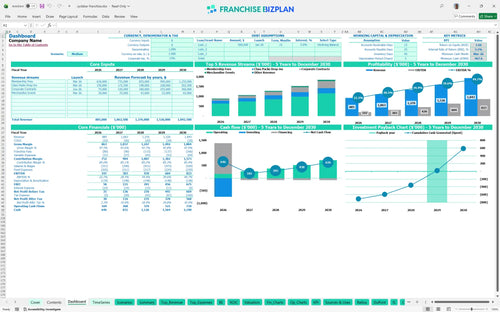
All-in-one Dashboard
Core inputs and core outputs



This franchise unit financial projections template for entrepreneurs provides a comprehensive Excel-based framework to forecast revenue, manage expenses, and calculate investment returns for a boutique fitness studio.
Core inputs and core outputs
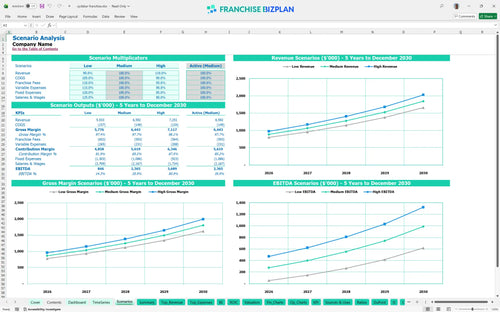
Three scenario analysis
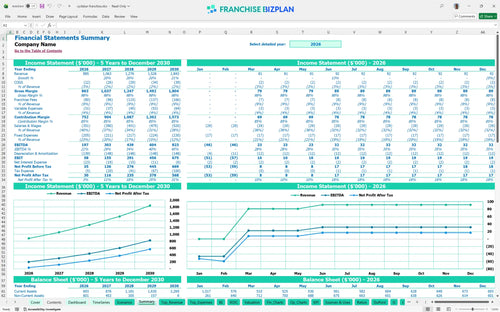
Presentation ready
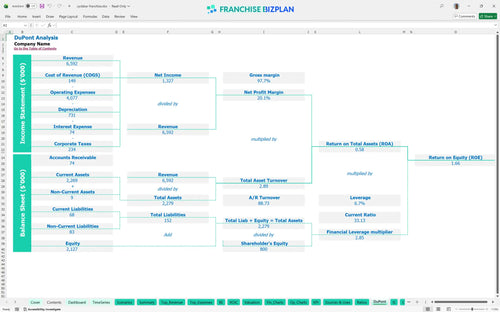
DuPont analysis
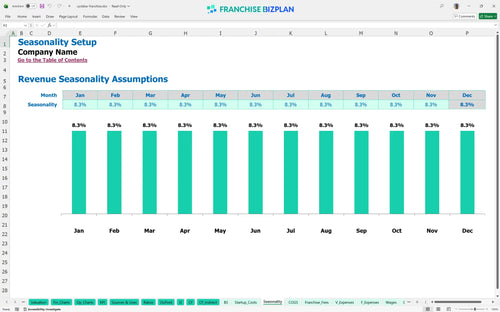
Researched revenue assumptions
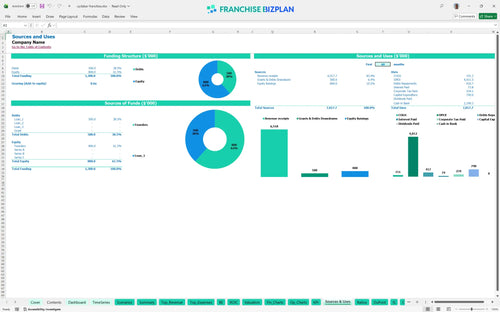
Lender-friendly financial outputs
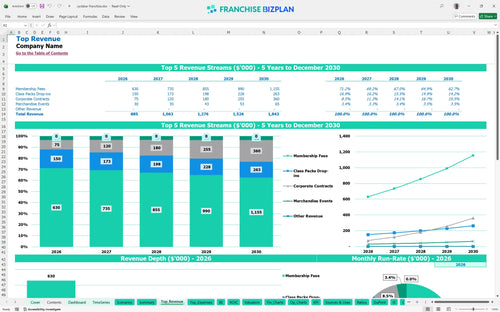
Revenue stream detailed view
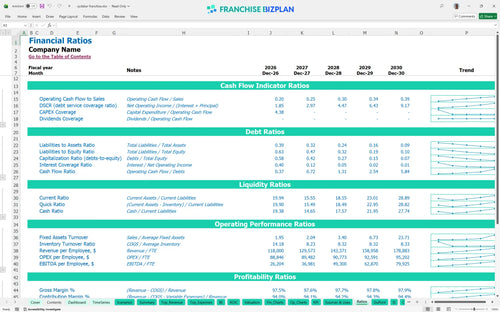
Performance metrics benchmark
We built this boutique fitness franchise profitability analysis Excel model using our own research into the indoor cycling industry. Key assumptions like the $885,000 year-one revenue and $10,500 monthly rent are pre-populated with researched data and are fully editable to match your specific territory. This tool provides a clear look at how a $197,000 EBITDA is achieved through membership and class pack sales.
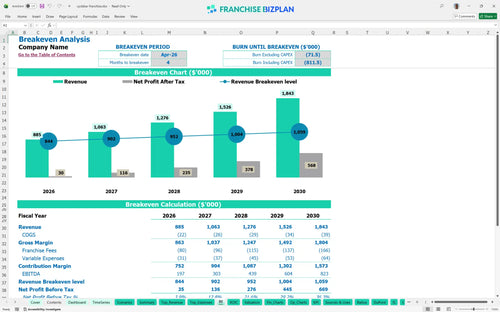
The studio reaches operational profitability by April 2026, just four months after the doors open. By year five, net profit scales significantly as revenue reaches $1.84 million, though you'll defintely need to manage the 7% royalty and 2% marketing fees that come off the top. Indoor cycling studio profit margins depend heavily on maintaining high class occupancy.
Launching this unit requires $740,000 in startup capital requirements to cover the $60,000 franchise fee and the $280,000 in leasehold improvements. This investment also includes $120,000 for spin bikes and $65,000 for the sound and lighting systems required to meet brand standards. Honestly, you need to have this liquidity ready before signing the lease.
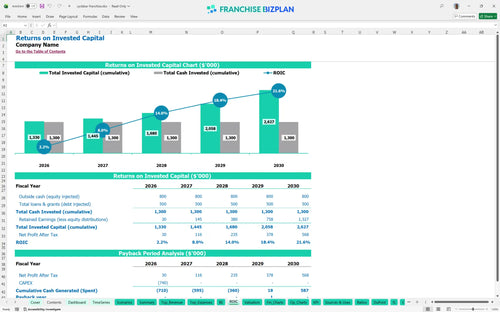
This fitness franchise investment analysis shows a 3.1% internal rate of return and a 1.66 return on equity over five years. With an ROI calculation for franchises showing a 4-year payback period, long-term wealth depends on growing the membership base to $770,000 in annual fees by 2030. Efficiency is the only way to protect your equity.
The break-even point is reached in April 2026, driven by a lean initial staffing model and strong early membership sales. Operational expense forecasting shows the biggest hurdle is the $10,500 monthly rent and the $13,333 monthly salary for the studio manager and sales team. Plus, you have to cover the 9% fee burden every single month.
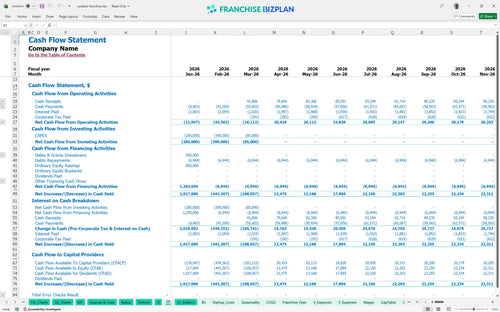
The lowest cash point is $468,000 in March 2026, which is why a financial planning guide for new boutique fitness owners always emphasizes liquidity. Fitness studio lease and overhead cost projections suggest you need enough runway to cover the $13,650 in monthly fixed costs before corporate contracts kick in by June 2026.
Franchise unit economic modeling shows that the high scenario jumps to $823,000 EBITDA if you maximize the $240,000 corporate contract opportunity. Creating a financial forecast for a new gym franchise requires this stress-testing, as the 9% combined royalty and marketing fee can squeeze margins if year-1 revenue falls below $885,000. Boutique fitness studio revenue stream modeling and estimating recurring revenue for fitness studios are key to hitting the high case.
Finance: update unit break-even and payback model by Friday.
This fitness franchise financial model is fully customizable in Excel, allowing you to tweak every variable from membership pricing to instructor pay. The pre-filled formulas and editable assumptions make it easy to adapt the projecktions to your specific local market and real estate costs.

Long-term planning is essential for any boutique studio, and this franchise business plan template provides detailed 5-year revenue, cost, and cash flow views. Use this financial model template for boutique indoor cycling studios to visualize how your profit margins evolve as you scale from year one to year five.

Operating a franchise means managing ongoing financial obligations like the 7% royalty and 2% marketing fund contributions. This tool simplifies analyzing franchise royalty and marketing fees in Excel, so you can see exactly how much of your $885,000 year-one revenue goes back to the franchisor.

Estimating boutique studio startup costs is the first step toward a successful launch, and this model covers everything from the $60,000 franchise fee to the $280,000 leasehold improvements. Knowing how to calculate startup costs for a fitness franchise helps you determine the exact sales volume needed to cover your fixed monthly overhead.

The model incorporates built-in boutique fitness industry benchmarks for key metrics like labor costs and occupancy, helping you sanity-check your assumptions. Comparing your expected performance against typical ranges ensures your revenue drivers and gross margin targets remain realistic for a high-end studio.


Simply purchase and download the financial model template, then access it instantly using Microsoft Excel or Google Sheets. No installation or technical expertise required-just open and start working.

Enter your business-specific numbers, including revenue projections, costs, and investment details. The pre-built formulas will automatically calculate financial insights, saving you time and effort.

Leverage the investor-ready format to confidently showcase your financial projections to banks, franchise representatives, or investors. Impress stakeholders with clear, data-driven insights and professional reports.

Leverage the investor-ready format to confidently present your projections to banks, franchise representatives, or investors.