


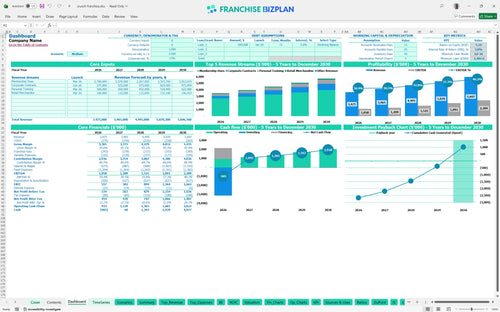
All-in-one Dashboard
Core inputs and core outputs



This gym franchise startup budget breakdown includes everything from initial build-out costs to five-year membership revenue projections and detailed staffing plans.
Core inputs and core outputs
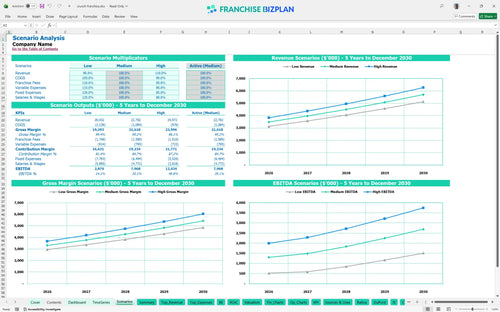
Three scenario analysis
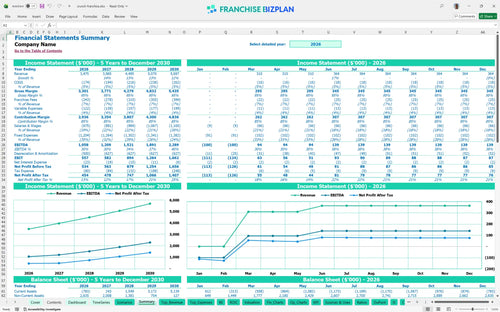
Presentation ready
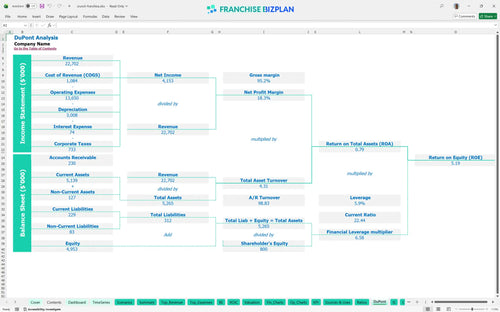
DuPont analysis
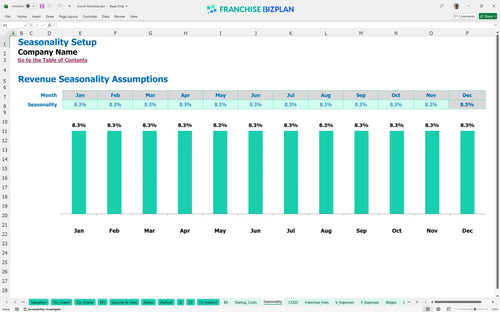
Researched revenue assumptions
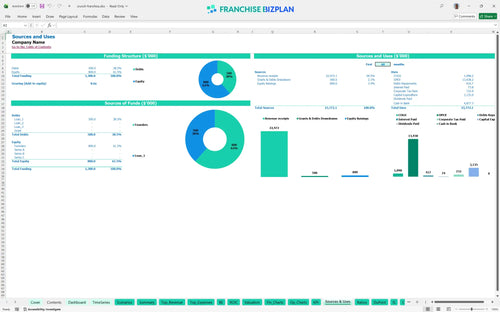
Lender-friendly financial outputs
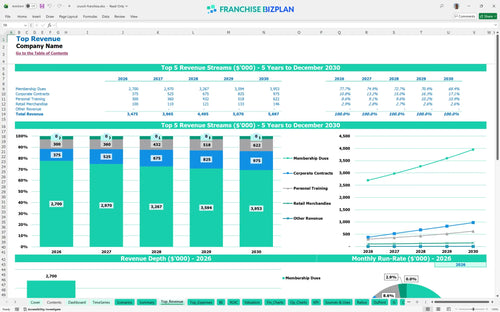
Revenue stream detailed view
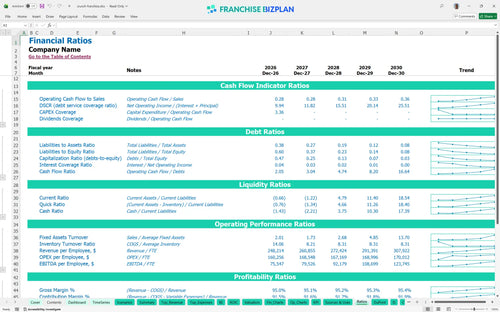
Performance metrics benchmark
We built this fitness franchise financial model using detailed market research on high-volume gym operations. The pre-populated data includes a $3.1M+ initial investment and 7% total franchise fees, but every assumption is fully editable to match your local market. With Year 1 EBITDA projected at $1.05M and revenue scaling to $5.6M, this tool helps you track if your local demand supports these aggressive performance targets.
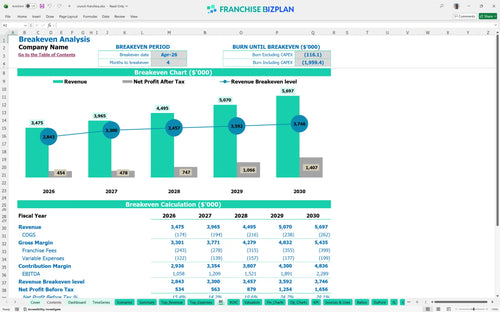
Based on the data, this unit hits its stride quickly, reaching breakeven by April 2026, just four months after the doors open. After accounting for the 5% royalty and 2% marketing fee, you are looking at an EBITDA of $1.058M in the first year. This fitness franchise revenue forecasting tool shows profit scaling as membership dues grow from $1.8M to over $2.6M by year five.
You will need roughly $3.135M in total capital according to this gym startup cost template. This covers the $35,000 franchise fee, $1.2M for leasehold improvements, and about $1.25M for strength, cardio, and functional gear. Plus, you need to account for the $1.4M minimum cash dip during the initial ramp-up phase in mid-2026.
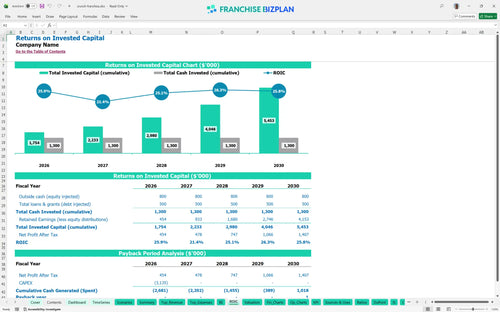
The return on investment analysis shows an IRR of 2.96% and a 5.19% ROE over the five-year period. While the payback period is 5 years, the unit generates significant cash flow, with EBITDA climbing to $2.28M by year five. This gym franchise investment return calculator helps you see the long-term value beyond the initial heavy build-out costs.
You reach the break-even point in month 4, which is quite fast for a facility of this size. The biggest hurdle is the $85,000 monthly rent, so hitting your membership dues target of $150,000 per month is critical to covering fixed costs. This fitness business profitability spreadsheet identifies volume as your primary driver for sustainability.
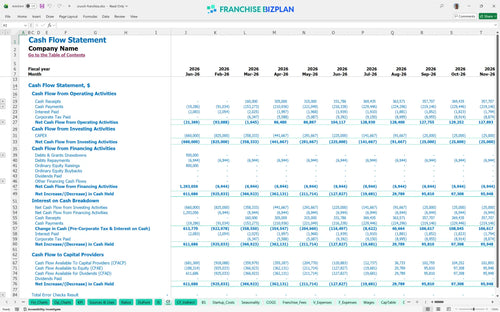
Your lowest cash point is -$1.402M in July 2026, meaning you need significant working capital or financing beyond just the build-out costs. This dip happens because of the timing between equipment payments and the membership ramp-up. These financial projections for new gym location scenarios help you plan your loan draws accordingly.
In a high-growth scenario where membership dues exceed the $1.8M year-1 target, your ROE will defintely improve. However, if corporate contracts lag or labor costs for instructors rise above the $240k starting point, your peak cash need will deepen. Evaluating fitness center franchise profitability requires looking at these operating cost analysis for commercial gyms under various stress levels.
This fitness franchise financial model is built as a financial modeling guide for franchise owners who need to manipulate every variable. You can adjust membership tiers, local rent, or staffing levels to see how they impact your bottom line in real-time. It is a fully editable tool designed to reflect your specific territory rather than just a generic estimate.

Map out your gym franchise investment calculator results over a sixty-month horizon to understand how the business scales. The model tracks how revenue grows from $3.47M in the first year to over $5.6M by year five as your membership base matures. This long-term view is essential for planning multi-unit expansion or securing traditional bank financing.

Use this franchise business plan spreadsheet to account for the 5% royalty and 2% marketing fund contributions required by the brand. It ensures you see exactly how much cash stays in the unit after corporate takes its cut from your monthly dues. Tracking these ongoing obligations helps you maintain brand standards without sacrificing your store-level margin.

Learning how to calculate startup costs for a fitness franchise is easier when you list the $1.2M leasehold and $1M+ in equipment upfront. This tool shows you need to hit specific membership targets to cover your $85,000 monthly rent and other fixed costs. It provides a clear picture of the capital expenditure forecasting needed before you sign a lease.

Compare your fitness center profitability analysis against industry norms for labor, utilities, and amenities. If your amenities supplies cost more than 3.5% of sales, the model flags it so you can adjust your operating expense benchmarks. This helps you sanity-check your projections against real-world franchise unit financial performance data.


Simply purchase and download the financial model template, then access it instantly using Microsoft Excel or Google Sheets. No installation or technical expertise required-just open and start working.

Enter your business-specific numbers, including revenue projections, costs, and investment details. The pre-built formulas will automatically calculate financial insights, saving you time and effort.

Leverage the investor-ready format to confidently showcase your financial projections to banks, franchise representatives, or investors. Impress stakeholders with clear, data-driven insights and professional reports.

Leverage the investor-ready format to confidently present your projections to banks, franchise representatives, or investors.