


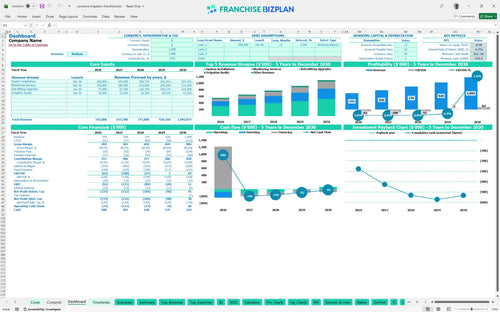
All-in-one Dashboard
Core inputs and core outputs



This franchise financial model template provides a complete Excel-based toolkit for forecasting revenue, managing irrigation-specific expenses, and calculating long-term ROI.
Core inputs and core outputs
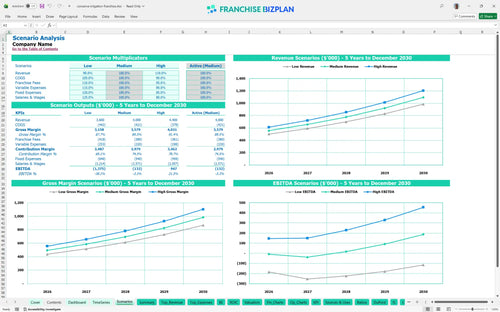
Three scenario analysis
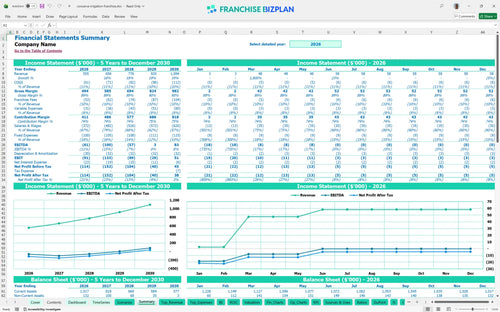
Presentation ready
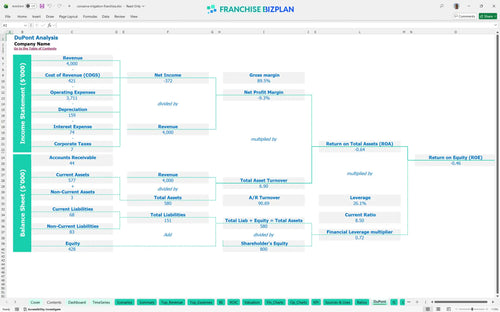
DuPont analysis
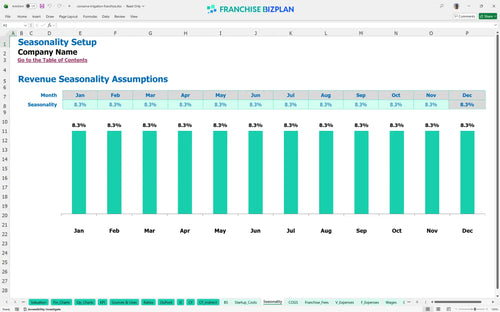
Researched revenue assumptions
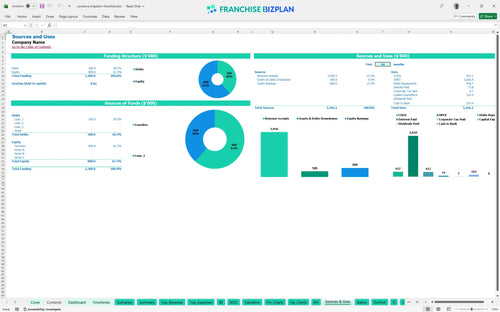
Lender-friendly financial outputs
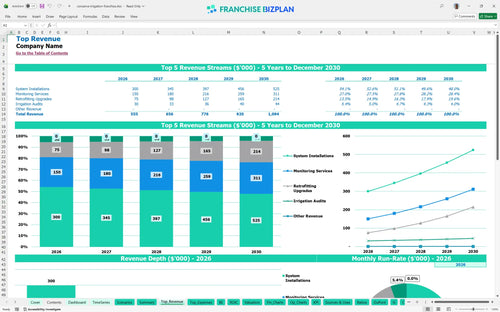
Revenue stream detailed view
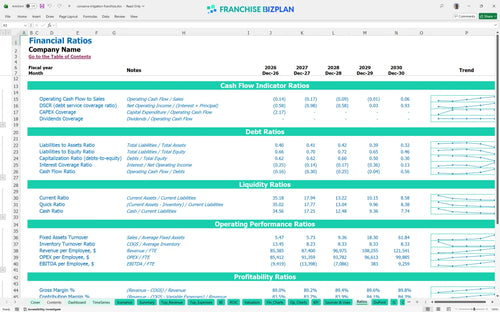
Performance metrics benchmark
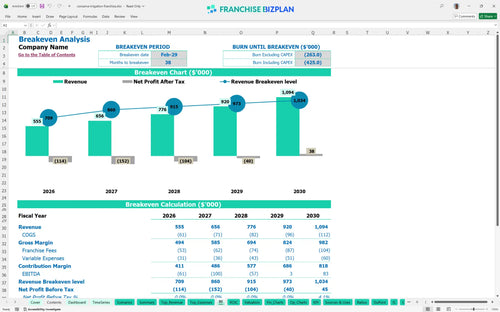
We built this irrigation franchise unit financial model using our own research into the smart water and landscaping sector. Key assumptions like revenue streams, operating expenses, and the 8% royalty are pre-populated with researched data specific to this irrigation franchise and are fully editable. Year 5 revenue is projected at $1,094,000, providing a clear target for multi-unit growth while accounting for a 38-month ramp-up to break-even.
You should expect a longer ramp-up, as the franchise profitability analysis shows the unit becomes EBITDA positive in Year 4 with a modest $3,000 profit. After accounting for the 8% royalty and significant labor costs for a 5-person tech crew, Year 5 sees a jump to $83,000 in earnings. Profitability is a marathon, not a sprint, in high-end service.
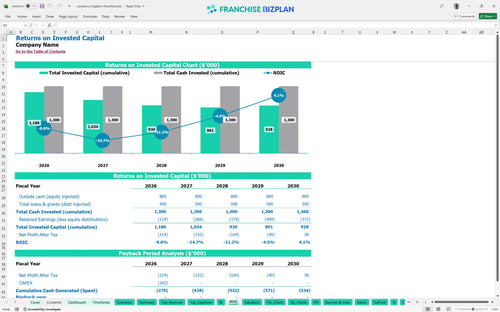
You will need approximately $162,000 in initial CAPEX to cover the franchise fee and essential equipment, but the irrigation franchise business plan suggests a $519,000 cash position for the ramp-up. This service-based franchise operating expenses spreadsheet accounts for the $49,500 franchise fee and $45,000 for vehicles. Cash is king, but equipment is the crown.
The current franchise investment ROI shows an IRR of -4.66% over the first five years, primarily because the payback period extends beyond the 60-month mark. While calculating ROI for smart irrigation business, we see that the heavy upfront investment in staff means you are playing a long-term equity game. Equity growth often outpaces annual cash flow in the early years.
The irrigation franchise unit profit and loss template shows the unit reaches its break-even date in February 2029, roughly 38 months after launch. The primary driver for this timeline is the high fixed overhead, including $4,500 in monthly rent and a $75,000 manager salary. Volume is the only cure for high fixed occupancy costs.
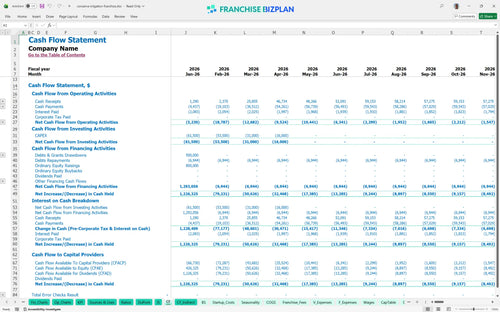
The lowest cash point occurs in December 2030, with a minimum cash requirement of $519,000 to sustain operations through the ramp-up phase. When estimating recurring revenue for home service franchises, you must account for the 3-year period of negative EBITDA before the recurring revenue model scales. A dry bank account is more dangerous than a dry lawn.
Financial forecasting for luxury landscape service business requires looking at Low vs High cases; a high-growth scenario pushes the $3,000 Year 4 EBITDA much higher if technician productivity improves. This franchise financial feasibility study template helps you see that a 15% drop in system installations would deepen the peak cash need significantly. Scenarios are the fire drills for your bank account.
This franchise financial model template is fully customizable in Excel, allowing you to tweak every variable from service pricing to local labor rates. You get pre-filled formulas and editable assumptions that let you stress-test different weather patterns or territory densities. It's built to adapt to your specific market conditions and fleet size, so you can see how a 10% shift in installation volume affects your bottom line. Every 1-point margin leak matters fast in a single-unit model.

Long-term planning is non-negotiable when you're managing a fleet and recurring service contracts. This small business financial projection template provides a detailed 5-year outlook on revenue, costs, and cash flow, specifically tailored for a service-based franchise unit. You can see how scaling from 3 to 5 technicians impacts your profitability over half a decade. Timing gaps between opening costs and mature performance are the silent killers in this industry.

The model tracks your specific financial obligations to the franchisor, including the initial $49,500 fee and ongoing 8% royalty payments. By baking in the 1.5% brand marketing fund contribution, you see the true store-level margin after all brand-related 'taxes' are paid. This franchise royalty fee structure ensures you don't overlook the cost of being part of a national network. You can't manage what you don't measure against the brand standard.

Launching requires a clear view of your total initial investment, from the $45,000 for service vehicles to the $22,000 in diagnostic tools. This franchise startup cost calculator identifies your monthly fixed costs, like the $4,500 warehouse rent, and tells you how to calculate startup costs for a service franchise effectively. It defintely helps you plan for the 38 months it takes to reach the break-even point. Break-even depends more on local density than headline sales.

We've integrated industry-standard benchmarks for home services and landscaping to help you sanity-check your numbers. If your labor costs for technicians or your fuel percentages drift too far from the norm, this franchise unit performance benchmarking tool flags it. This allows you to compare your expected performance against typical high-efficiency irrigation units. Benchmarks are the guardrails that keep your fleet on the road.


Simply purchase and download the financial model template, then access it instantly using Microsoft Excel or Google Sheets. No installation or technical expertise required-just open and start working.

Enter your business-specific numbers, including revenue projections, costs, and investment details. The pre-built formulas will automatically calculate financial insights, saving you time and effort.

Leverage the investor-ready format to confidently showcase your financial projections to banks, franchise representatives, or investors. Impress stakeholders with clear, data-driven insights and professional reports.

Leverage the investor-ready format to confidently present your projections to banks, franchise representatives, or investors.