


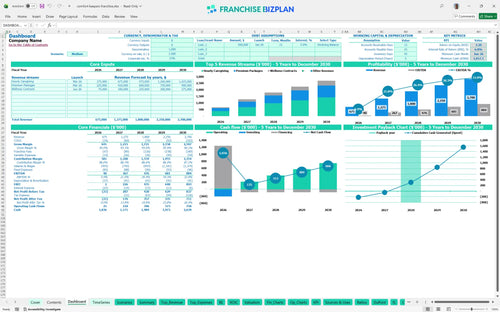
All-in-one Dashboard
Core inputs and core outputs



This franchise financial projection tool includes detailed modules for revenue scaling, caregiver payroll, and territory-specific overhead to help you map out a 5-year growth plan.
Core inputs and core outputs
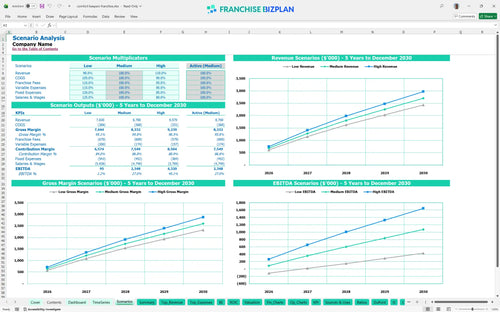
Three scenario analysis
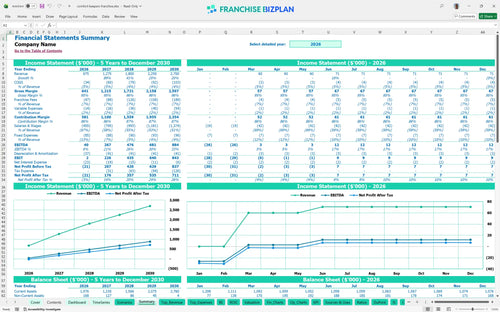
Presentation ready
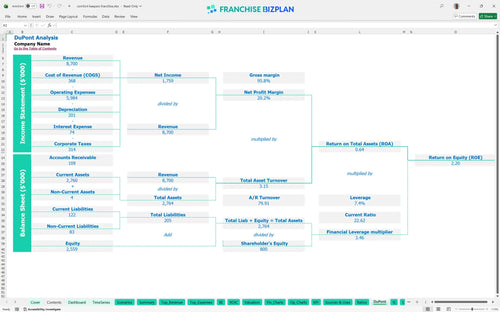
DuPont analysis
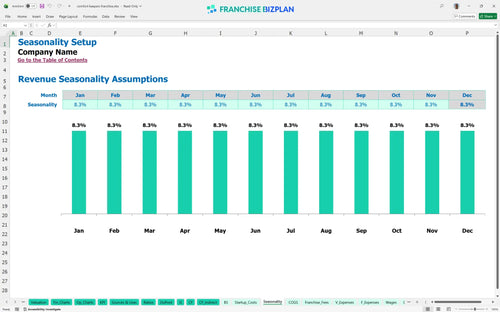
Researched revenue assumptions
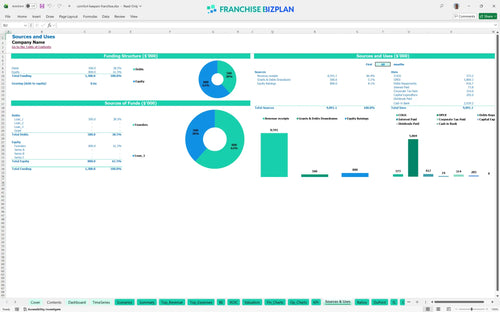
Lender-friendly financial outputs
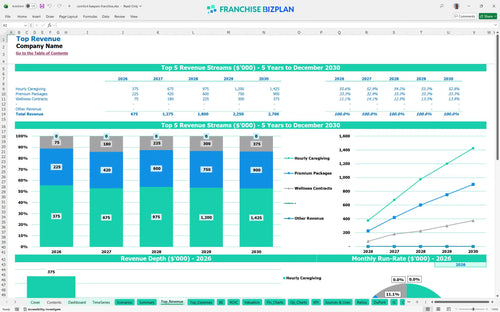
Revenue stream detailed view
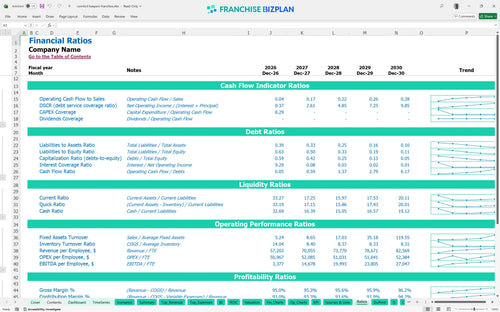
Performance metrics benchmark
We developed this financial model template for senior home care business using our own research on territory scaling and unit performance. Key assumptions like the 5% royalty and $55,000 initial fee are pre-populated, showing a path from $675,000 in year one to $2.7 million in year five. It is a grounded tool for senior care business operations and evaluating franchise investment opportunities in senior care. Real data beats a gut feeling every time.
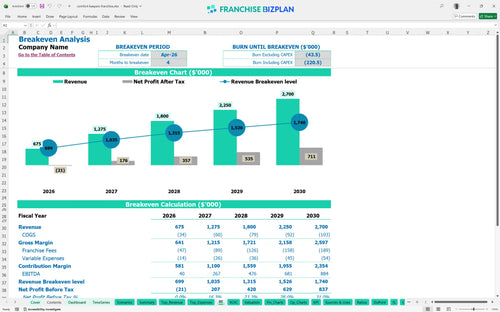
Based on the Excel template for home care franchise revenue projections, the unit hits profitability by April 2026, just four months after opening. This assumes you scale from $675,000 in year-one revenue to $1.275 million in year two while managing a 5% royalty and 2% marketing fee. Speed to profit defines your first year.
Your startup budget for independent senior care franchise requires approximately $205,000 for initial CAPEX, but you should have $1,017,000 in total home health care startup capital to handle the ramp-up. This ensures you have enough liquidity to cover the $75,000 GM salary and $3,500 monthly rent before cash flow stabilizes. Cash is the fuel that gets you to month four.
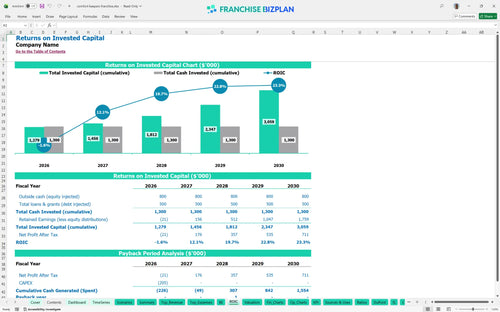
The franchise investment ROI is highlighted by a 3-year payback period and an internal rate of return (IRR) of 6.77%. With a return on equity (ROE) of 2.2, the model demonstrates how consistent census growth leads to an EBITDA of $884,000 by the fifth year. Your time is money; make sure the return reflects it.
Understanding unit economics in home care franchising is key to hitting your break-even date in April 2026. You need to reach a specific volume of hourly caregiving and wellness contracts to cover the $7,100 in monthly fixed costs, including rent and insurance. Volume is the only cure for high fixed costs.
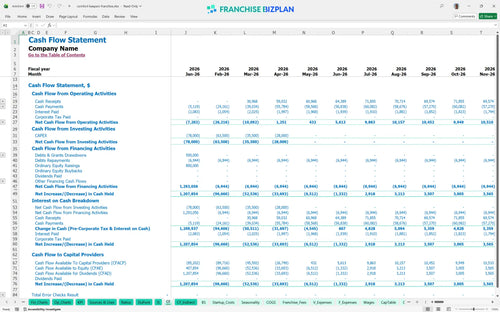
The lowest cash point occurs in June 2026, where the model shows a minimum cash requirement of $1,017,000 to sustain operations. It is defintely vital to maintain this buffer to handle the timing gap between payroll for 8 caregivers and receiving payments from private-pay clients. The valley of death is usually in month six.
Assessing profitability of a senior care franchise unit involves comparing low, medium, and high revenue cases. A high-growth scenario where you hit $2.7 million in revenue by year five significantly improves your year-1 EBITDA of $40,000 and shortens the payback period. Plan for the best but model the worst.
Finance: update unit break-even and payback model by Friday
This home care franchise financial model is built in Excel with open formulas, letting you tweak every driver from caregiver pay rates to local rent. You can adjust the franchise unit economics template to match your specific territory, whether you are in a high-cost urban hub or a rural market. Every cell is open for your local market reality.

Financial forecasting for home care agency owners requires a detailed 5-year outlook to secure funding. This model maps revenue scaling from $675,000 in year one to $2.7 million in year five, making it an essential tool for preparing a franchise business plan for investors. Growth is a marathon, not a sprint.

Understanding franchise royalty fees is vital for protecting your store-level margin. The model automatically calculates the 5% royalty and 2% marketing fund contribution based on your monthly billings so you know exactly what stays in your pocket after corporate obligations. Royalties are a top-line tax you must plan for.

Learning how to calculate startup costs for a home care franchise is the first step to avoiding mid-year cash crunches. This section details the $205,000 initial outlay, including the $55,000 franchise fee and $45,000 in leasehold improvements, while pinpointing your April 2026 break-even date. Knowing your zero-day is the first step to sleep.

This home care franchise operational expenses spreadsheet includes built-in benchmarks for non-medical home care profitability. We pre-set care supply costs at 3.8% and PPE uniforms at 1.2% of revenue so you can compare your actual performance against industry standards. Don't fly blind when industry averages are available.


Simply purchase and download the financial model template, then access it instantly using Microsoft Excel or Google Sheets. No installation or technical expertise required-just open and start working.

Enter your business-specific numbers, including revenue projections, costs, and investment details. The pre-built formulas will automatically calculate financial insights, saving you time and effort.

Leverage the investor-ready format to confidently showcase your financial projections to banks, franchise representatives, or investors. Impress stakeholders with clear, data-driven insights and professional reports.

Leverage the investor-ready format to confidently present your projections to banks, franchise representatives, or investors.