


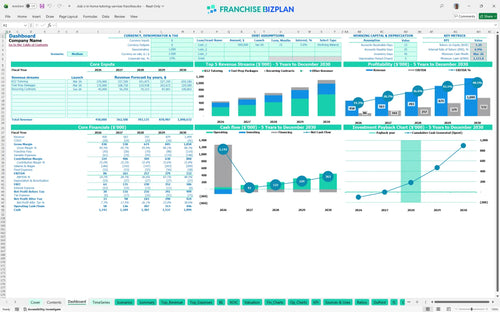
All-in-one Dashboard
Core inputs and core outputs



This franchise unit financial performance projection template provides a complete roadmap for managing a service-based education business from launch through maturity.
Core inputs and core outputs
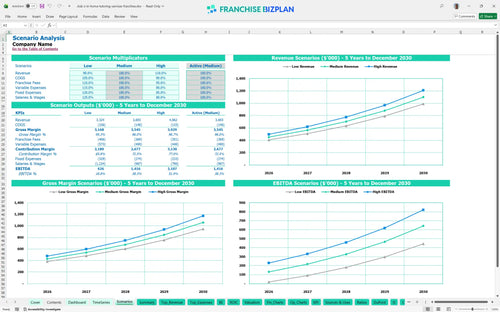
Three scenario analysis
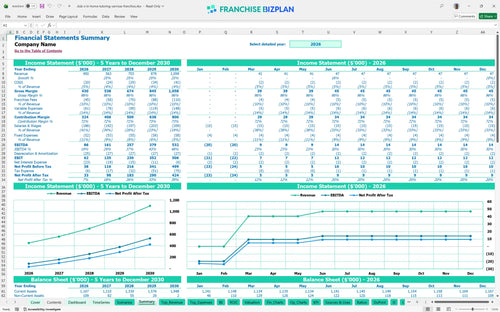
Presentation ready
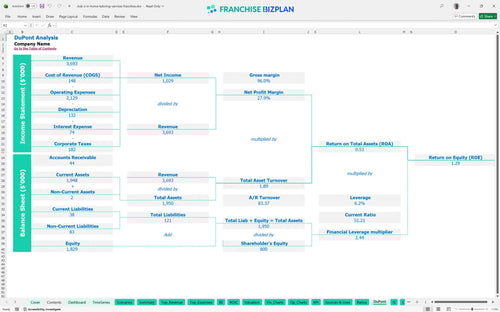
DuPont analysis
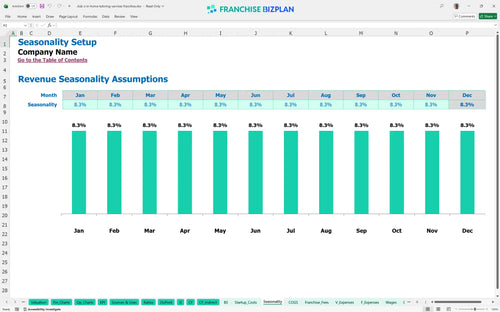
Researched revenue assumptions
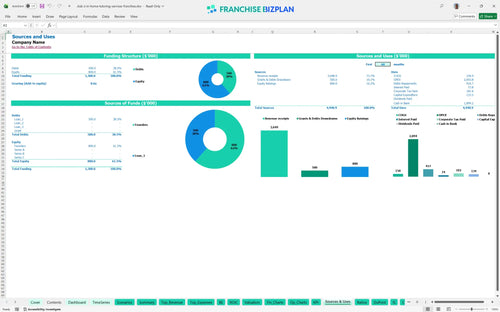
Lender-friendly financial outputs
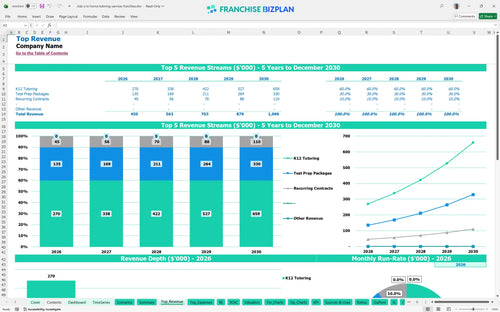
Revenue stream detailed view
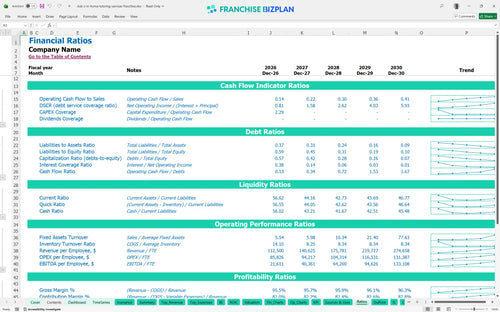
Performance metrics benchmark
We developed this in-home tutoring business financial projections tool using deep-dive research into the service-based education sector. The model comes pre-loaded with a $450,000 year-one revenue target and a 4-month window to reach break-even, but every cell is editable to fit your local market reality. Here is the math: with $133,500 out the door for startup, you need to hit your trading days and tutor utilization targets early to protect your cash.
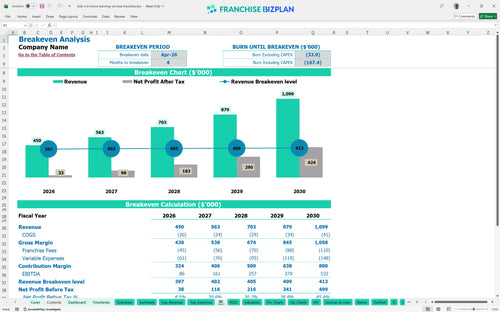
You can expect to hit the break-even point by April 2026, just four months after launching. With year-one EBITDA starting at $86,000 and scaling to $532,000 by year five, the tutoring franchise profit margin analysis shows a strong upward curve as recurring contracts kick in. Speed to profit depends on how fast you match tutors to students in those first 90 days.
Launching this unit in the US requires roughly $133,500 in upfront capital. This covers the $59,000 franchise fee, $18,000 for a company vehicle, and $12,000 for launch marketing to ensure you hit your year-one targets. Still, you need to watch the timing of these payments to avoid a cash crunch before your first tutoring session. Here is the breakdown of where your money goes on day one.
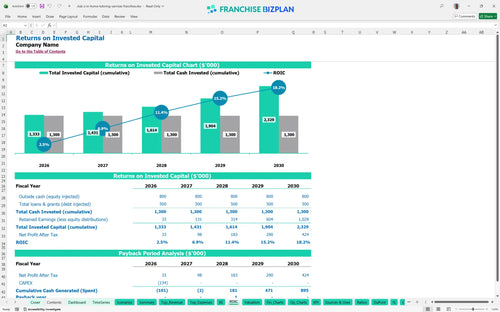
The model projects an Internal Rate of Return (IRR) of 6.94% and a Return on Equity (ROE) of 1.29. While the IRR is modest, the 3-year payback period is attractive for a service-based model with low overhead. Honestly, the real value is in the year-5 EBITDA of $532,000, which represents a significant multiple of your initial $133,500 investment.
You need to reach break-even by April 2026 to stay on track with the 3-year payback plan. The biggest lever here is tutor contractor payments-set at 12% of revenue-which means your ability to manage labor costs directly dictates how fast you cover your $2,100 monthly rent. If tutor matching takes longer than planned, your break-even date will slide. Efficiency in the matching process is your best friend.
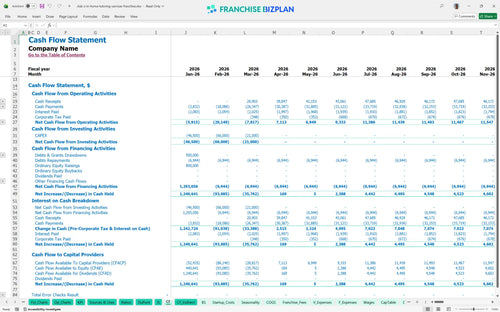
Your lowest cash point hits in March 2026 at $1,112, which is uncomfortably close to zero. This is a tight margin, so having a small business P&L template to monitor monthly outflows for CRM software and insurance is critical during the first six months. If launch marketing costs more than $12,000, you will need an additional cash buffer to survive the ramp-up. Cash is oxygen, and you are breathing thin air in month three.
Evaluating profitability of in-home tutoring services requires looking at high and low cases. A 10% drop in K-12 tutoring revenue could push your break-even date back several months, while hitting the high-growth scenario significantly boosts your year-5 EBITDA of $532,000. The model allows you to toggle these scenarios to see how peak cash needs change when revenue fluctuates. Planning for the worst helps you achieve the best.
Finance: update unit break-even and payback model by Friday.
This tutoring franchise financial model is built in Excel so you can tweak every driver to match your specific territory. We have pre-filled the template with researched data, but you can easily adjust tutor pay rates or local marketing spend to see how they impact your bottom line. It is a flexible tool designed to handle your specific location and operating scenario without breaking the formulas. One wrong assumption can tank a budget, so we made everything editable.

Planning for the long haul is easier when you can see the jump from $450,000 in year one to over $1 million by year five. This education franchise business plan maps out your growth trajectory, helping you visualize how scaling from K-12 tutoring to test prep packages impacts your cash flow. You get a clear view of the balance sheet and long-term profitability to help secure financing or plan your exit. Growth is great, but only if the margins scale with the revenue.

We built in a specific franchise royalty fee calculation to handle the 8% royalty and 2% marketing fund contributions. These off-the-top costs are non-negotiable, so the model ensures you see exactly how they eat into your gross margin before you pay your tutors. Tracking these ongoing obligations is the only way to understand the real economics of your unit. Royalties are a reality of the system, so we account for every penny.

Use this franchise startup cost template to track the $133,500 initial investment, from the $59,000 franchise fee to the $18,000 company vehicle. Determining break-even point for home-based tutoring franchise units is vital, and this model shows you exactly which month the bleeding stops. You will know the exact sales level required to cover your $2,100 monthly rent and $161,000 in annual fixed wages. Knowing your number is the first step to sleeping better at night.

Comparing your tutoring center operating expenses against industry norms keeps your projections grounded. We have included benchmarks for tutor contractor payments and curriculum costs so you can defintely see if your 12% labor assumption is realistic for your market. These sanity checks help you spot margin leaks before they become permanent problems. Benchmarks are the guardrails that keep your business plan on the road.


Simply purchase and download the financial model template, then access it instantly using Microsoft Excel or Google Sheets. No installation or technical expertise required-just open and start working.

Enter your business-specific numbers, including revenue projections, costs, and investment details. The pre-built formulas will automatically calculate financial insights, saving you time and effort.

Leverage the investor-ready format to confidently showcase your financial projections to banks, franchise representatives, or investors. Impress stakeholders with clear, data-driven insights and professional reports.

Leverage the investor-ready format to confidently present your projections to banks, franchise representatives, or investors.