


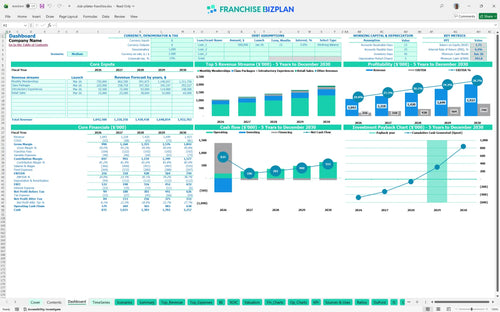
All-in-one Dashboard
Core inputs and core outputs



This franchise financial projection template includes detailed tabs for revenue, labor, CAPEX, and a full set of financial statements to help you master your studio profitability metrics.
Core inputs and core outputs
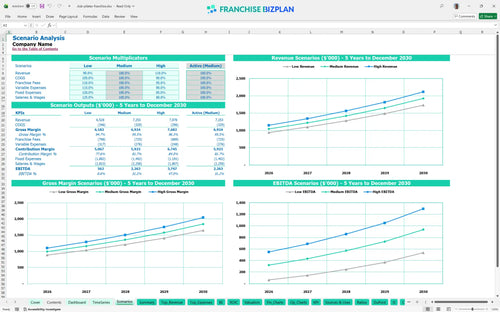
Three scenario analysis
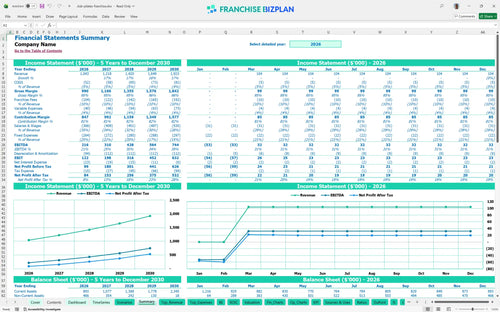
Presentation ready
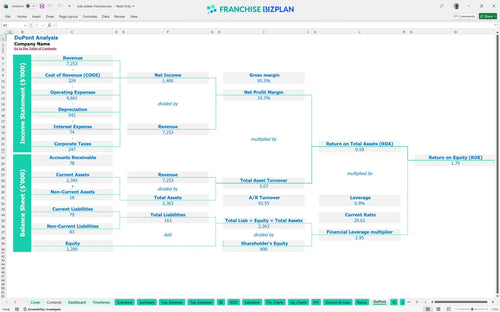
DuPont analysis
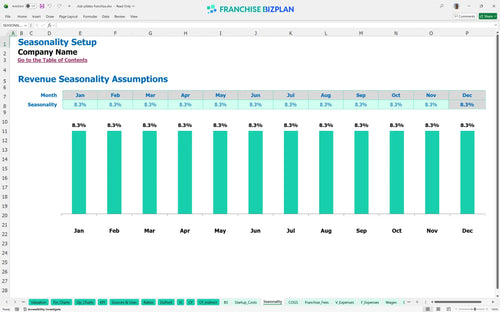
Researched revenue assumptions
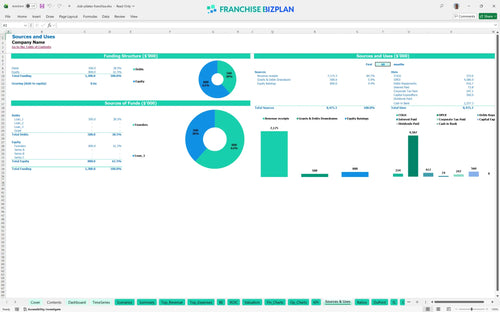
Lender-friendly financial outputs
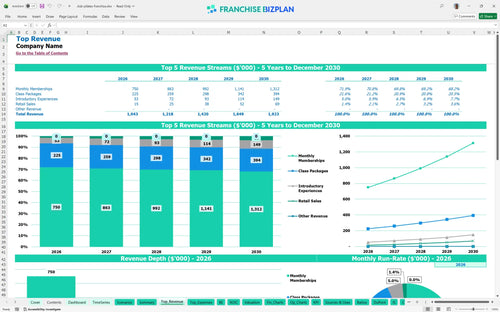
Revenue stream detailed view
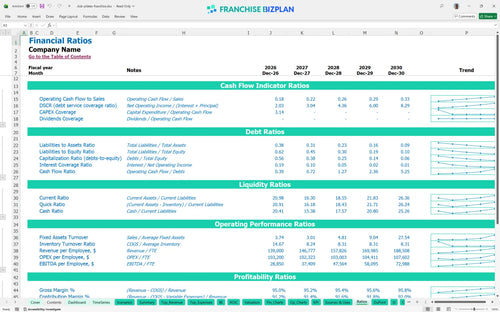
Performance metrics benchmark
We built this Pilates studio investment analysis using real-world data and market research. The pre-populated assumptions cover everything from $500,000 in initial membership revenue to the 8% royalty structure, and they are defintely ready for your local adjustments. This tool is designed to provide financial planning for new fitness franchise owners who need to see the numbers before they commit.
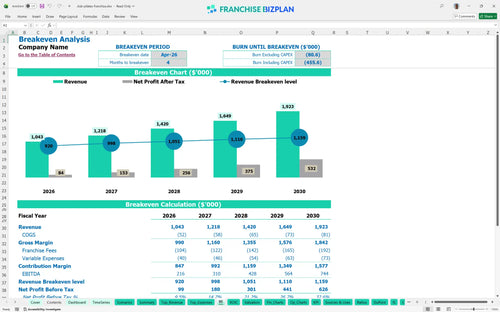
The model shows the unit hitting its stride quickly, with a breakeven date in April 2026. By year two, EBITDA is projected at $310,000, assuming you maintain a strong recurring revenue model and keep instructor costs aligned with class volume. Here's the quick math: your profit margin expands as you fill more spots in each class without increasing fixed rent.
You will need significant upfront capital, including $200,000 for leasehold improvements and $120,000 for equipment. The total investment covers the franchise fee and a cash buffer to handle the first few months of operation. What this estimate hides is the potential for construction overruns, so keep your contingency fund ready.
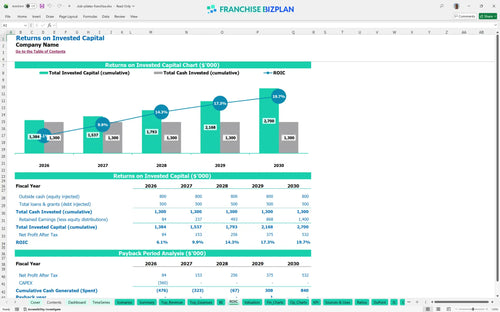
Investors can look for an IRR of 4.21% and a 4-year payback period based on these projections. While the ROE sits at 1.75, the long-term value lies in the scaling revenue that reaches $1.92M by the fifth year. This is a marathon, not a sprint, but the cash flow becomes very attractive once the initial debt is cleared.
The studio hits break-even just 4 months after launch, which is fast for boutique fitness. This rapid timeline depends heavily on hitting the $500,000 membership revenue target and keeping fixed costs like the $15,000 rent under control. If your membership ramp-up is slower, that break-even date will slide right quickly.
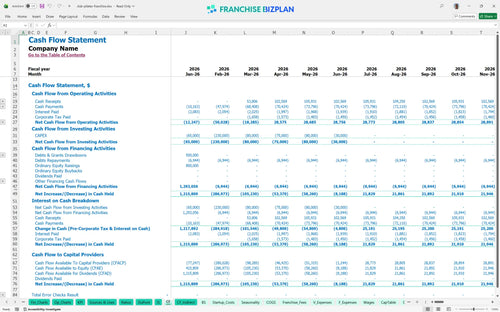
The lowest cash point occurs in June 2026 at $704,000. This suggests you need a healthy liquidity cushion to handle the heavy CAPEX phase before the recurring revenue from class packages fully kicks in. Still, the model shows a strong recovery once the membership base stabilizes and the initial build-out costs are behind you.
A high-performance scenario significantly boosts the 1.75 ROE by increasing class throughput and retail sales. Conversely, a low-revenue year makes the $15,000 rent a much heavier burden, potentially extending the 4-year payback period. Honestly, your success depends on local marketing execution and keeping those reformer beds full during peak hours.
Finance: update unit break-even and payback model by Friday
This Pilates franchise financial model is built in Excel, allowing you to tweak every variable from class pricing to instructor pay. Since every territory has different labor rates and rent prices, these editable assumptions ensure the math fits your specific market. It is a flexible tool for anyone needing a boutique fitness studio business plan that adapts to real-world changes.

Long-term planning is vital when scaling a boutique fitness studio business plan. The model projects five years of performance, showing revenue climbing from $1.04M in year one to over $1.9M by year five. This allows you to see how recurring revenue models compound over time as your membership base matures.

Managing franchise royalty fees is a non-negotiable part of your monthly cash flow. This model tracks the 8% royalty and 2% marketing fund against your gross sales to show exactly what stays in your pocket after the franchisor takes their cut. It simplifies the complex math of calculating monthly obligations based on fluctuating studio traffic.

Knowing how to calculate startup costs for a pilates studio keeps you from running out of cash before the doors open. We factor in everything from the $65,000 franchise fee to the $120,000 equipment package to give you a clear picture of the total check you need to write. One bad construction delay can sink a budget, so we track every dollar of your initial investment.

Use this fitness franchise startup costs tool to compare your projected labor and rent against industry standards. If your $15,000 monthly rent is too high for your member count, the model flags the margin squeeze before you sign the lease. It is essentially a sanity check for your Pilates studio profit margin analysis.


Simply purchase and download the financial model template, then access it instantly using Microsoft Excel or Google Sheets. No installation or technical expertise required-just open and start working.

Enter your business-specific numbers, including revenue projections, costs, and investment details. The pre-built formulas will automatically calculate financial insights, saving you time and effort.

Leverage the investor-ready format to confidently showcase your financial projections to banks, franchise representatives, or investors. Impress stakeholders with clear, data-driven insights and professional reports.

Leverage the investor-ready format to confidently present your projections to banks, franchise representatives, or investors.