


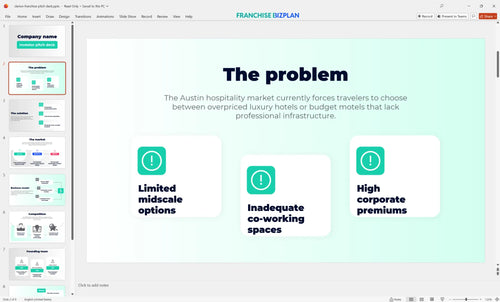
Problem
Defines market pain



The franchise unit development business plan includes 100% editable slides covering executive summaries, market analysis, operational strategies, and five-year financial projections tailored for hotel investors.
Defines market pain
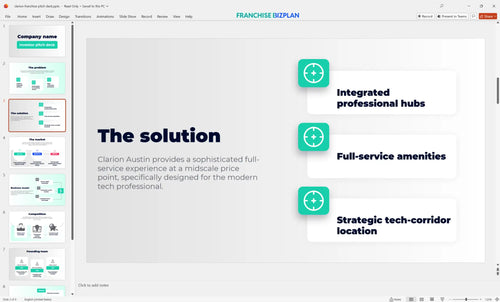
Explains your fix
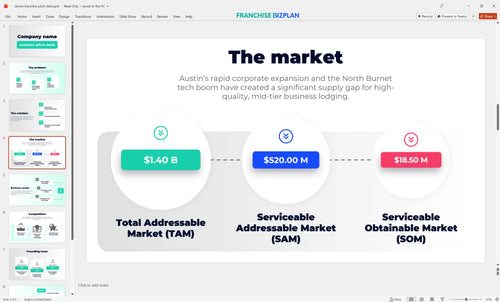
Quantifies opportunity size
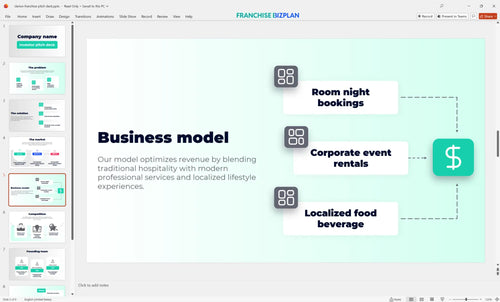
Shows revenue engine
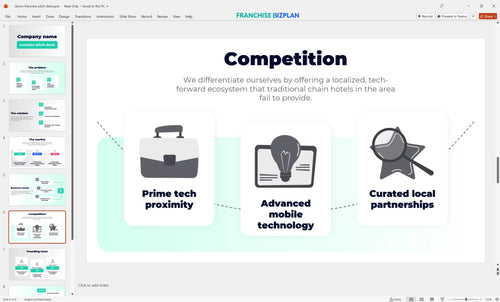
Highlights competitive edge
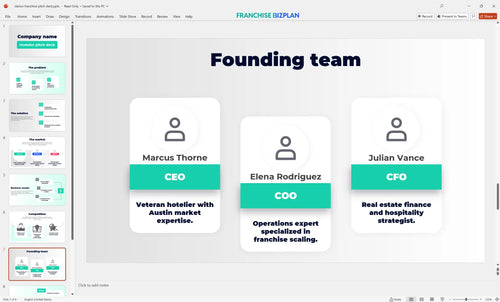
Proves operator credibility
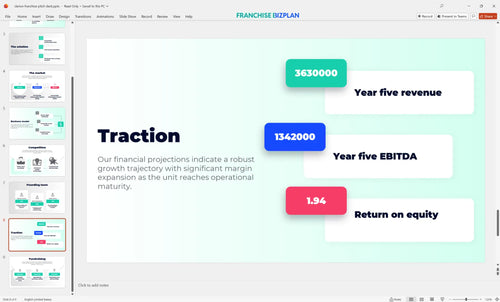
Demonstrates market momentum
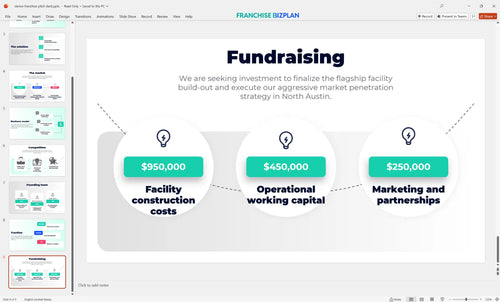
Details capital use
We built this Clarion Franchise franchise unit pitch deck in Microsoft PowerPoint format using our own deep-dive research into the midscale hospitality sector. All slides come pre-populated with realistic data, including a Year 1 revenue target of $1,410,000 and a detailed $950,000 build-out budget. It is a practical tool designed to help you move from a franchise disclosure document to a fully funded operation.
Modern professionals are tired of overpaying for luxury or settling for dated budget motels that lack functional workspace. This unit fills the 'midscale gap' by providing a tech-forward, full-service experience in high-growth corridors where corporate demand is surging. Honestly, the local market is starving for a 'Get Together' hub that blends sleep with productive co-working environments.
This unit offers a seamless, tech-forward stay featuring mobile check-in and versatile 'Get Together' co-working lounges. It beats local alternatives by offering premium amenities like meeting spaces and locally inspired F&B at a price point that fits standard corporate travel policies. It is defintely a more productive environment for the modern business traveler compared to traditional limited-service hotels.
The primary customers are corporate travelers, local startups, and project teams working in the surrounding tech corridor. With a Year 1 revenue projection of $1,410,000, the opportunity is sized to capture both recurring B2B contracts and high-margin weekend leisure traffic. Here's the quick math: the local SAM (Serviceable Addressable Market) is driven by thousands of annual room nights from nearby corporate headquarters.
Revenue flows from four main channels: room nights, meeting room rentals, co-working fees, and food and beverage sales. While room revenue is the anchor, the model leverages a 4.5% royalty and 3.25% marketing fee to tap into a global reservation system that drives consistent occupancy. What this estimate hides is the high-margin potential of the $100,000 in Year 1 meeting space rentals.
Main competitors include traditional midscale chains and upscale boutique hotels that lack the brand's global reach. This unit's edge is the combination of the franchisor's massive reservation engine and a localized, tech-forward operational model. This 'moat' protects your margins by reducing reliance on expensive third-party OTA (Online Travel Agency) commissions, which start at 4.8%.
The project requires significant upfront capital, including $950,000 for leasehold improvements and a $45,000 franchise fee. These funds unlock a fully operational 80-room facility, with a milestone of reaching breakeven by April 2026, just four months after launch. Still, you must plan for the $803,000 minimum cash requirement to cover the ramp-up period before EBITDA turns positive in Year 2.
Finance: update unit break-even and payback model by Friday
This hospitality franchise investment presentation is pre-structured to eliminate the heavy lifting of starting from scratch. You can easily edit the slides in Microsoft PowerPoint to match your specific territory, funding requirements, or local market data. It provides a professional framework that ensures you cover every critical detail lenders and investors expect to see in a hotel business plan template.

Understanding how a hotel franchise investment generates cash is vital for securing capital. This template includes a dedicated revenue model slide that breaks down income from room nights, meeting space rentals, and food sales. It simplifies complex hospitality revenue management concepts into a clear unit economics view that demonstrates exactly how the operation scales toward its $3.63M year-five revenue target.

Success in commercial real estate investment depends on your ability to dominate a local trade area. The deck provides structured slides to analyze local demand, customer profiles, and competitor positioning. This helps you explain why your specific location in a high-growth corridor will outperform existing budget and luxury alternatives through superior strategic positioning.

A professional franchise opportunity proposal must look the part to win over sophisticated lenders. The design uses a clean, modern layout that emphasizes key financial facts and operational milestones without distracting clutter. You don't need design skills to present a high-end investor pitch deck for a hospitality startup that communicates authority and precision.

To secure funding for a hotel franchise, you must articulate what makes your unit different. This slide helps you define your 'moat,' such as the integration of co-working spaces or tech-forward guest amenities. It's designed to answer the investor's most important question: why will customers choose your hotel over the established brand down the street?


Get instant access to your pitch deck by downloading the template in PowerPoint or Google Slides. Open it in your preferred software and start customizing immediately.

Easily personalize each slide by replacing the placeholder text with your business information, market insights, and key financial details, ensuring the deck aligns perfectly with your vision.

Review and adjust the financial slides to align with your revenue model, cost breakdown, and funding needs, ensuring investors receive a clear and professional financial overview.

Refine your presentation for clarity and impact, ensuring it tells a compelling story about your business, highlights your competitive edge, and makes a strong case for investment.