


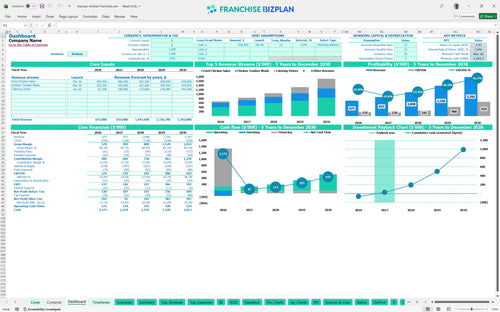
All-in-one Dashboard
Core inputs and core outputs



The franchise unit financial model template provides a complete Excel framework including dynamic P&L statements, cash flow tracking, and automated startup budget calculators.
Core inputs and core outputs
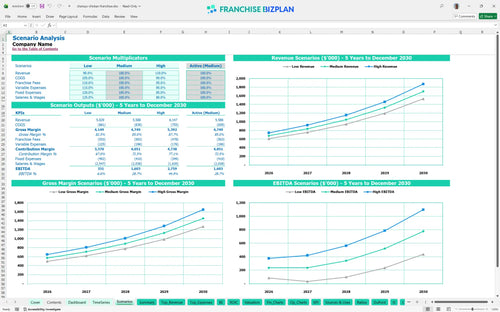
Three scenario analysis
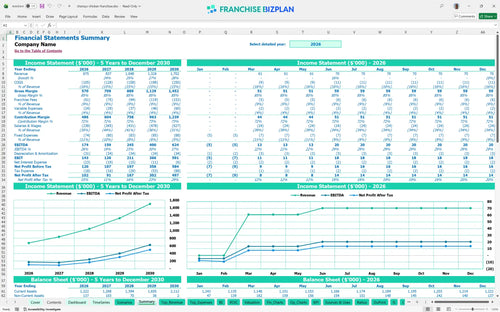
Presentation ready
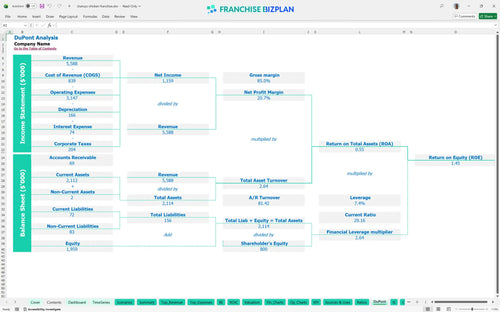
DuPont analysis
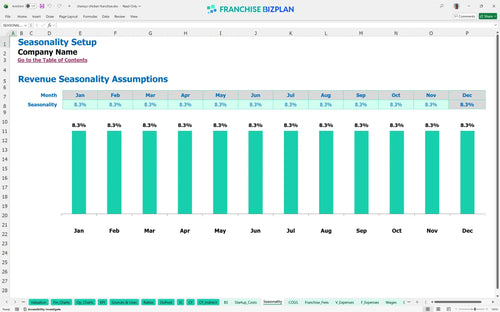
Researched revenue assumptions
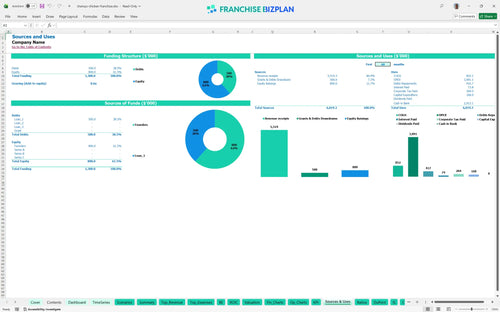
Lender-friendly financial outputs
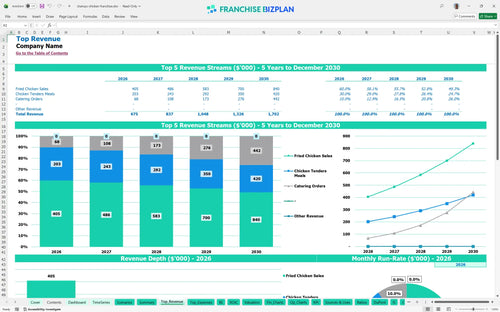
Revenue stream detailed view
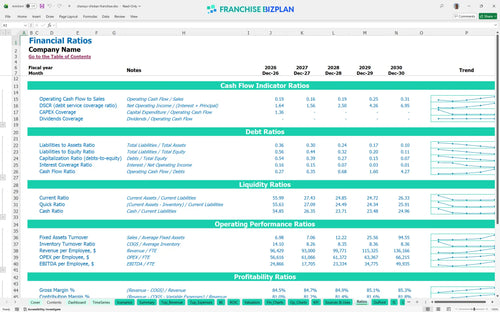
Performance metrics benchmark
We developed this franchise unit financial model using detailed research to provide a realistic store-within-a-store business model financial projections. Key assumptions, including the $675,000 year-one revenue and the 9% combined royalty and marketing burden, are pre-populated and fully editable to reflect your specific territory and local demand.
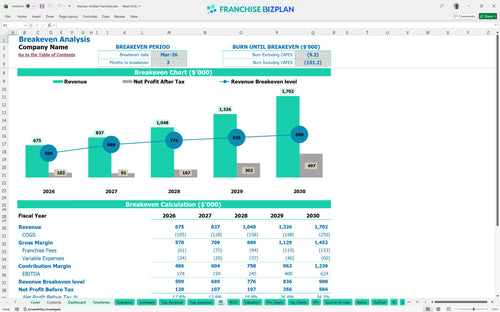
The unit is projected to reach profitability in year one, hitting its break-even point in March 2026, just three months after opening. With year-one EBITDA estimated at $174,000, the model shows that tight control over the 14% food cost and efficient staffing is the key to early positive cash flow.
You will need approximately $168,000 in total capital to cover the initial investment, which includes the $25,000 franchise fee and $112,000 for build-out and kitchen equipment. This startup budget template for small food service franchise also includes $8,000 for initial inventory and $6,000 for staff training to ensure a smooth opening month.
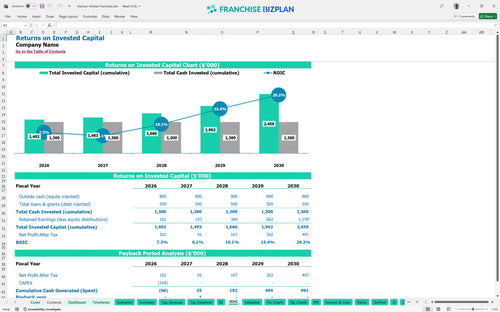
The model projects a 2-year payback period and an Internal Rate of Return (IRR) of 7.59%, which is a strong result for a single-unit food service operation. With a Return on Equity (ROE) of 1.45, the financial modeling for quick service restaurant franchise demonstrates how scaling revenue to $1.7 million by year five drives long-term value for the owner.
To cover your $3,500 monthly rent and roughly $6,600 in additional fixed costs, you need to reach your break-even sales level by the third month of operation. The biggest driver for reaching this point faster is maximizing throughput during the lunch window, as the 9% royalty and marketing fee creates a fixed margin floor you must defintely exceed.
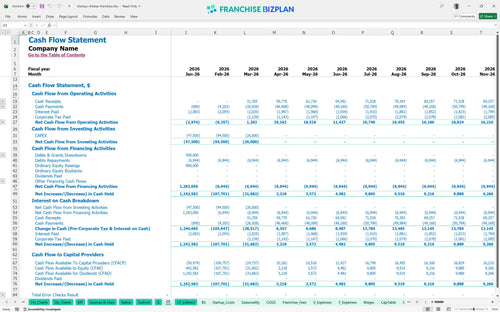
The lowest cash point is projected for March 2026 at $1,103,000, assuming you launch with the recommended liquidity to handle the ramp-up phase. While the model shows a fast 3-month path to break-even, maintaining a cash buffer is vital to manage the timing gaps when estimating catering revenue for food service franchises from institutional clients.
In a high-performance scenario, aggressive catering sales-starting at $45,000 in year one-can significantly accelerate your ROI calculation and increase the year-one margin. Conversely, the low-case scenario shows that if revenue drops by 10%, your manager productivity and waste control become the only things protecting your store-level EBITDA from turning negative.
This franchise financial model is built in Excel with fully editable assumptions, allowing you to swap out pre-filled data for your specific location and market conditions. You can adjust the food service financial spreadsheet to reflect your actual rent, local labor rates, and specific equipment quotes without breaking the underlying formulas.

Long-term planning is essential for multi-unit growth, and this model provides a detailed 5-year outlook for your franchise unit. It tracks revenue projections scaling from $675,000 in year one to over $1.7 million by year five, giving you a clear view of how the franchise profitability analysis evolves as your customer base matures.

Managing ongoing franchisor obligations is critical for maintaining store-level margins, so this tool automates the calculation of the 5% royalty and 4% marketing fund contributions. By integrating these costs directly into the P&L, you can see the real-world impact of brand fees on your monthly cash flow and overall unit economics.

Knowing how to calculate startup costs for a food franchise prevents mid-project funding gaps by aggregating everything from the $25,000 initial fee to the $45,000 leasehold improvements. The model then performs a break-even analysis to identify the exact sales volume needed to cover your $3,500 monthly rent and other fixed operating expenses.

This model incorporates researched industry benchmarks to help you sanity-check your assumptions against typical performance for a chicken restaurant franchise. You can compare your 14% food ingredient cost and labor allocations against standard ranges to ensure your franchise business plan template is grounded in reality rather than best-case guesses.


Simply purchase and download the financial model template, then access it instantly using Microsoft Excel or Google Sheets. No installation or technical expertise required-just open and start working.

Enter your business-specific numbers, including revenue projections, costs, and investment details. The pre-built formulas will automatically calculate financial insights, saving you time and effort.

Leverage the investor-ready format to confidently showcase your financial projections to banks, franchise representatives, or investors. Impress stakeholders with clear, data-driven insights and professional reports.

Leverage the investor-ready format to confidently present your projections to banks, franchise representatives, or investors.