


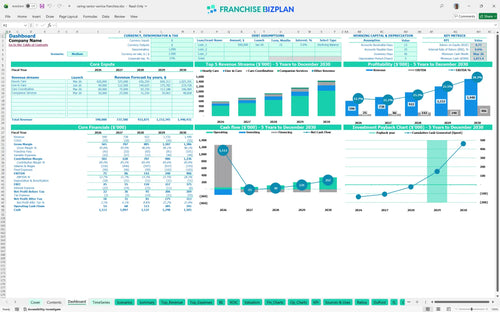
All-in-one Dashboard
Core inputs and core outputs



This Excel template for home care franchise financial forecasting includes everything from CAPEX schedules to detailed payroll tracking for recruiters and service directors.
Core inputs and core outputs
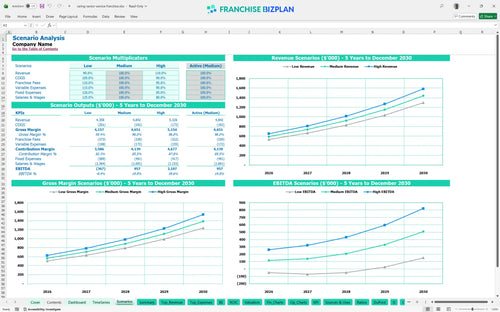
Three scenario analysis
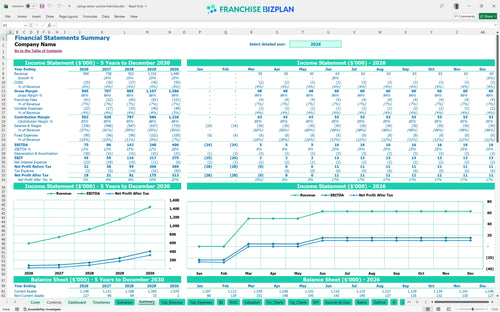
Presentation ready
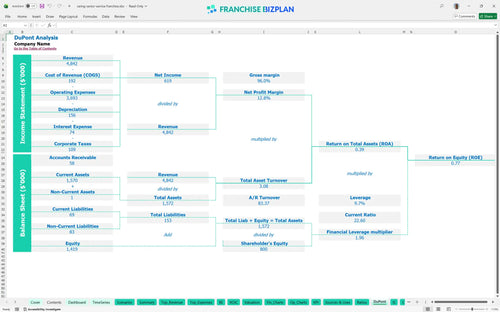
DuPont analysis
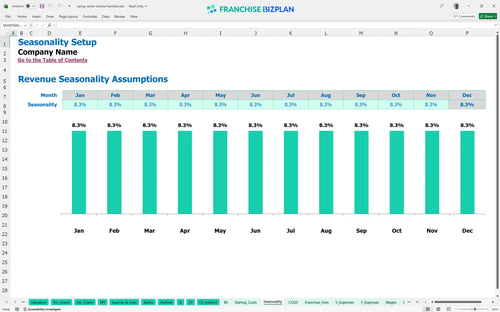
Researched revenue assumptions
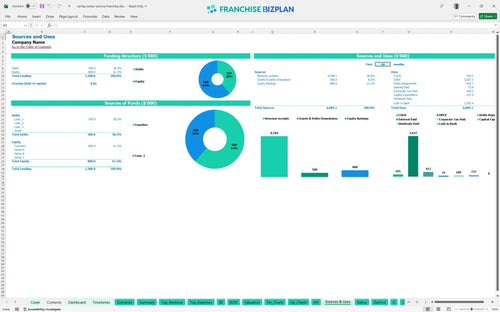
Lender-friendly financial outputs
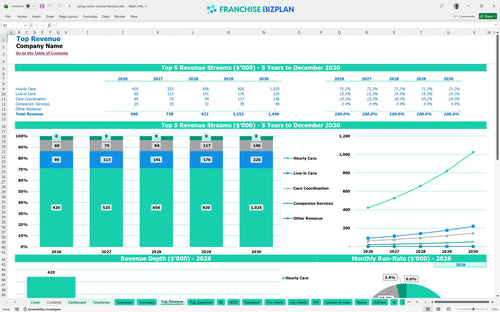
Revenue stream detailed view
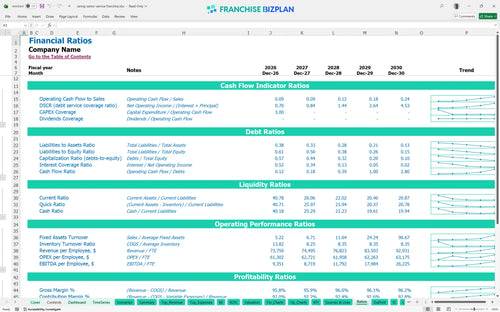
Performance metrics benchmark
We built this senior care business plan Excel model using deep research into the home care sector. The pre-populated data includes four primary revenue streams-like hourly care and care coordination-and accounts for $157,000 in upfront capital costs. You can use these researched numbers to see how a $590,000 first-year revenue target translates into a $75,000 EBITDA while keeping the ability to edit every single line item as your local demand shifts.
The unit hits positive EBITDA of $75,000 in the first year and scales significantly by Year 5 to $406,000. Profitability defintely accelerates as you move past the initial 4-month breakeven period and start leveraging fixed costs like the $4,200 monthly rent. Honestly, the real gains show up in Year 4 when EBITDA jumps to $248,000 as care coordination and live-in services mature.
You need approximately $157,000 for the initial launch, covering the franchise fee and office setup. This startup budget template for senior home care services also accounts for a significant cash buffer, as the minimum cash point hits $1,073,000 in May 2026. Most of your funds go toward the brand fee and getting the Scottsdale-style high-visibility office ready for clients.
The financial model for new senior care franchise owners shows a 4-year payback period on the initial investment. With an internal rate of return (IRR) of 4.58% and a return on equity (ROE) of 0.77, the investment is steady but requires patience. The long-term value is in the Year 5 performance where net margins expand as the caregiver roster reaches 10.5 full-time equivalents.
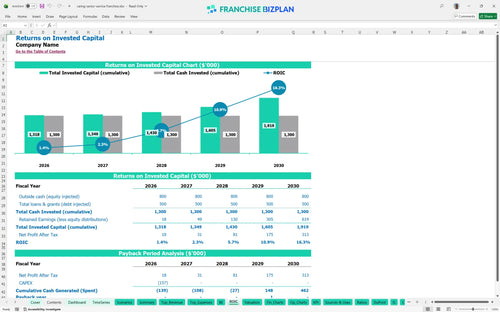
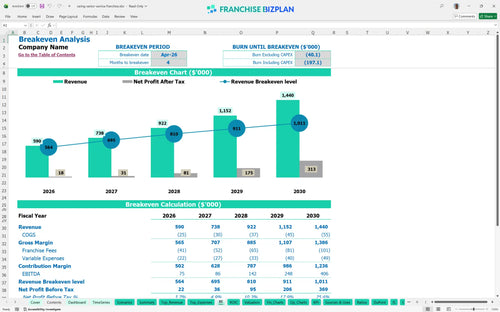
You reach the break-even point in April 2026, just four months after launching. The biggest driver for hitting this fast is managing caregiver labor costs and ensuring the $40,000 in care coordination revenue starts on time. If you miss your caregiver recruitment targets, the fixed costs like the $550 Tendio software fee and $4,200 rent will stretch that timeline quickly.
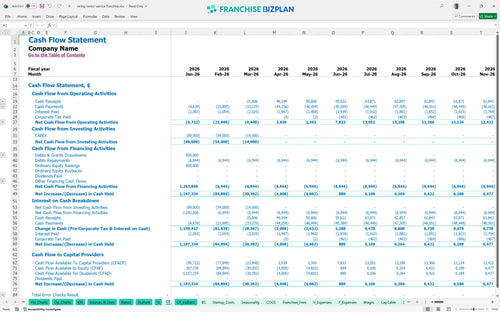
Your lowest cash point occurs in May 2026 at $1,073,000, which includes your initial financing and operating reserves. You need to watch the timing between paying caregivers and collecting from affluent retirees or insurance providers. Still, the 4-month ramp-up is relatively short for this industry, so your runway is protected if you keep a tight lid on pre-opening expenses.
In a high-growth scenario, hitting the $1.44 million revenue mark by Year 5 transforms the unit into a high-margin asset. If revenue drops 10%, the 5% royalty and 2% marketing fee stay constant, which puts heavy pressure on your $70,000 Service Director salary. The difference between a medium and high case usually comes down to caregiver retention and the average hours per client.
Finance: update unit break-even and payback model by Friday.
This senior care franchise financial model is built in Excel to give you total control over your territory's numbers. You can swap out pre-filled formulas and editable assumptions to match your specific market, whether you are looking at a high-density urban area or a spread-out suburban zone. It is a flexible franchise financial projection template that handles everything from local caregiver wages to specific office lease terms without breaking the logic.

Planning for the long haul is the only way to survive in the non-medical home care business. This tool provides a detailed 5-year outlook, showing revenue growing from $590,000 in Year 1 to over $1.4 million by Year 5. You get a clear view of how your profit and cash flow evolve as you scale from a handful of clients to a mature operation with a full roster of caregivers.

Analyzing franchise royalty fees in financial projections is critical because they eat into your store-level margin every single month. This model automatically calculates the 5% royalty and 2% marketing fund contributions based on your gross sales. It defintely helps you see the real cost of the brand's support and software systems like Tendio before you sign the agreement.

Knowing how to calculate startup costs for a senior care franchise prevents mid-launch cash crunches. The model aggregates your $49,000 franchise fee, leasehold improvements, and initial marketing to show a total initial investment. It then maps these against your monthly burn to find the exact sales volume you need to stop losing money and start making it.

We have included senior care franchise revenue stream analysis and expense benchmarks so you can sanity-check your plan. If your caregiver labor costs are way off the $29,000 per FTE average or your rent exceeds the $4,200 monthly baseline, the model flags it. This helps you stay realistic about franchise unit economics compared to other operators in the system.


Simply purchase and download the financial model template, then access it instantly using Microsoft Excel or Google Sheets. No installation or technical expertise required-just open and start working.

Enter your business-specific numbers, including revenue projections, costs, and investment details. The pre-built formulas will automatically calculate financial insights, saving you time and effort.

Leverage the investor-ready format to confidently showcase your financial projections to banks, franchise representatives, or investors. Impress stakeholders with clear, data-driven insights and professional reports.

Leverage the investor-ready format to confidently present your projections to banks, franchise representatives, or investors.