


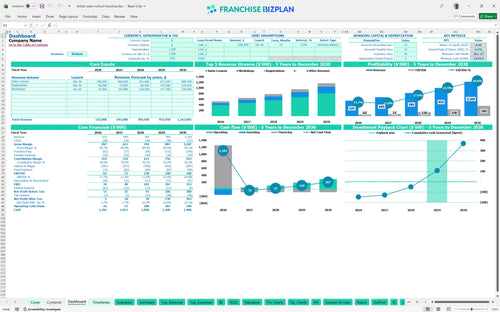
All-in-one Dashboard
Core inputs and core outputs



This comprehensive Excel financial model for franchise unit profitability includes a detailed breakdown of swim school franchise operating expenses, five-year revenue forecasts, and a complete franchise unit cash flow projection template.
Core inputs and core outputs
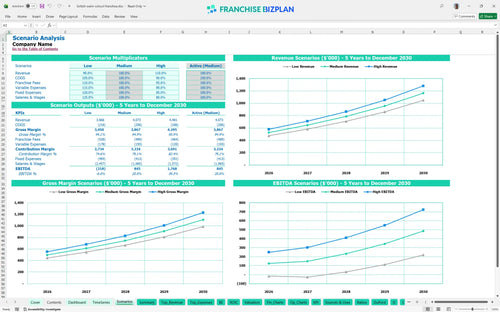
Three scenario analysis
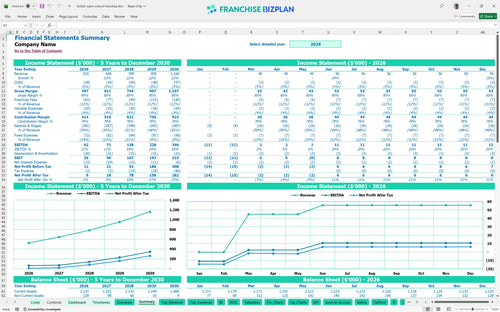
Presentation ready
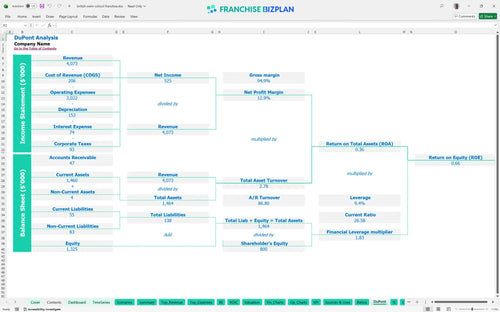
DuPont analysis
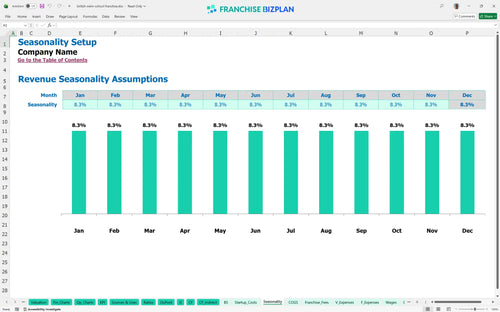
Researched revenue assumptions
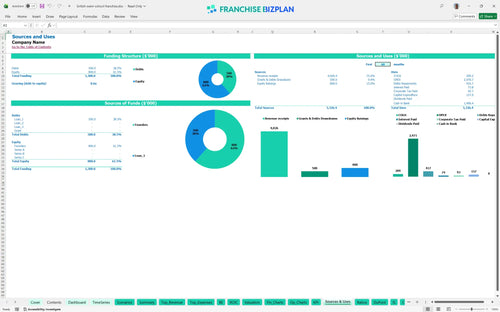
Lender-friendly financial outputs
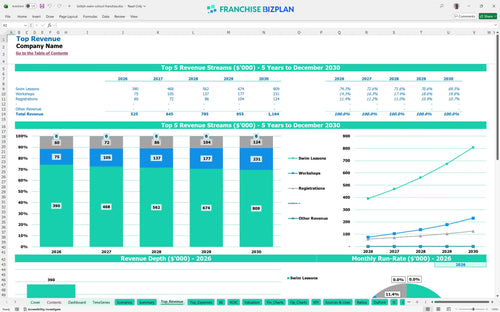
Revenue stream detailed view
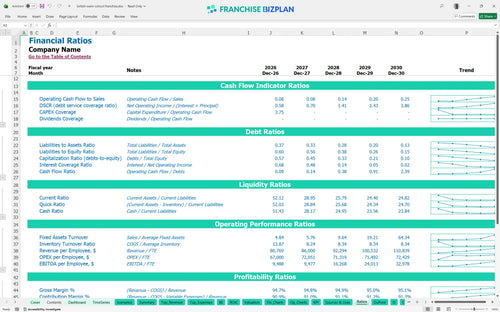
Performance metrics benchmark
We built this British Swim School Franchise franchise unit financial model using our own research to provide a realistic roadmap for your investment. The model comes pre-populated with specific data, such as a $59,500 franchise fee and 12% total royalty/marketing burden, while remaining fully editable for your local market. With year-one EBITDA projected at $62,000 and growing to $346,000 by year five, this tool gives you the precision needed for preparing a business plan for a swim school franchise.
The franchise unit achieves profitability in its first year of operation, generating $62,000 in EBITDA and scaling significantly as enrollment density increases. By year five, net profit reaches $346,000 as fixed costs like the $3,000 monthly pool access fee are spread across a much larger student base.
You need approximately $157,000 in total capital to launch the unit, covering everything from the initial franchise fee to equipment and pre-opening marketing. This investment leverages the pool-sharing model, which defintely keeps your upfront costs lower than building a dedicated aquatic facility.
Investors can expect a 4.25% Internal Rate of Return (IRR) with a full payback of the initial investment within 4 years. While the initial return seems modest, the long-term cash flow stability is supported by a 0.66 Return on Equity (ROE) as the unit matures.
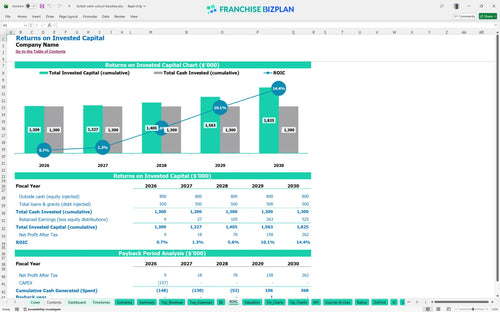
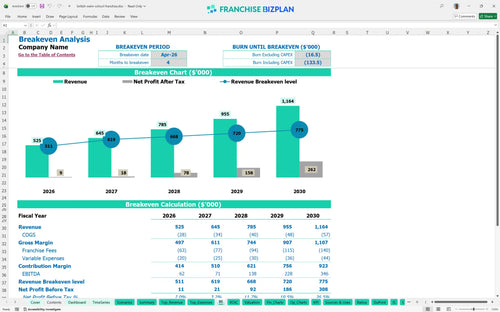
The unit reaches its monthly break-even point in April 2026, just four months after the initial setup begins and two months after lessons start. This rapid break-even is driven by the low fixed overhead of the pool-sharing model and the high demand for survival-first swim lessons.
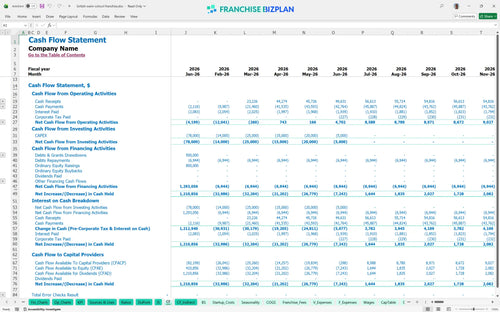
The model shows a minimum cash position of $1,071,000 in December 2027, suggesting a very strong liquidity buffer is maintained throughout the ramp-up phase. Still, you should monitor the gap between your $157,000 startup spend and your first few months of $30,000+ in monthly operating expenses.
In a high-growth scenario, increasing student volume by 20% dramatically pulls forward your payback period and boosts your year-5 EBITDA well beyond $346,000. Conversely, a low-growth case where registrations lag by 15% will tighten margins quickly due to the fixed $85,000 Aquatics Director salary.
This franchise unit financial model template provides a flexible Excel environment where you can adjust every variable to fit your specific territory. It features pre-filled formulas and editable assumptions for recurring revenue modeling and operational overhead forecasting, allowing you to swap out pool rental rates or instructor wages as local market conditions shift. You can easily modify the timing of your launch or the speed of your student enrollment to see how it impacts your bottom line.

Long-term planning is essential for a swim school business financial projections, and this model delivers a detailed 5-year outlook. It tracks your growth from an initial $525,000 in year one to a mature $1,164,000 by year five, giving you a clear view of how scaling student volume improves your store-level margin. The model includes integrated profit and loss statements, balance sheets, and cash flow views to ensure you have a complete franchise investment feasibility study for your bank or partners.

Understanding the real cost of your brand partnership is vital, so we built a dedicated franchise royalty fee calculator into the core logic. The model automatically applies a 10% royalty and a 2% marketing fund contribution against your gross sales, ensuring you never overlook these critical obligations. By mapping out these ongoing costs alongside your initial $59,500 franchise fee, you get a realistic picture of the cash remaining for local operations and owner draws.

Launching a new territory requires precise capital expenditure analysis to avoid mid-ramp liquidity crunches. This tool helps you calculate startup costs for a swim school franchise by totaling your $157,000 initial investment, including equipment, training, and legal fees. It then identifies the exact monthly revenue needed to cover your fixed pool facility access fees and staff salaries, providing a clear roadmap to your first month of positive cash flow.

We have integrated best practices for franchise financial performance tracking to help you sanity-check your numbers against the pool-sharing model. The model uses researched data for instructional supplies and pool usage fees-estimated at roughly 5% of revenue-to ensure your cost of goods sold (COGS) stays within a realistic range. This allows you to compare your labor costs, like the $85,000 Aquatics Director salary, against typical industry standards to maintain a healthy store-level EBITDA.


Simply purchase and download the financial model template, then access it instantly using Microsoft Excel or Google Sheets. No installation or technical expertise required-just open and start working.

Enter your business-specific numbers, including revenue projections, costs, and investment details. The pre-built formulas will automatically calculate financial insights, saving you time and effort.

Leverage the investor-ready format to confidently showcase your financial projections to banks, franchise representatives, or investors. Impress stakeholders with clear, data-driven insights and professional reports.

Leverage the investor-ready format to confidently present your projections to banks, franchise representatives, or investors.