


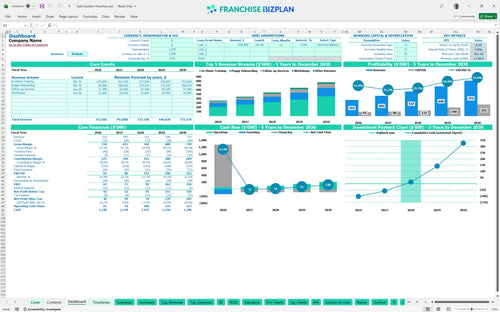
All-in-one Dashboard
Core inputs and core outputs



This franchise financial model template provides a complete Excel-based toolkit for projecting revenue, managing expenses, and calculating ROI for mobile pet service business units.
Core inputs and core outputs
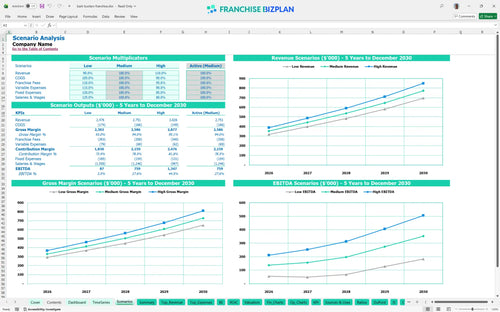
Three scenario analysis
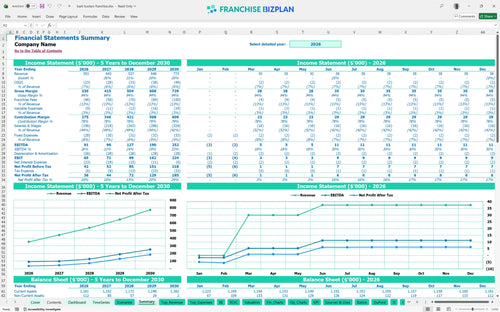
Presentation ready
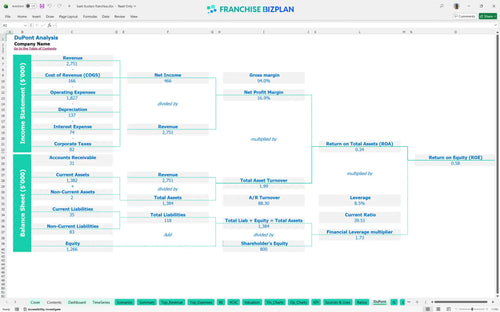
DuPont analysis
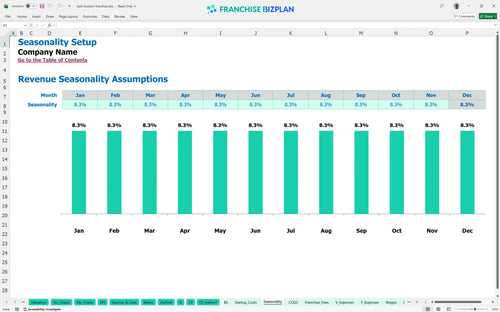
Researched revenue assumptions
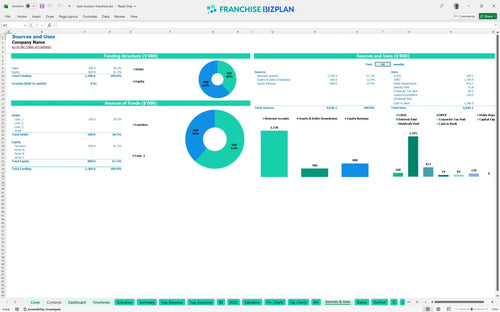
Lender-friendly financial outputs
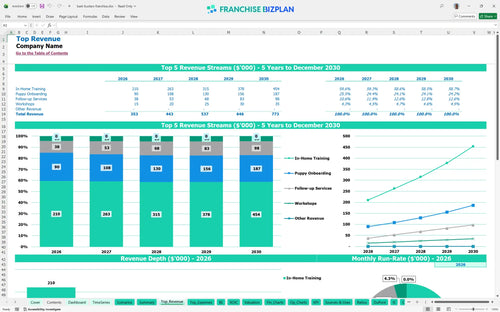
Revenue stream detailed view
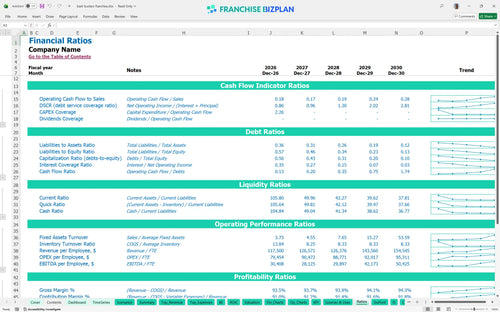
Performance metrics benchmark
We built this franchise unit financial model using deep research into the unit economics of this specific pet training concept. Key assumptions like the $353,000 year-one revenue and the 10% royalty structure are pre-populated and fully editable to match your local market. It defintely helps you see how the $138,500 startup cost translates into a 5.01% IRR over five years.
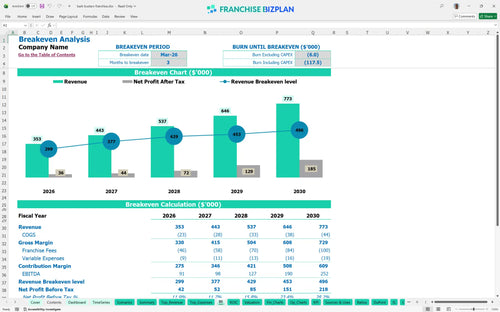
You can expect this unit to reach profitability quickly, with the model projecting a break-even date in March 2026. After covering the 10% royalty and 3% marketing fees, the unit generates a $91,000 EBITDA in year one, scaling to $252,000 by year five. These dog training franchise profit margin projections depend on managing your lead trainer's $75,000 salary against growing session volume.
Learning how to calculate startup costs for a pet training franchise is the first step toward a successful launch. You need $138,500 in total capital, which includes the $49,500 franchise fee and $35,000 for a company vehicle. Other major uses include $15,000 for website development and $12,000 for initial marketing to jumpstart your local presence.
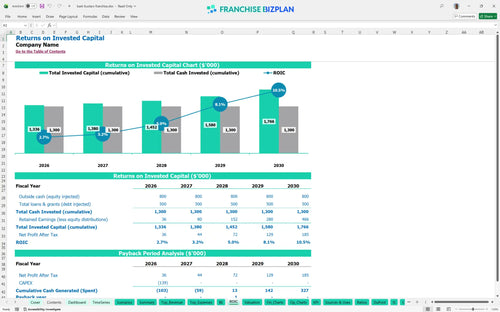
This franchise unit investment analysis spreadsheet shows a 3-year payback period and an Internal Rate of Return (IRR) of 5.01%. By projecting annual revenue for dog training franchise operations to grow from $353,000 to $773,000, your Return on Equity (ROE) reaches 0.58. The long-term value is clear as the EBITDA margin improves from 25% to over 32% by year five.
Your cash flow projection template for new franchises indicates a break-even point just 3 months after opening. To hit this, you must manage operational expense forecasting carefully, especially the $2,450 in monthly fixed costs like vehicle leases and insurance. The primary lever for reaching this milestone is session volume, as the 13% total fee burden remains constant regardless of sales.
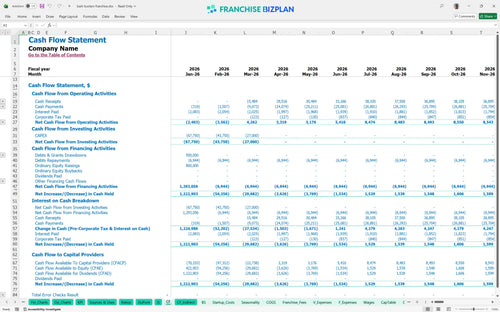
When estimating operating expenses for in-home pet business units, the lowest cash point is often the most dangerous. This financial model for service-based franchise units shows your cash dipping to $1,130 in June 2026. You should maintain a small cash buffer to handle the ramp-up phase, especially since your $15,000 website and $12,000 marketing costs hit early in the cycle.
Using this franchise business plan template for service providers, you can test how Low, Medium, and High scenarios change your outcome. A High-growth scenario driven by strong local marketing execution can significantly shorten the 3-year payback period. However, if year-one revenue falls below the $353,000 target, the fixed $159,000 wage bill will put immediate pressure on your cash runway.
Finance: update unit break-even and payback model by Friday
This franchise unit business plan template lives in Excel, so you can tweak every number to fit your specific territory. It includes pre-filled formulas for revenue drivers like in-home sessions and puppy onboarding, plus editable fields for local labor rates and rent. Whether you are scaling to multiple territories or staying lean, the logic adapts to your actual operating scenario.

Long-term planning is about more than just surviving the first year. This small business financial projection spreadsheet projects five years of performance, showing revenue climbing from $353,000 in year one to $773,000 by year five. It maps out how EBITDA scales as you add trainers and increase throughput, giving you a clear view of your future balance sheet and cash flow.

Franchising has specific costs that can eat your margin if you don't track them properly. We built in logic for the franchise royalty fee structure and the 3% marketing fund contribution based on gross sales. By seeing these outflows alongside your $49,500 initial franchise fee, you get a realistic look at the true cost of ownership and ongoing obligations.

Launching requires a clear capital expenditure planning strategy to avoid early cash crunches. This model aggregates your $138,500 initial investment, covering everything from trainer certification to your company vehicle. It then calculates the exact sales volume needed to cover your $900 monthly vehicle lease and other fixed costs, so you have a clear break-even analysis for franchises target from day one.

Don't guess if your $75,000 lead trainer salary or 3.5% supply cost is normal for this sector. The model includes built-in benchmarks to help you sanity-check your franchise revenue modeling against industry standards. Comparing your projected 25% year-one EBITDA margin against typical ranges ensures your franchise profitability analysis is grounded in reality, not just optimism.


Simply purchase and download the financial model template, then access it instantly using Microsoft Excel or Google Sheets. No installation or technical expertise required-just open and start working.

Enter your business-specific numbers, including revenue projections, costs, and investment details. The pre-built formulas will automatically calculate financial insights, saving you time and effort.

Leverage the investor-ready format to confidently showcase your financial projections to banks, franchise representatives, or investors. Impress stakeholders with clear, data-driven insights and professional reports.

Leverage the investor-ready format to confidently present your projections to banks, franchise representatives, or investors.