


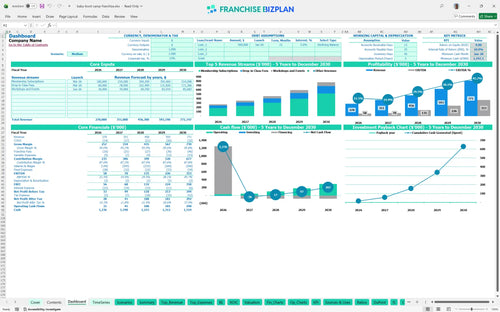
All-in-one Dashboard
Core inputs and core outputs



This Excel template for franchise financial forecasting provides a complete roadmap for launching and scaling a mobile fitness unit with integrated membership and event revenue streams.
Core inputs and core outputs
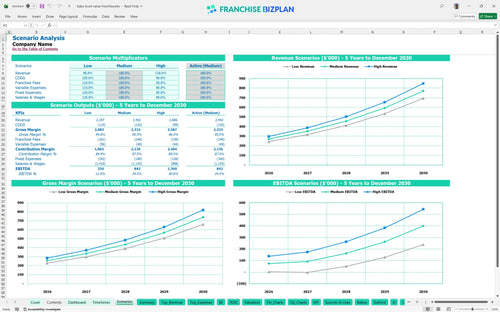
Three scenario analysis
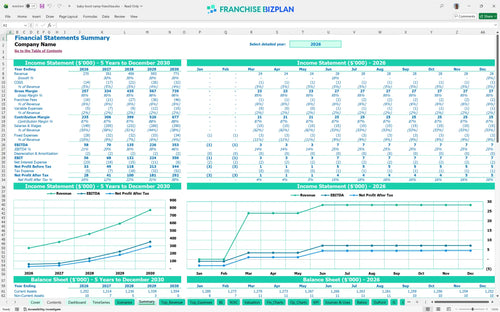
Presentation ready
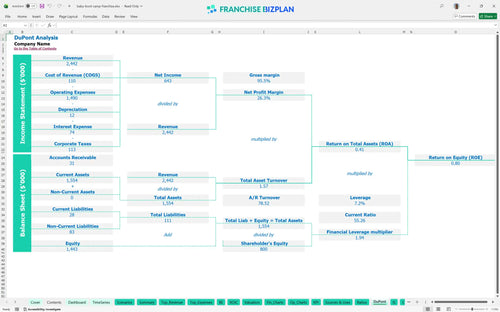
DuPont analysis
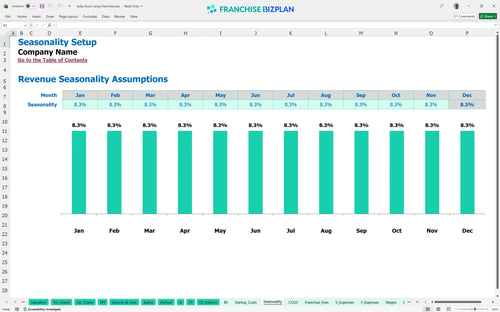
Researched revenue assumptions
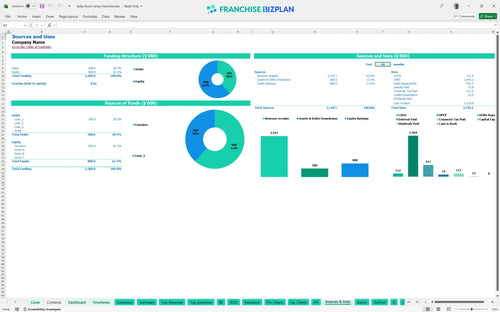
Lender-friendly financial outputs
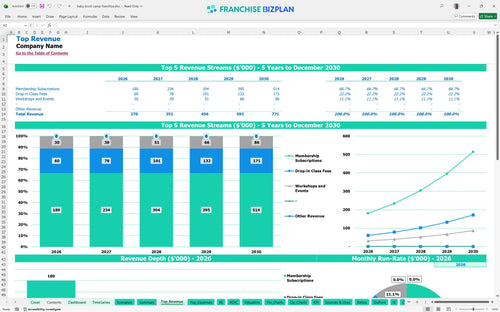
Revenue stream detailed view
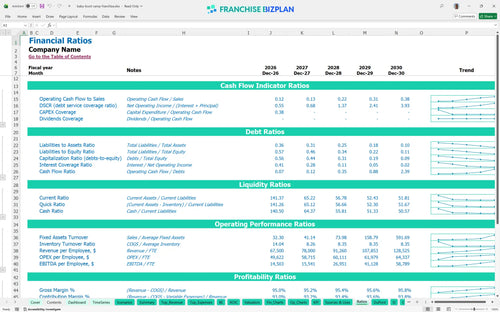
Performance metrics benchmark
We developed this financial model for mother and baby fitness business owners based on deep research into mobile fitness units. The pre-populated data includes everything from $120,000 in first-year membership revenue to the 6% royalty structure, giving you a realistic starting point that is fully editable. With a year-five EBITDA of $353,000, the model shows how a lean operation can scale effectively in a high-density urban hub.
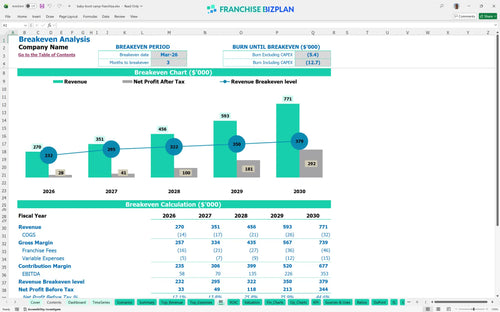
This unit hits its stride quickly, reaching breakeven by March 2026, just three months after launch. With year-one EBITDA starting at $58,000 and climbing to $353,000 by year five, the profitability analysis for boutique fitness franchises shows a strong upward curve as membership matures. Still, you need to watch the 1.2% payment processing fees which can eat into your net margin over time.
You need roughly $12,049 to get this off the ground, covering the $5,300 franchise fee and initial gear. This small business capital requirements estimate includes everything from $1,800 for fitness mats to $349 for local permits, ensuring you aren't surprised by hidden pre-opening costs. Honestly, having a small cash buffer is vital since your lowest cash point hits in early 2028.
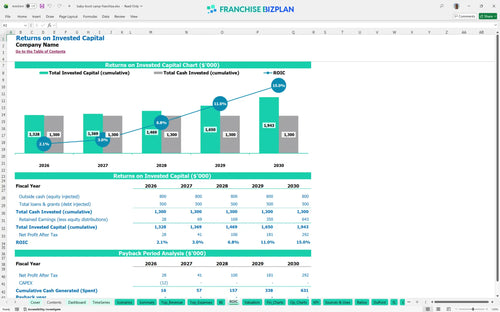
The franchise ROI calculation for new gym owners shows an Internal Rate of Return (IRR) of 18.86%. While the full payback period extends past year five due to the growth-focused reinvestment in instructors, the 0.8 Return on Equity (ROE) suggests a solid performance for a lean, mobile model. Here's the quick math: your year-five revenue of $771,000 is nearly triple your year-one start.
You hit break-even in month three, March 2026. The main driver here is membership volume; because fixed costs like the $650 park permit and $750 marketing budget are relatively low, reaching about $15,000 in monthly sales covers your overhead and instructor wages. If opening takes 90+ days longer than planned, your working capital pressure will rise significantly.
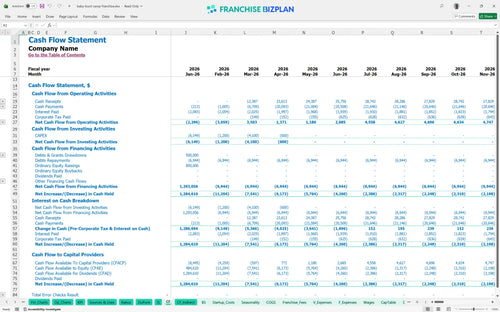
Your lowest cash point is $1,197 in January 2028. This suggests that while the unit is profitable, the timing of instructor raises or equipment replacement could tighten liquidity, so keeping a small cash buffer is smart. Estimating monthly operating expenses for a franchise accurately is the only way to navigate these tight windows without extra debt.
This pre-written financial model for fitness franchise owners allows you to toggle between performance levels. A High scenario, driven by better retention in the $120,000 membership line, significantly pulls forward the payback date, while a Low scenario might require more working capital during the 2028 cash dip. Every 1-point margin leak in instructor pay matters fast in this model.
This franchise financial model template is built in Excel, allowing you to tweak every variable from membership pricing to instructor headcounts. It uses pre-filled formulas and editable assumptions so you can defintely test different Austin-specific scenarios without starting from scratch. Here's the quick math: changing your membership price by just $5 can shift your year-one EBITDA by thousands.

Planning for the long haul requires more than just a guess at next month's sales. This franchise business plan Excel tool provides a detailed 5-year outlook, showing how revenue scales from $270,000 in year one to $771,000 by year five. What this estimate hides is the complexity of scaling your instructor team as class demand grows, which we've modeled through FTE (Full-Time Equivalent) forecasts.

We built in specific fields for the $5,300 initial franchise fee and the ongoing 6% franchise royalty fees. This ensures your fitness studio financial projections account for every dollar owed to the franchisor before you calculate your take-home pay. Since the marketing fund contribution is currently 0%, you have more room to fund local Mueller-specific promotions to drive traffic.

Knowing how to calculate startup costs for a fitness franchise is the first step to avoiding a cash crunch. The model maps out the $12,049 initial investment-including equipment and permits-and identifies the exact sales level required to cover your $2,550 in monthly fixed costs. If your park permit or insurance costs spike, the model automatically adjusts your break-even point.

This tool helps with post-natal fitness market analysis by comparing your projected margins against industry standards. It includes benchmarks for instructor wages and park permit fees, helping you spot if your operating expense forecasting is too optimistic. To be fair, your store-level margin depends heavily on keeping fitness prop costs under 3.5% of total revenue.


Simply purchase and download the financial model template, then access it instantly using Microsoft Excel or Google Sheets. No installation or technical expertise required-just open and start working.

Enter your business-specific numbers, including revenue projections, costs, and investment details. The pre-built formulas will automatically calculate financial insights, saving you time and effort.

Leverage the investor-ready format to confidently showcase your financial projections to banks, franchise representatives, or investors. Impress stakeholders with clear, data-driven insights and professional reports.

Leverage the investor-ready format to confidently present your projections to banks, franchise representatives, or investors.