


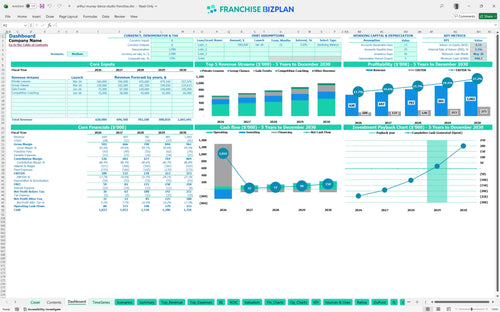
All-in-one Dashboard
Core inputs and core outputs



This franchise unit financial model template provides a complete Excel spreadsheet for franchise business financial planning, covering everything from initial CAPEX to long-term ROI.
Core inputs and core outputs
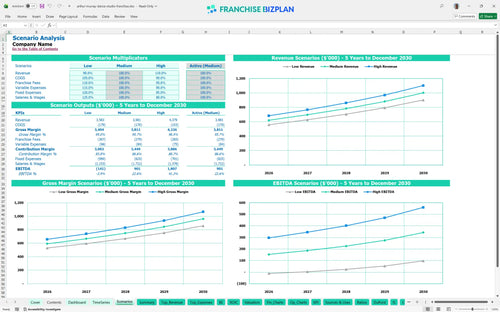
Three scenario analysis
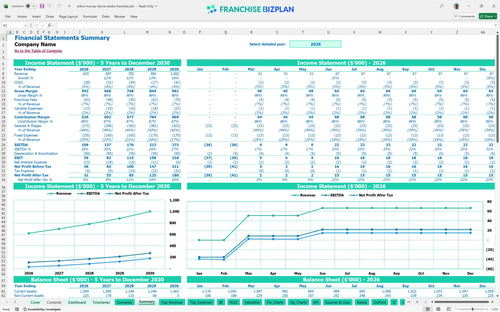
Presentation ready
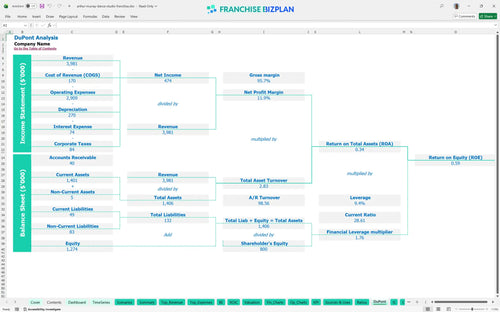
DuPont analysis
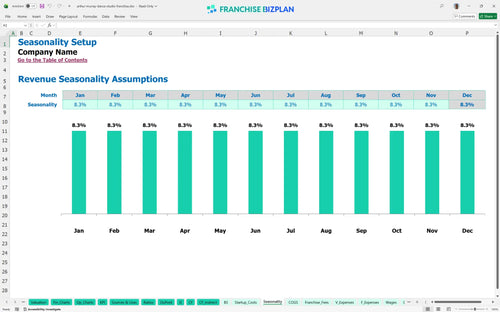
Researched revenue assumptions
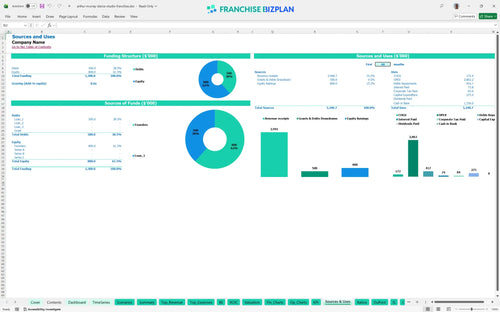
Lender-friendly financial outputs
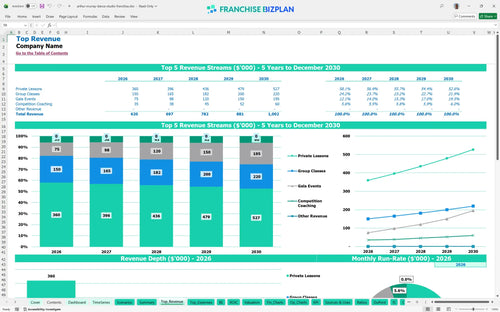
Revenue stream detailed view
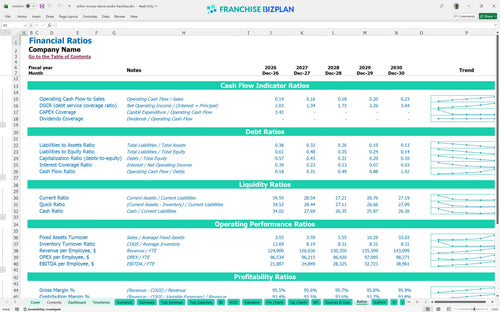
Performance metrics benchmark
We built this franchise unit financial model using our own research into the luxury ballroom instruction market. Key assumptions, including the $620,000 Year 1 revenue target and the 4-year payback period, are pre-populated but fully editable to match your local SouthPark or similar high-end demographic. This tool defintely helps you visualize the path from a $100,000 franchise fee to a mature, profitable studio.
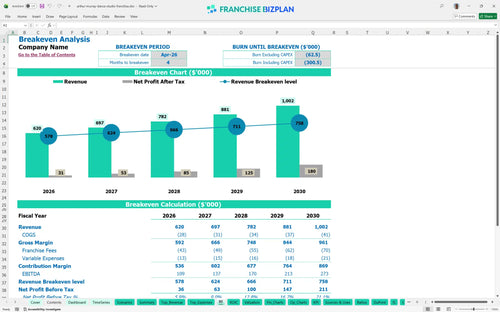
Based on the data, the unit hits its break-even date in April 2026, just four months after launching. With Year 1 EBITDA projected at $109,000, the model shows steady growth reaching $273,000 by Year 5 as student retention and gala events scale. Profitability depends on maintaining high-ticket private lessons which start at $240,000 annually. Speed to profit is all about your pre-opening sales funnel.
You will need significant capital to launch, with the model showing a minimum cash requirement of $941,000 by May 2026. This covers the $100,000 franchise fee, $60,000 in leasehold improvements, and $35,000 for professional dance floor installation. Estimating operating expenses for a high-end dance studio requires accounting for these premium assets early. High-end finishes attract high-end clients.
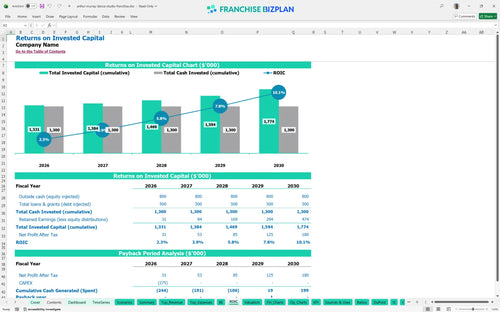
The model projects an Internal Rate of Return (IRR) of 3.21% and a Return on Equity (ROE) of 0.59. While the initial investment is high, the payback period is estimated at 4 years, which is standard for luxury service franchises with significant build-out costs. Analyzing return on investment for franchise locations requires looking past the first year of ramp-up losses. Patience is a requirement in the ballroom business.
Monthly break-even occurs in month 4, driven heavily by private lesson volume and group class attendance. Since fixed costs like the $9,000 prime location rent and $1,200 utilities are constant, student throughput is the biggest factor in covering your monthly nut. How to calculate startup costs for a dance studio franchise starts with identifying these fixed obligations. Every empty slot on the dance floor is lost margin.
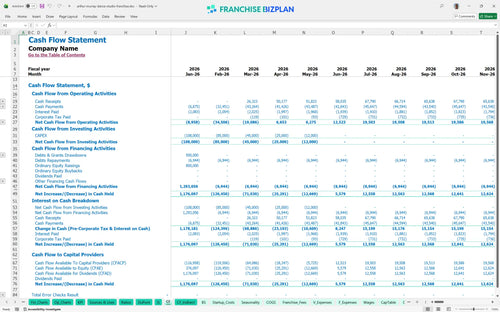
The lowest cash point occurs in May 2026, hitting $941,000 according to the projections. You need to maintain a substantial buffer to handle the timing gaps between your $273,000 in Year 5 EBITDA and the initial heavy CAPEX spend. Budgeting for dance studio franchise marketing and events is essential to ensure you don't run dry during the critical month 5 dip. Cash is your oxygen during the ramp-up phase.
Financial projections for luxury service franchises allow you to toggle between Low, Medium, and High cases. A 10% drop in private lesson revenue significantly delays the 4-year payback, while the High case leverages fixed rent to double your Year 5 net profit. Revenue forecasting must be conservative because luxury spending can be sensitive to local economic shifts. Plan for the worst but execute for the best.
This dance studio franchise financial model is fully customizable in Excel, featuring pre-filled formulas and editable assumptions. You can easily adjust lesson pricing, student volume, and instructor commissions to fit your specific territory or local market conditions. This flexibility allows you to stress-test various operating scenarios before committing capital. One-size-fits-all models don't work for luxury services, so we made every driver adjustable.

Map out your long-term studio performance with detailed 5-year revenue, cost, and profit projections. This ballroom dance studio business plan accounts for the gradual ramp-up of private lesson packages and the scaling of competitive coaching fees over time. It provides a clear view of how your EBITDA grows from $109,000 in Year 1 to $273,000 by Year 5. Long-term planning is the only way to manage a high-end service brand effectively.

The model captures specific financial obligations like the $100,000 initial fee and ongoing 5% royalty payments. It ensures you see the real impact of the 2% marketing fund contribution on your monthly bottom line before you sign the agreement. Understanding these royalty fees is critical because they come off the top, regardless of your local rent or labor costs. Every dollar sent to the franchisor must be offset by brand-driven value.

Use this franchise startup cost template to estimate your total initial investment, including leasehold improvements and specialized dance floor installation. It calculates the exact sales volume needed to cover your $9,000 monthly rent and other fixed overheads. Knowing your break-even point helps you set realistic targets for your sales team from day one. If you don't know your floor, you can't find your ceiling.

We've integrated industry benchmarks to help you sanity-check your labor costs and gross margins. Comparing your instructor payroll against typical boutique fitness franchise metrics ensures your unit economic performance metrics remain competitive and realistic. This prevents you from over-hiring before your student base can support the additional salary expense. Data-driven benchmarks take the guesswork out of studio management.


Simply purchase and download the financial model template, then access it instantly using Microsoft Excel or Google Sheets. No installation or technical expertise required-just open and start working.

Enter your business-specific numbers, including revenue projections, costs, and investment details. The pre-built formulas will automatically calculate financial insights, saving you time and effort.

Leverage the investor-ready format to confidently showcase your financial projections to banks, franchise representatives, or investors. Impress stakeholders with clear, data-driven insights and professional reports.

Leverage the investor-ready format to confidently present your projections to banks, franchise representatives, or investors.