


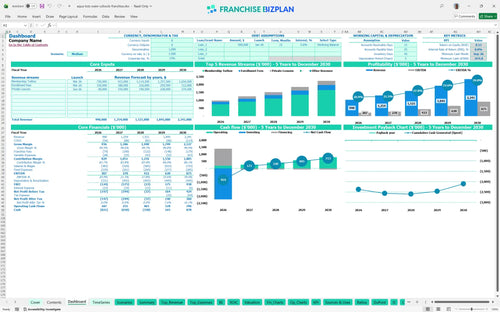
All-in-one Dashboard
Core inputs and core outputs



This franchise financial projection tool includes a complete Excel-based framework with pre-populated CAPEX, revenue streams, and payroll schedules tailored for premium aquatic centers.
Core inputs and core outputs
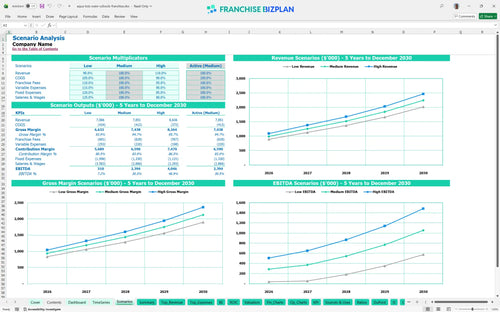
Three scenario analysis
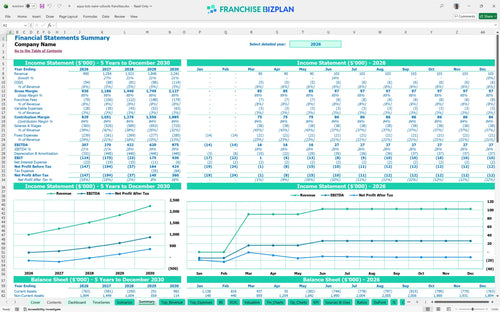
Presentation ready
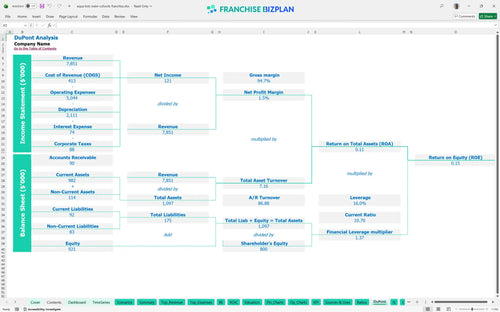
DuPont analysis
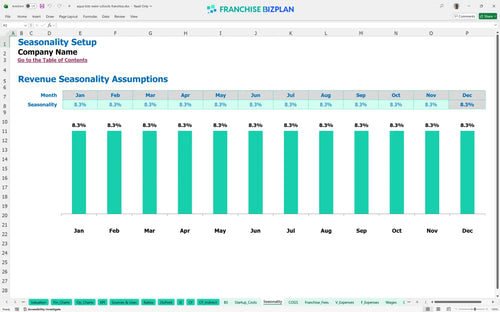
Researched revenue assumptions
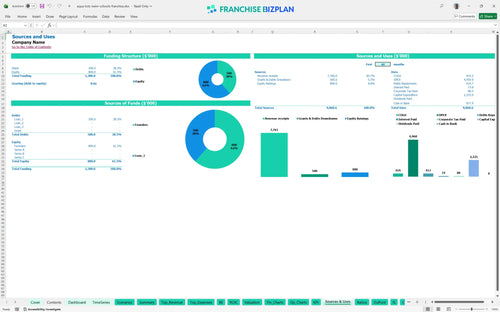
Lender-friendly financial outputs
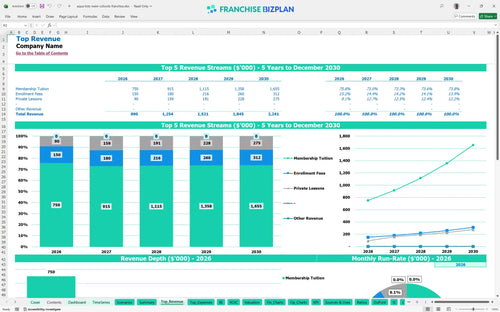
Revenue stream detailed view
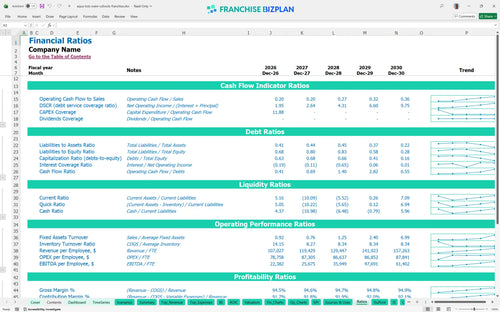
Performance metrics benchmark
We built this franchise unit financial model using our own research to help you navigate the high-CAPEX world of aquatic centers. The key assumptions-covering everything from the $1 million pool construction to recurring membership tuition-are pre-populated with data for this specific swim school model and are fully editable. With a projected year-one revenue of $990,000 and a 3-month path to operational break-even, the numbers show a strong but capital-intensive opportunity.
You can expect to see positive EBITDA almost immediately, with year one showing $207,000 in earnings. While the unit generates cash quickly after the March 2026 launch, the high initial investment means true accounting profitability takes time to settle. We calculate this by netting out your 8% franchise fees and heavy facility costs against recurring membership tuition.
Launching a premium indoor swim school requires substantial liquidity, with total project costs exceeding $2.2 million. This includes a $50,000 franchise fee and a massive $1.4 million allocation for pool construction and specialized HVAC systems. You also need to budget for the $875,000 minimum cash dip that occurs during the ramp-up phase.
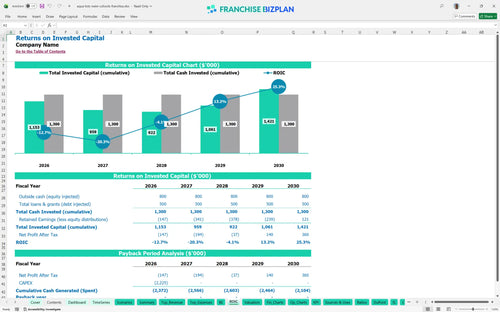
This is a long-term play where the return on equity (ROE) sits at 0.15, but the payback period extends beyond the five-year mark. While the IRR is effectively flat at -0.01% over the first five years due to the heavy $2.2M+ build-out, the cash flow matures significantly by year five. You are trading high upfront CAPEX for a stable, recurring revenue stream with an $875,000 annual EBITDA potential.
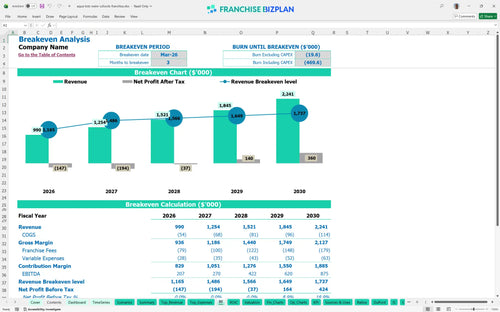
The model shows a fast operational break-even just 3 months after opening in March 2026. To cover your $12,000 rent and $20,000+ in monthly fixed costs, you need to move quickly through the enrollment funnel. The biggest lever here is membership volume; since your pool and staff costs are mostly fixed, every new student adds straight to the margin.
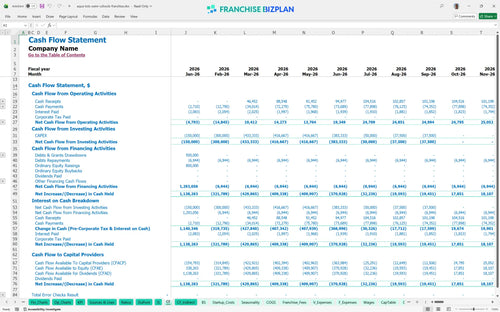
Your lowest cash point hits -$875,000 in September 2026, roughly six months after launch. This reflects the timing gap between finishing the $1.4 million pool/HVAC build-out and scaling the membership base. You need enough working capital to survive this trough before the recurring revenue starts to outpace the heavy facility overhead.
Evaluating profitability of a premium swim school franchise requires looking at Low, Medium, and High cases. A 10% drop in membership tuition can delay your payback by years, while hitting the High case accelerates your EBITDA toward that $875,000 target. The model shows that your year-one margin is very sensitive to how fast you can fill those 4:1 class spots.
This swim school franchise financial model is built in Excel, allowing you to modify every assumption to fit your specific territory. Whether you are adjusting the 4:1 student-to-instructor ratio or local utility rates, the pre-filled formulas handle the heavy lifting. It is a flexible tool designed to help you stress-test different occupancy levels and pricing tiers before you sign a lease.

Mapping out a five-year horizon is essential for an indoor swim school investment analysis. This model tracks your growth from an initial $990,000 in year one to a projected $2.24 million by year five as your membership base matures. You get a clear view of how scaling from 5 to 9 swim instructors impacts your bottom line over time. Honestly, seeing the long-term EBITDA climb to $875,000 helps justify the massive upfront construction costs.

Royalties and brand funds are 'off-the-top' expenses that never go away, so we built a franchise royalty fee calculator directly into the logic. At an 8% combined load (6% royalty plus 2% marketing), a mature unit doing $2.2 million in sales sends over $179,000 back to the franchisor annually. This tool ensures you account for every dollar of brand-mandated spending alongside your local operating costs. It defintely prevents surprises when calculating your true store-level margin.

Figuring out how to calculate startup costs for a swim school franchise is the first hurdle for any new owner. Between the $1 million pool construction and $400,000 for HVAC and filtration, your 'all-in' number is significant. This swim school franchise ROI and break-even analysis shows you exactly how many enrollment fees and monthly memberships you need to cover your $12,000 monthly rent. Most units hit a cash break-even quickly, but the full capital recovery takes much longer.

We use real-world data to set guardrails for your operating expense forecasting. For example, pool chemicals and towels should hover around 5.5% of sales, while labor for instructors and directors is your biggest variable. Comparing your projected $207,000 year-one EBITDA against industry norms helps you see if your staffing plan is too heavy or too lean. It is a sanity check to ensure your swim school business plan template is not based on 'best-case' fantasies.


Simply purchase and download the financial model template, then access it instantly using Microsoft Excel or Google Sheets. No installation or technical expertise required-just open and start working.

Enter your business-specific numbers, including revenue projections, costs, and investment details. The pre-built formulas will automatically calculate financial insights, saving you time and effort.

Leverage the investor-ready format to confidently showcase your financial projections to banks, franchise representatives, or investors. Impress stakeholders with clear, data-driven insights and professional reports.

Leverage the investor-ready format to confidently present your projections to banks, franchise representatives, or investors.