


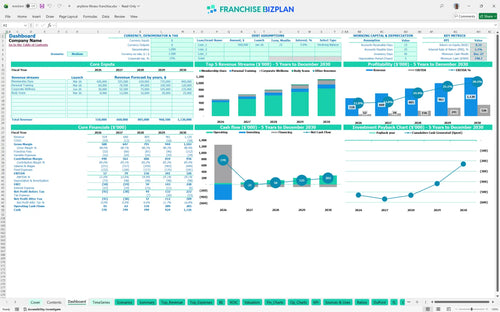
All-in-one Dashboard
Core inputs and core outputs



This Excel template for gym franchise financial projections provides everything needed to estimate startup costs, forecast 5-year revenue, and evaluate long-term investment returns for a single-unit fitness operation.
Core inputs and core outputs
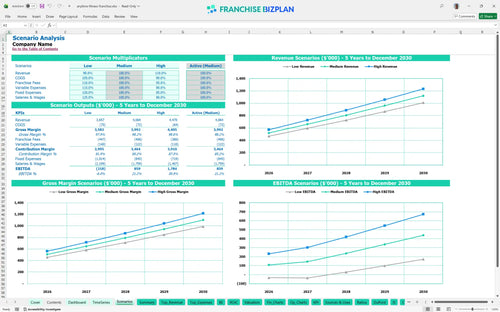
Three scenario analysis
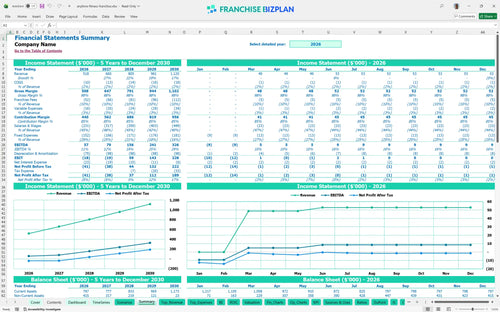
Presentation ready
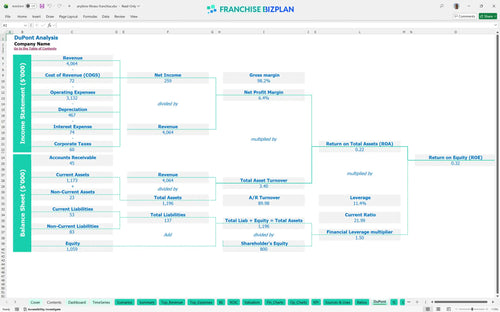
DuPont analysis
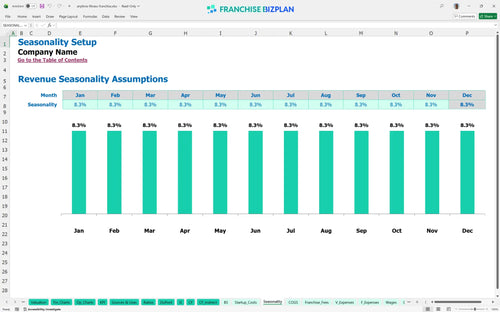
Researched revenue assumptions
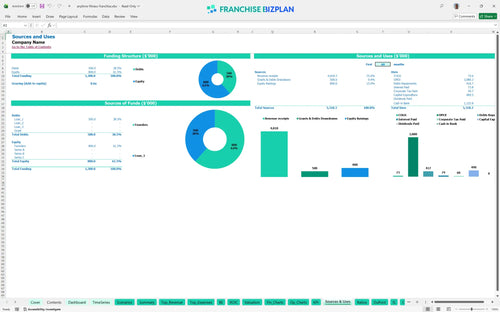
Lender-friendly financial outputs
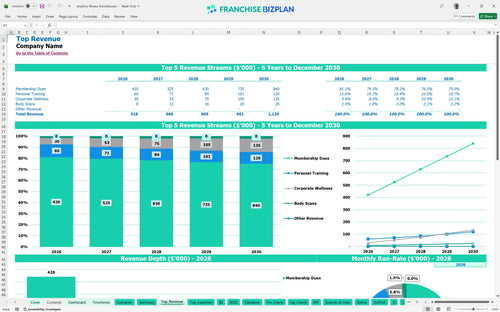
Revenue stream detailed view
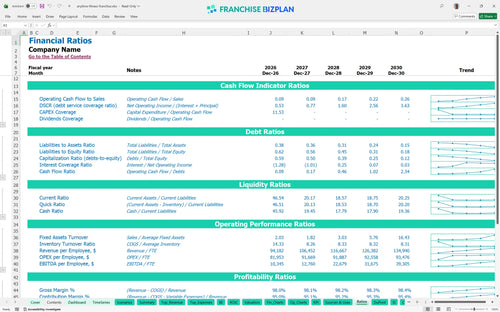
Performance metrics benchmark
We developed this Anytime Fitness Franchise franchise unit financial model using rigorous market research to ensure your franchise business plan template is grounded in reality. Key assumptions, including the $42,500 franchise fee, $130,000 in equipment CAPEX, and membership dues reaching $560,000 by year five, are pre-populated and fully editable to help you evaluate franchise unit economic performance with confidence.
The unit achieves positive EBITDA of $57,000 in the first year, but true bottom-line strength appears in year three as revenue hits $805,000. By year five, the model projects an EBITDA of $326,000 as membership dues and personal training revenue scale against fixed occupancy costs.
You need approximately $489,500 to launch, which covers the $42,500 franchise fee and $220,000 for leasehold improvements. This capital expenditure analysis includes $130,000 for cardio and strength equipment, plus $22,000 for Evolt scanners to drive data-driven wellness revenue.
The ROI for fitness franchise investors shows an Internal Rate of Return (IRR) of 1.12% and a Return on Equity (ROE) of 0.32. While the cash flow is consistent, the significant upfront build-out means the years to payback extend after year five, making this a long-term equity play.
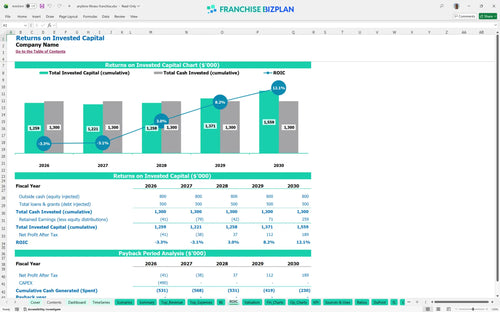
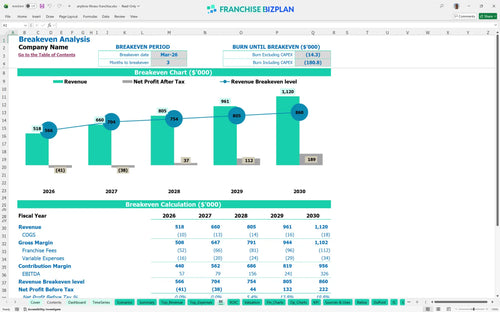
The gym reaches its break-even date in March 2026, just three months after opening. To cover the $13,400 in monthly fixed costs and royalties, you must focus on high-volume membership dues and maintaining a $40,000 annual personal training revenue stream in year one.
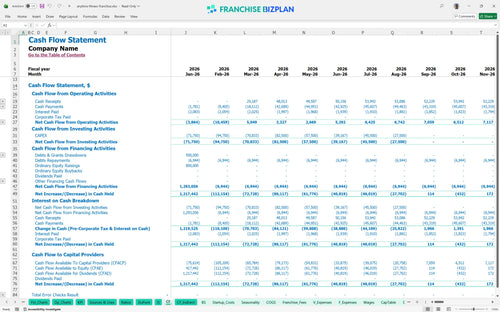
The lowest cash point is $749,000 in December 2027, providing a substantial buffer for 24-hour gym operations. Still, you should monitor the timing of the $220,000 build-out and equipment payments to ensure you don't face a liquidity crunch during the initial ramp-up phase.
In a low-revenue scenario, a 10% dip in membership dues defintely tightens the year-one EBITDA of $57,000 and delays the payback period. The high scenario, driven by strong corporate wellness contracts and personal training, can push the year-five EBITDA well beyond the $326,000 target.
This fitness franchise financial model is a completely editable Excel framework designed for precision and flexibility. You can adjust pre-filled membership data and local demografics to match your specific territory, using dynamic formulas that update your five-year outlook instantly when you change a single revenue or cost driver.

Planning for a gym requires looking well past the grand opening to understand long-term sustainability. This tool provides a 60-month view of revenue, scaling from $518,000 in year one to $1,120,000 by year five, while tracking your fitness center profit and loss statement to ensure margins remain healthy as you scale.

Royalties and brand funds are the ongoing costs of using a proven system, and they impact your store-level margin significantly. This model bakes in the 8% royalty and 2% marketing fund contributions, showing the real-world franchise royalty fee structure so you can see exactly how much cash stays in your pocket after the franchisor takes their cut.

Launching a 24-hour gym involves significant gym franchise startup costs, particularly the $220,000 allocated for leasehold improvements. This franchise investment calculator helps you determine the exact sales volume needed to cover your $7,000 monthly rent and $11,200 in total fixed costs, providing a clear break-even analysis for gyms.

We include industry-standard benchmarks for labor and occupancy to help you sanity-check your operational expense forecasting. If your staffing costs for trainers and managers deviate from the researched norms, the model highlights the gap, allowing you to use it as a financial modeling guide for new gym owners to maintain competitive margins.


Simply purchase and download the financial model template, then access it instantly using Microsoft Excel or Google Sheets. No installation or technical expertise required-just open and start working.

Enter your business-specific numbers, including revenue projections, costs, and investment details. The pre-built formulas will automatically calculate financial insights, saving you time and effort.

Leverage the investor-ready format to confidently showcase your financial projections to banks, franchise representatives, or investors. Impress stakeholders with clear, data-driven insights and professional reports.

Leverage the investor-ready format to confidently present your projections to banks, franchise representatives, or investors.