


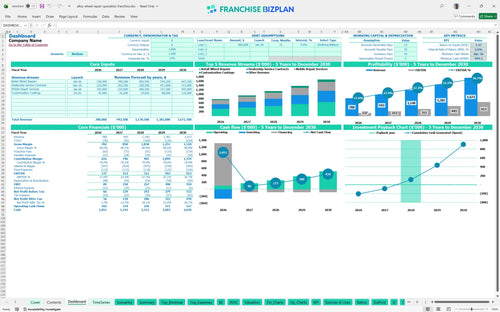
All-in-one Dashboard
Core inputs and core outputs



This franchise unit financial model template provides a professional Excel spreadsheet for franchise financial projections, including a full profit and loss statement and capital expenditure projection.
Core inputs and core outputs
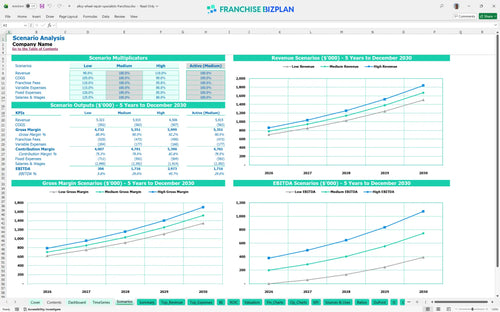
Three scenario analysis
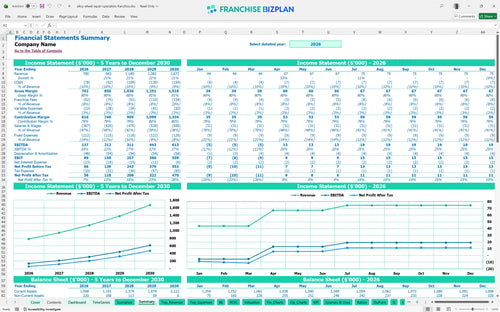
Presentation ready
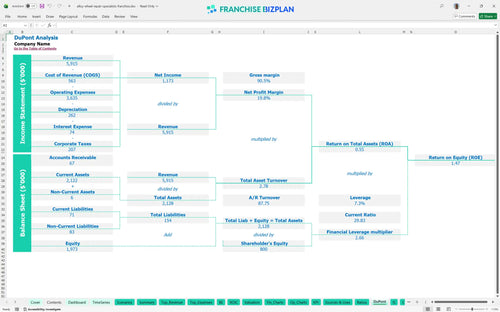
DuPont analysis
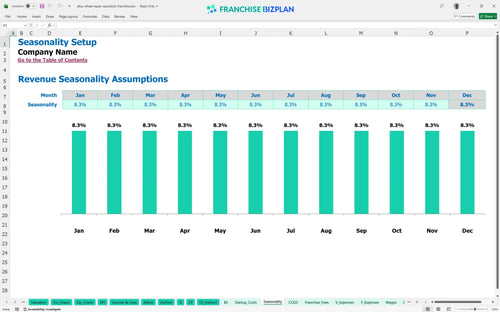
Researched revenue assumptions
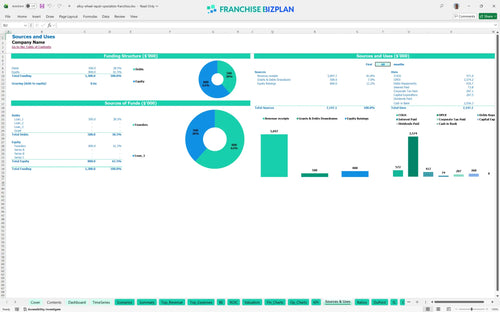
Lender-friendly financial outputs
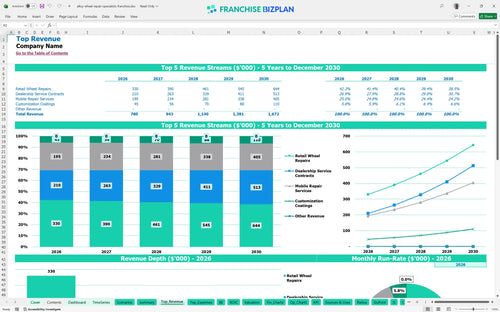
Revenue stream detailed view
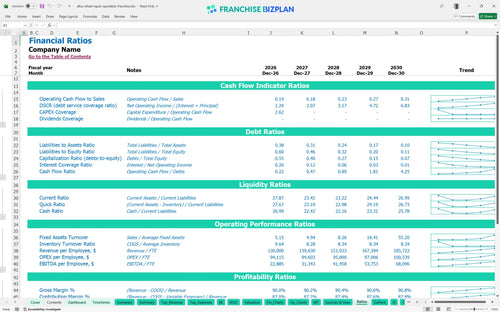
Performance metrics benchmark
We built this franchise unit financial model using our own research to create a realistic Alloy wheel repair business plan. Key assumptions like the 6% royalty fee, $40,000 initial franchise fee, and Year 1 revenue of $780,000 are pre-populated and fully editable. This tool helps you analyze the automotive franchise investment with specific data on EBITDA growth from $137,000 in Year 1 to $613,000 in Year 5. Data beats intuition every single time.
The unit is projected to reach profitability almost immediately, with a break-even date of January 2026. By Year 3, the profitability analysis for wheel repair franchise shows an EBITDA of $311,000 after accounting for all COGS, royalties, and fixed costs like the $5,500 monthly rent. Profitability is defintely tied to managing the 10% combined cost of materials and consumables while scaling the technician team. Speed to profit is the ultimate franchise metric.
The startup capital requirements for wheel restoration business total approximately $267,500 for initial assets and fees. This includes the $40,000 franchise fee, $64,000 for mobile repair vans, and $42,000 for wheel straightening equipment. To be fair, you also need to account for the minimum cash point of $994,000 in April 2026 to ensure you have enough liquidity during the first few months. Allocation is about where every dollar goes to work.
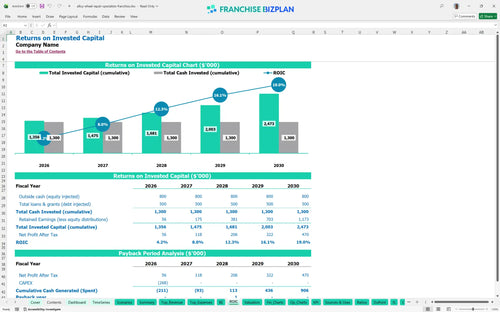
Estimating ROI for mobile automotive service units shows a 3-year payback period and an Internal Rate of Return (IRR) of 5.64%. The Return on Equity (ROE) stands at 1.47, reflecting the steady cash flow generated as the business scales to $1.67 million in annual revenue by Year 5. ROI is the only number that truly measures success.
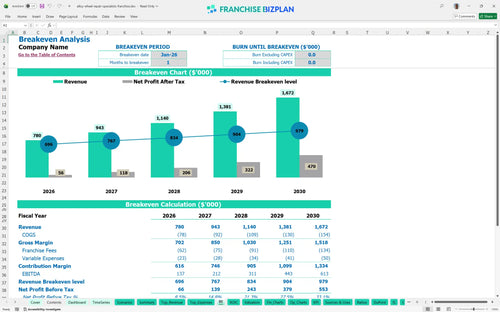
The monthly break-even analysis indicates the unit covers its fixed costs by January 2026, just one month after launch. The primary driver for this is the high average ticket for wheel repairs compared to the $5,500 monthly rent and $1,100 utilities. Break-even is the first major milestone of your journey.
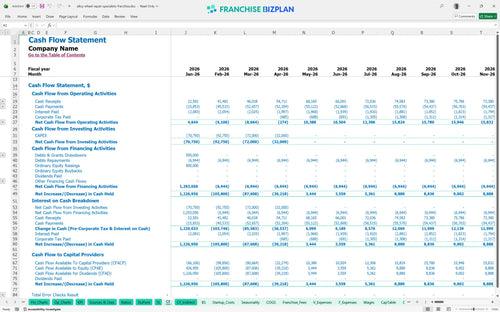
The cash flow forecast for small business franchise shows the lowest cash balance of $994,000 occurring in April 2026. This suggests that while the unit is profitable, the timing of equipment purchases and the initial build-out requires significant liquidity. Cash is the oxygen that keeps the doors open.
Comparing Low, Medium, and High scenarios shows that Year 1 EBITDA can swing significantly based on how to calculate startup costs for a mobile repair franchise and the speed of revenue ramp-up. In a High scenario, where retail repairs exceed the $220,000 Year 1 target, the 3-year payback could accelerate. Planning for the worst helps you hit the best.
This franchise unit financial model is fully customizable in Excel, allowing you to adjust pre-filled formulas and editable assumptions for your specific territory. Whether you are budgeting for equipment and fleet in franchise business or setting local price points, the model adapts to your unique operating scenario. Every cell is open for your specific market adjustments.

Planning for a five-year horizon is essential for understanding the automotive franchise investment. The model tracks revenue growth from $780,000 in Year 1 to over $1.67 million by Year 5, giving you a clear view of how scaling your fleet and dealership contracts drives value. Five years of data turns a guess into a strategy.

Operating within a system means managing a specific franchise fee structure that impacts your store-level margin. This model accounts for the $40,000 initial franchise fee and the ongoing 6% royalty plus 2% marketing fund contributions. Royalties are the price of entry for brand power.

Understanding your franchise startup costs is the first step to avoiding a cash crunch. With significant investments like $64,000 for mobile repair vans and $42,000 for wheel straightening equipment, you need a precise break-even analysis to show the exact sales level required to cover your $5,500 monthly rent. Know your survival number before you sign the lease.

We use real-world data to ensure your franchise unit economics are realistic and grounded. The model includes benchmarks for wheel repair materials, projected at 8% of sales, and labor costs for skilled technicians like your $62,000 Lead Technician. Benchmarks keep your projections from floating away.


Simply purchase and download the financial model template, then access it instantly using Microsoft Excel or Google Sheets. No installation or technical expertise required-just open and start working.

Enter your business-specific numbers, including revenue projections, costs, and investment details. The pre-built formulas will automatically calculate financial insights, saving you time and effort.

Leverage the investor-ready format to confidently showcase your financial projections to banks, franchise representatives, or investors. Impress stakeholders with clear, data-driven insights and professional reports.

Leverage the investor-ready format to confidently present your projections to banks, franchise representatives, or investors.