


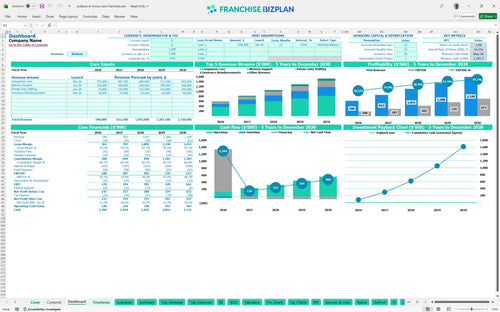
All-in-one Dashboard
Core inputs and core outputs



This comprehensive tool provides a detailed financial modeling for boutique senior care businesses, covering everything from initial fit-out to five-year cash flow maturity.
Core inputs and core outputs
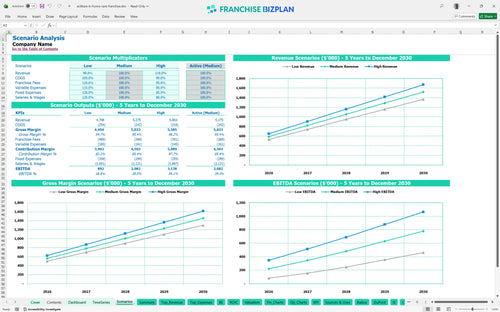
Three scenario analysis
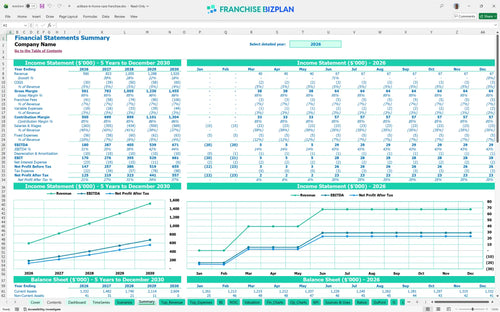
Presentation ready
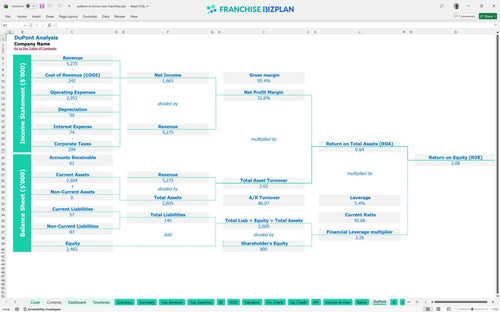
DuPont analysis
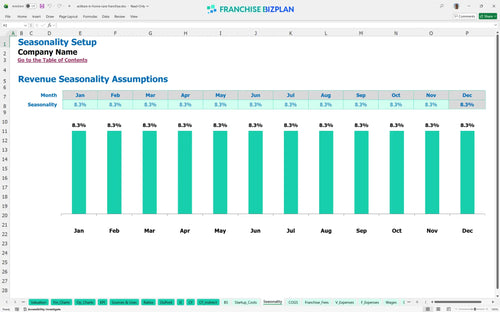
Researched revenue assumptions
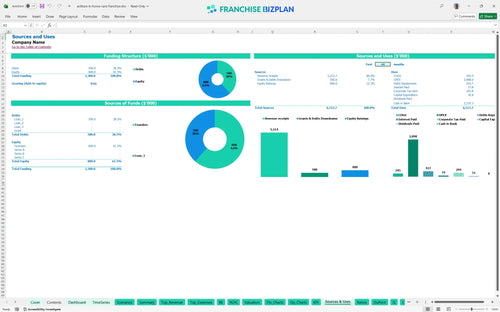
Lender-friendly financial outputs
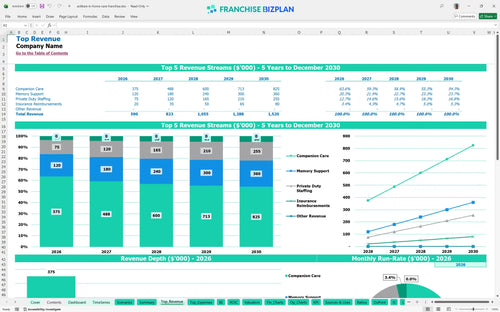
Revenue stream detailed view
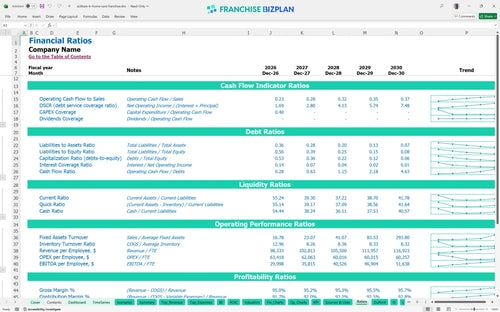
Performance metrics benchmark
We built this model using detailed research on senior care franchise startup costs and operational realities. The pre-populated data includes four revenue streams and specific staffing costs, like the $65,000 general manager salary, to give you a realistic starting point that you can fully customize. With a projected year-one revenue of $590,000, the model provides a data-driven foundation for your investment decision.
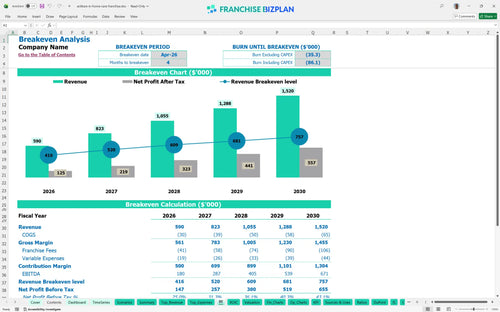
The unit shows immediate operational strength with a $180,000 EBITDA in year one, but true home health care franchise profitability accounts for all fees. You reach the break-even point in April 2026, just four months after launch, by balancing companion care volume against fixed costs like the $2,800 monthly rent and 5% royalties.
Launching this unit in the US requires about $50,800 in initial capital expenditure planning for the office and equipment. When creating a budget for a new home care franchise location, you must also account for the $19,750 franchise fee and a substantial cash buffer. The model shows a minimum cash requirement of $1,185,000 to navigate the ramp-up phase safely.
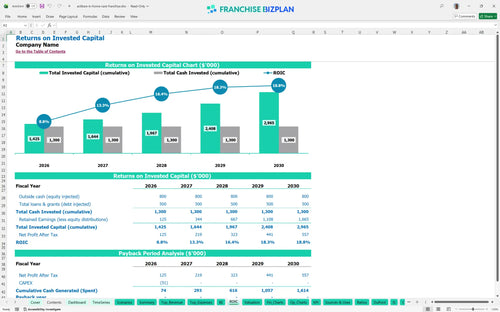
This investment offers an Internal Rate of Return (IRR) of 16.13% and a Return on Equity (ROE) of 2.08. While the cash flow is strong, the ROI analysis for senior home care franchise investment shows a payback period extending beyond year five due to the high initial cash reserves. Still, the year-five EBITDA of $671,000 represents a very healthy mature-state margin.
The monthly break-even point is reached in month 4, driven primarily by non-medical home care revenue from companion services. Because your fixed costs are relatively low-with rent at $2,800 and utilities at $600-the biggest variable affecting your break-even is how quickly you can recruit and deploy your first three full-time caregivers.
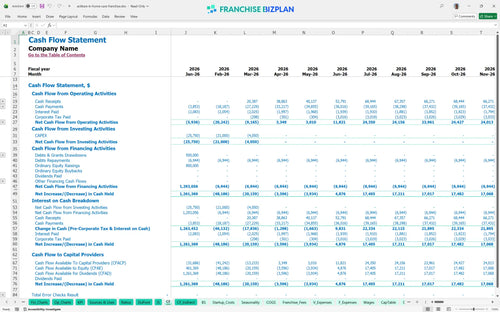
Your lowest cash point occurs in May 2026, so you need enough runway to cover the first five months of operations. This franchise unit financial projections spreadsheet defintely shows that while you break even early, the timing of insurance reimbursements can create temporary gaps. You should maintain a buffer to handle the lag between paying caregivers and receiving client payments.
The high-growth scenario focuses on forecasting profitability for memory care services, which scales from $80,000 to $240,000 over five years. A low-demand scenario would tighten margins significantly, as the $158,000 in base management salaries remains fixed regardless of volume. Success depends on your private duty staffing model and ability to maintain a 10-FTE caregiver team by year five.
Finance: update unit break-even and payback model by Friday.
This home care franchise financial model lives in Excel, so you can tweak every number without breaking the math. It uses an Excel financial template for senior care franchise owners that features pre-filled formulas and editable assumptions, making it easy to adapt to your specific territory and local labor market. Honestly, having a flexible tool is the only way to handle the moving parts of a service-based business.

Scaling from $590,000 in year one to over $1.5 million by year five requires a clear roadmap for franchise unit financial forecasting. This model provides a comprehensive 5-year view of your revenue, costs, and cash flow to help you plan for multi-unit growth or a single-unit exit. It serves as a franchise business plan template that maps out your path to a $671,000 annual EBITDA.

The model captures your specific financial obligations, including the 5% royalty fee calculation and the 2% brand marketing fund contribution. These are calculated off gross sales, so you can see exactly how much goes to the franchisor before you cover your local rent and utilities. Plus, it tracks the initial $19,750 franchise fee to ensure your total invested capital is accounted for from day one.

Knowing how to calculate startup costs for a home care franchise is the first step toward avoiding a cash crunch. This model analyzes your $50,800 in capital expenditures alongside monthly fixed costs like the $2,800 office rent. Estimating caregiver wages in franchise financial models is also built-in, helping you find the exact sales volume needed to cover your overhead and start keeping the profit.

We have included built-in benchmarks to help you sanity-check your franchise operational expenses against industry standards. This ensures your projections for care supplies, which start at 3.8% of revenue, stay within a realistic range for the sector. Using best practices for home care franchise financial planning helps you spot margin leaks before they become a problem for your bottom line.


Simply purchase and download the financial model template, then access it instantly using Microsoft Excel or Google Sheets. No installation or technical expertise required-just open and start working.

Enter your business-specific numbers, including revenue projections, costs, and investment details. The pre-built formulas will automatically calculate financial insights, saving you time and effort.

Leverage the investor-ready format to confidently showcase your financial projections to banks, franchise representatives, or investors. Impress stakeholders with clear, data-driven insights and professional reports.

Leverage the investor-ready format to confidently present your projections to banks, franchise representatives, or investors.