


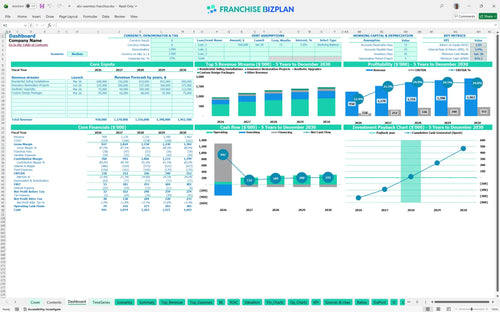
All-in-one Dashboard
Core inputs and core outputs



This Excel template for franchise unit financial projections includes a detailed franchise unit operating budget template, capital expenditure planning, and a simple financial model for home exterior business owners to track monthly performance.
Core inputs and core outputs
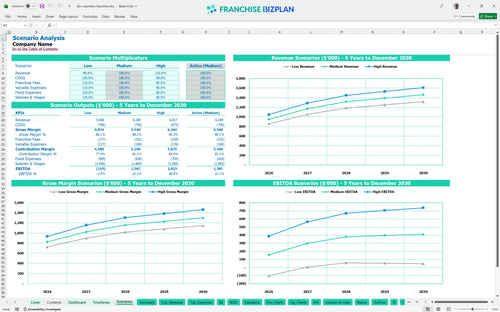
Three scenario analysis
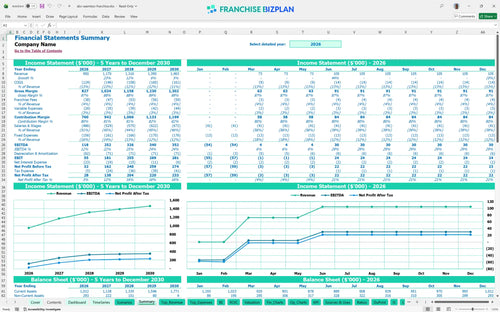
Presentation ready
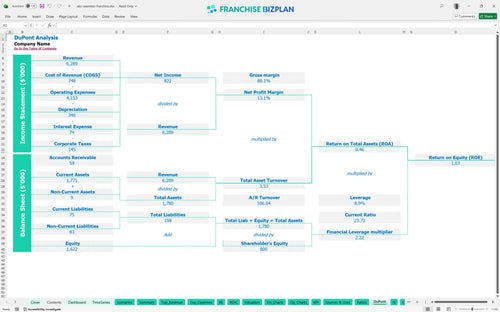
DuPont analysis
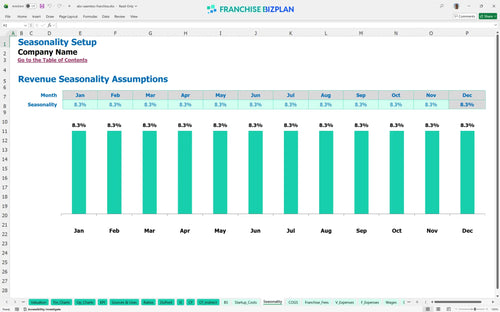
Researched revenue assumptions
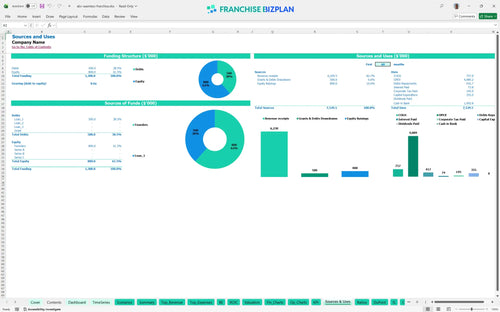
Lender-friendly financial outputs
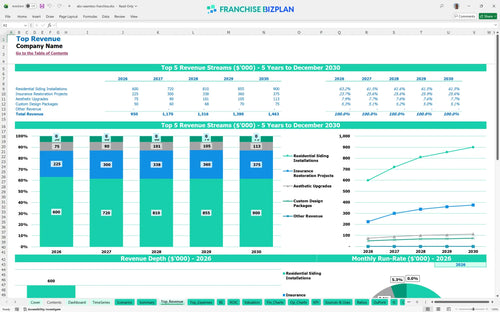
Revenue stream detailed view
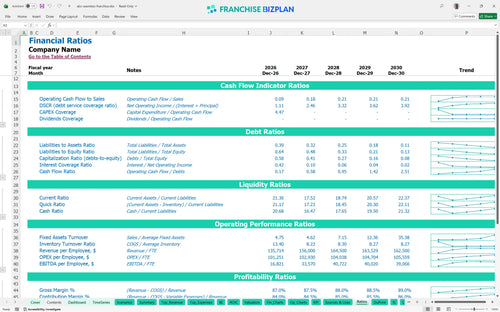
Performance metrics benchmark
We built this franchise unit financial model using our own research into the home exterior and siding industry. Key assumptions like the $950,000 year-one revenue target and the $355,000 in initial equipment and build-out costs are pre-populated but fully editable. Honestly, the 3% royalty and 4-month path to break-even make this a compelling model for operators who can manage a skilled installation team effectively.
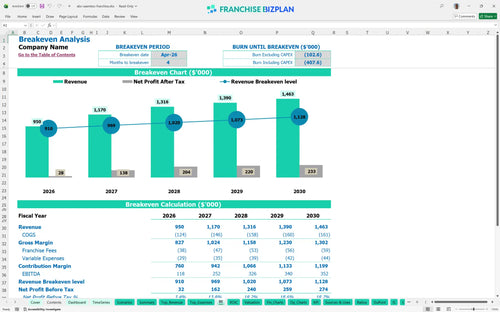
The model shows this unit hits its break-even date in April 2026, just four months after launching. By year two, EBITDA (earnings before interest, taxes, depreciation, and amortization) is projected to reach $252,000 as you ramp up insurance restoration projects. Every margin point matters when you're rolling steel on a driveway.
To launch this unit in the US, you will need approximately $1,171,000. This includes $355,000 for CAPEX (capital expenditure) items like the $55,000 franchise fee and $120,000 for two mobile manufacturing vehicles, plus a significant $816,000 cash buffer to handle the ramp-up. Here is the quick math: your equipment and showroom are your biggest upfront hurdles.
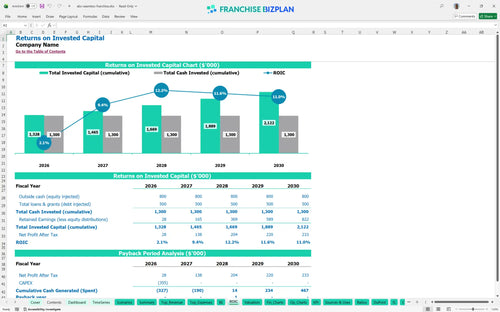
Investors can expect an Internal Rate of Return (IRR) of 3.91% and a Return on Equity (ROE) of 1.03. The payback period is estimated at 3 years, which is a solid timeline for a heavy-asset construction model. What this estimate hides is that your ROI scales significantly if you can push year-three revenue past the $1.3M mark.
Monthly break-even is achieved within 4 months of the March 2026 launch. The primary driver for hitting this is the volume of residential siding installations, which must offset the $8,000 monthly rent and the $1,200 equipment maintenance costs. To be fair, your fixed costs are relatively high, so throughput is everything.
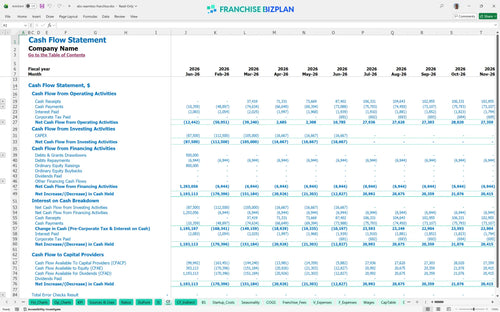
The lowest cash point occurs in June 2026 at $816,000, meaning you need a deep pool of working capital to survive the initial build-out and hiring phase. Cash is the lifeblood, and the first six months are the stress test. Still, the model suggests you have plenty of runway if you hit your $950,000 year-one sales target.
In a High scenario where revenue hits $1.4M early, your year-one EBITDA margin expands significantly due to fixed-cost leverage. Conversely, a Low scenario with slower sales would push your 3-year payback further out and increase the pressure on your $816,000 cash reserve. Analyzing revenue streams for construction franchises shows that insurance work often stabilizes the Low case.
This franchise financial model template is built in Excel, giving you total control over the numbers. You can swap out pre-filled formulas or adjust editable assumptions to match your specific territory, whether you are looking at a high-density suburb or a rural market. It is a flexible small business financial projection template that handles everything from local labor rates to specific material costs for steel coils.

Long-term planning is about more than just next month's installs. This model provides 5-year revenue, cost, and cash flow projections designed for a home service franchise business plan. You can see how scaling from one 'factory-on-wheels' to a larger fleet impacts your bottom line over half a decade. It is the defintely the right tool for financial forecasting for new franchise owners who need to see the big picture.

Operating a franchise means managing specific overhead like a 3% royalty and a 1% marketing fund contribution. This model simplifies the franchise royalty fee structure by calculating these costs automatically based on your gross sales. It ensures you understand the real store-level margin after the franchisor takes their cut, helping you avoid surprises during your monthly reporting.

Knowing your total 'all-in' cost is vital before signing a lease. This franchise startup cost calculator includes the $55,000 initial fee, design center improvements, and mobile manufacturing equipment. By calculating break-even point for home improvement franchises, you will know exactly how many residential siding installations you need each month to cover your $8,000 rent and $27,000+ monthly payroll.

We have integrated industry-specific data to help you sanity-check your unit economics model. For example, steel coil materials are modeled at 9% to 11% of revenue, which is a key benchmark for this type of construction franchise profitability analysis. These guardrails help you identify if your labor costs or material waste are drifting too far from the standard for a home exterior business.


Simply purchase and download the financial model template, then access it instantly using Microsoft Excel or Google Sheets. No installation or technical expertise required-just open and start working.

Enter your business-specific numbers, including revenue projections, costs, and investment details. The pre-built formulas will automatically calculate financial insights, saving you time and effort.

Leverage the investor-ready format to confidently showcase your financial projections to banks, franchise representatives, or investors. Impress stakeholders with clear, data-driven insights and professional reports.

Leverage the investor-ready format to confidently present your projections to banks, franchise representatives, or investors.