


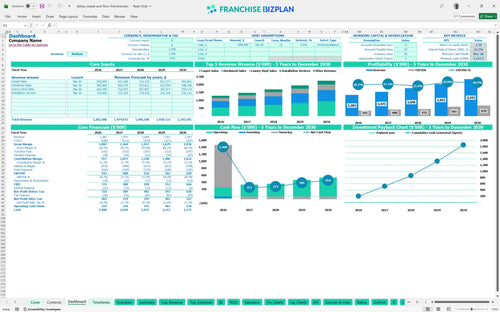
All-in-one Dashboard
Core inputs and core outputs



This franchise unit financial model template includes everything from revenue drivers and staffing plans to capital expenditure and detailed cash flow statements.
Core inputs and core outputs
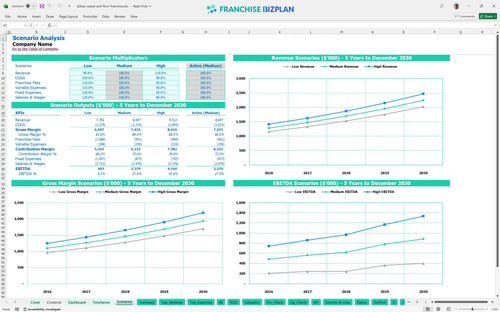
Three scenario analysis
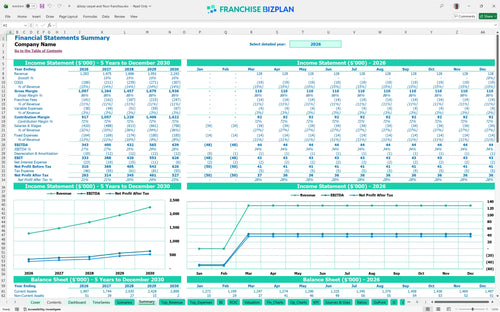
Presentation ready
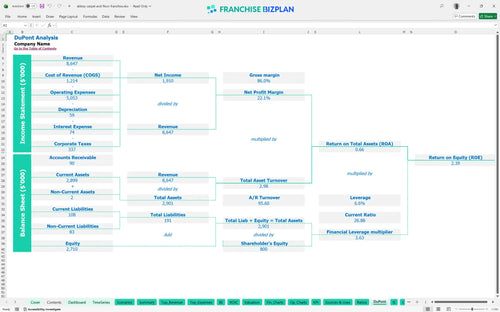
DuPont analysis
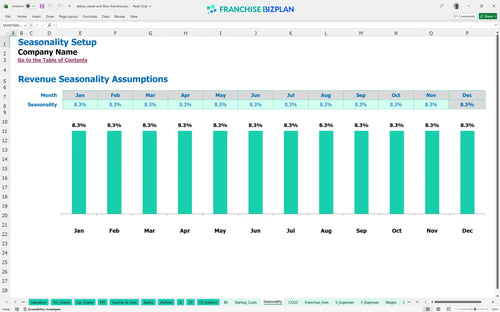
Researched revenue assumptions
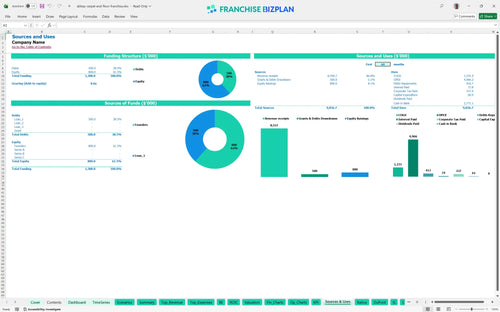
Lender-friendly financial outputs
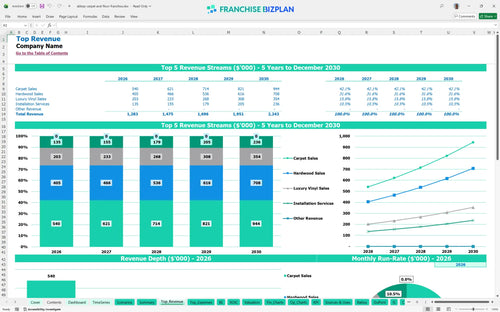
Revenue stream detailed view
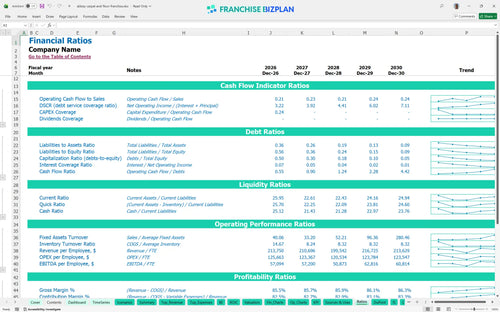
Performance metrics benchmark
We built this model using detailed research on the boutique flooring sector to help you map out your investment. With pre-populated data like the $1.28M year-one revenue target and 11% total franchise fees, these assumptions are ready for you to edit and refine. It's a practical tool to help you see if the store-level margin meets your goals before you sign the lease.
The unit is projected to reach profitability defintely within the first year, with a Year 1 EBITDA of $343,000. By Year 5, this grows to $639,000 as revenue scales toward $2.24M. This trajectory assumes you manage the 11% combined fee burden while maintaining tight control over inventory. Retail franchise profitability analysis shows that success depends on high-ticket sales like hardwood. Profit starts when you control the small margin leaks.
To launch this unit, you need to plan for a total initial investment covering the $10,000 franchise fee and $60,900 in total capital expenditure (CapEx). This includes $20,000 for leasehold improvements and $8,000 for display fixtures. How to calculate startup costs for a flooring franchise involves looking at these costs plus the $1.157M minimum cash reserve. Capital expenditure planning is vital to ensure the showroom reflects brand standards. Cash is your oxygen during the first six months.
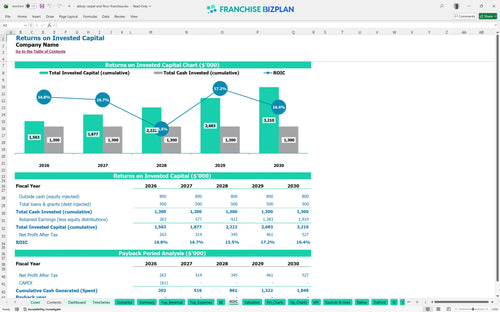
Investors can expect an Internal Rate of Return (IRR) of 22.29% and a Return on Equity (ROE) of 2.39. While the unit generates strong EBITDA early, the model shows the payback period occurs after Year 5 due to the high initial cash reserve. This franchise investment calculator helps you see that while the cash-on-cash return is steady, this is a long-term play. Returns are the only reason we're in this game.
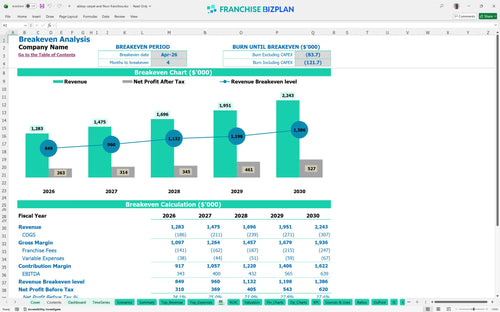
The unit hits its break-even point calculation in April 2026, just 4 months after launch. This fast start is driven by high average tickets and a lean initial staffing model of five core employees. Evaluating franchise profitability before investing requires looking at the 11% fee structure, which is the primary hurdle for monthly fixed costs. Volume solves most problems, but margin solves the rest.
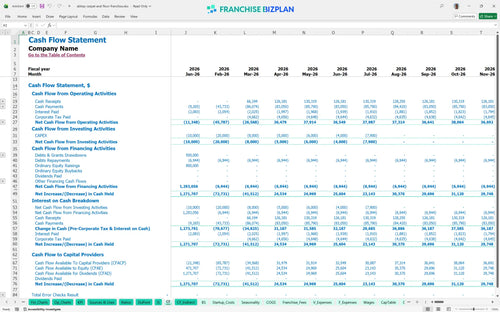
The lowest cash point occurs in March 2026, with a projected minimum cash balance of $1,157,000. This suggests a healthy buffer, but estimating operating expenses for a new franchise location is critical as you scale to four sales reps by Year 5. Using a cash flow projection template for small business franchise helps you monitor the timing gaps between material deposits and final payments. The lowest point in your bank account is the real stress test.
The model allows for a financial feasibility study for luxury retail franchise by testing Low, Medium, and High performance cases. In the base case, revenue grows from $1.28M to $2.24M, with EBITDA nearly doubling by Year 5. A franchise unit financial forecasting template shows that even a small dip in hardwood sales can delay profit targets, while the High case relies on maximizing sales team productivity. Plan for the worst so you can survive to see the best. Finance: update unit break-even and payback model by Friday.
This franchise financial model template is built in Excel with fully editable assumptions and pre-filled formulas, allowing you to adjust every driver to your specific territory. Whether you are looking at a single boutique location or planning a larger rollout, you can swap out rent, labor, and local pricing to see the impact on your bottom line. It's a plug-and-play tool for serious operators. This Excel financial model for home improvement franchise ensures you aren't starting from a blank sheet.

Success in boutique retail requires looking past the grand opening, which is why this franchise business plan template provides a detailed 5-year outlook. You can track how scaling your sales team from two reps to four impacts your store-level margin as revenue grows from $1.28M to over $2.24M. Five years of data beats a one-year guess every time. It maps out the long-term cash flow needs so you can plan for future showroom refreshes or territory expansion.

Operating expense projections must account for the specific costs of being part of a national network, including the 5% royalty and 6% marketing fund contributions. This model tracks these ongoing obligations against your monthly sales of carpet, hardwood, and luxury vinyl to show your true contribution margin. Royalties and marketing fees are top-line taxes you can't ignore. By automating these calculations, you can see exactly how much cash stays in the unit after the franchisor takes their cut.

Estimating flooring franchise startup costs is the first step to a successful launch, covering everything from the $10,000 initial fee to the $20,000 in leasehold improvements. This model includes a break-even point calculation that shows you exactly which month your boutique showroom starts paying for itself. Knowing your zero-day is the first step to sleeping better. How to build a budget for a new franchise unit becomes much simpler when you have a clear view of fixed versus variable costs.

We've integrated franchise unit economics and industry benchmarks to help you sanity-check your labor and occupancy costs against typical flooring retail standards. If your $9,500 monthly rent or your $85,000 general manager salary falls outside the norm, the model helps you identify those outliers before they become problems. Don't fly blind when you can use proven industry data. This comparison helps you maintain a competitive store-level EBITDA (earnings before interest, taxes, depreciation, and amortization) while meeting brand standards.


Simply purchase and download the financial model template, then access it instantly using Microsoft Excel or Google Sheets. No installation or technical expertise required-just open and start working.

Enter your business-specific numbers, including revenue projections, costs, and investment details. The pre-built formulas will automatically calculate financial insights, saving you time and effort.

Leverage the investor-ready format to confidently showcase your financial projections to banks, franchise representatives, or investors. Impress stakeholders with clear, data-driven insights and professional reports.

Leverage the investor-ready format to confidently present your projections to banks, franchise representatives, or investors.