


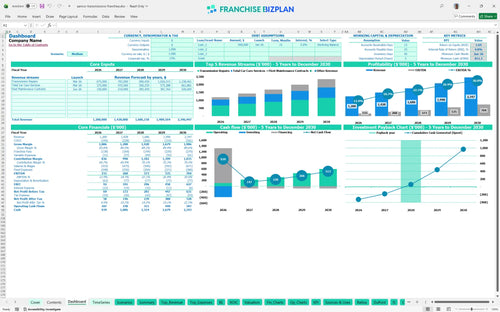
All-in-one Dashboard
Core inputs and core outputs



This template provides a complete pro forma financial statements for auto service franchise, including dynamic revenue drivers, detailed payroll schedules, and automated cash flow tracking.
Core inputs and core outputs
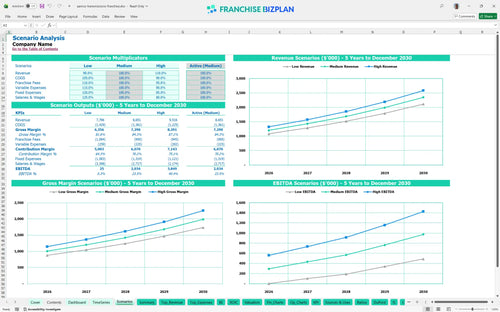
Three scenario analysis
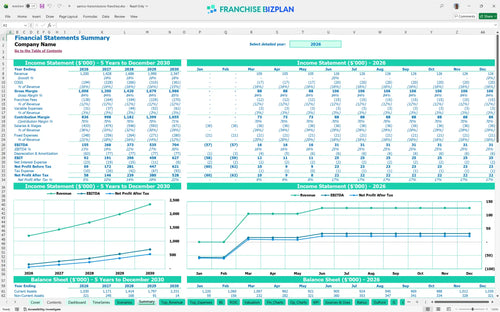
Presentation ready
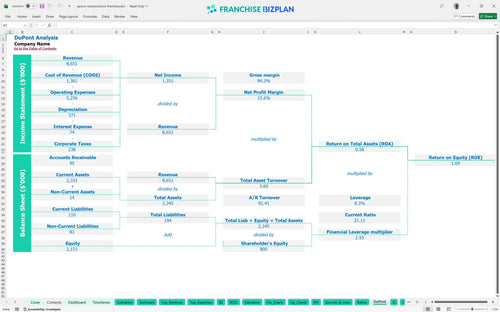
DuPont analysis
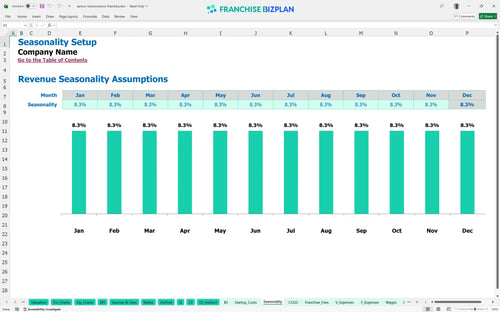
Researched revenue assumptions
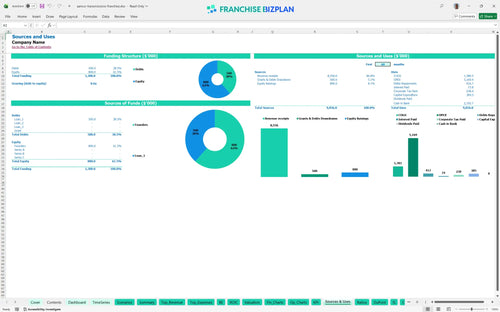
Lender-friendly financial outputs
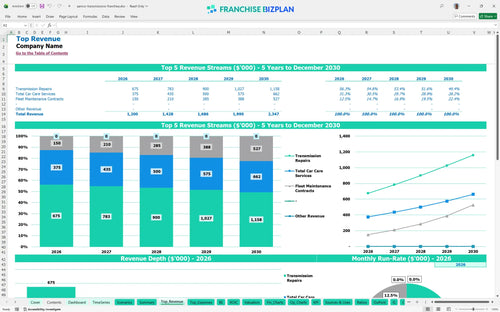
Revenue stream detailed view
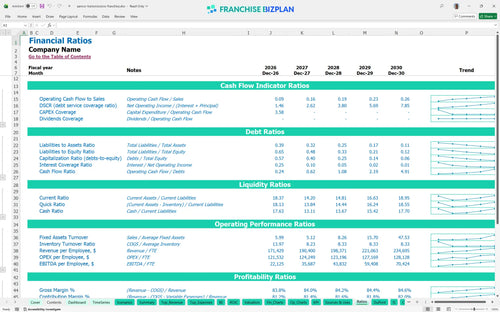
Performance metrics benchmark
We built this franchise unit financial model using our own research into the automotive repair sector. Key assumptions, including transmission repair volume, fleet maintenance contracts, and specialized technician wages, are pre-populated and fully editable. With a Year 1 revenue target of $1.2 million and an EBITDA of $155,000, this model gives you a realistic baseline for a high-performing shop.
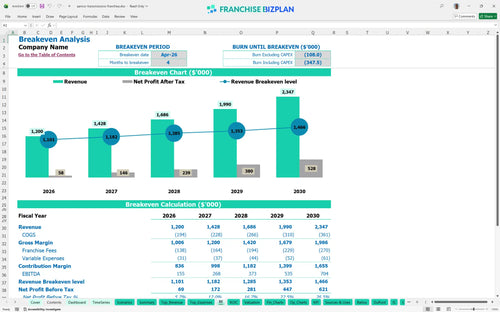
Based on our research, this unit hits its stride quickly, reaching break-even by April 2026, just four months after launch. With first-year EBITDA projected at $155,000 and growing to $704,000 by year five, the profitability trajectory is strong. We defintely see the 11.5% combined royalty and marketing fee as a major factor, but high-ticket transmission repairs keep the margins healthy.
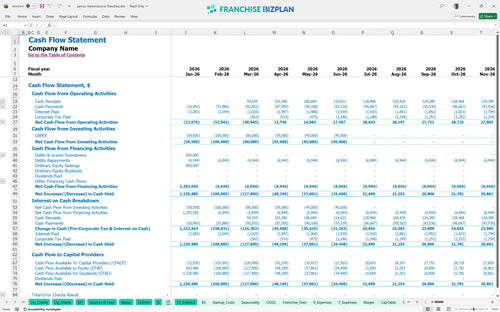
You will need roughly $384,500 in initial CAPEX plus a healthy cash buffer to get started in the US market. This covers the $39,500 franchise fee and the heavy equipment needed to turn wrenches. The model shows a minimum cash requirement of $811,000 by June 2026 to ensure you have enough runway during the ramp-up phase.
The model shows a 3-year payback period, which is standard for a high-CAPEX automotive franchise ROI. With an IRR of 4.77% and a Return on Equity of 1.69, the long-term play is about the cash flow from a mature shop. By year five, you are looking at a $704,000 EBITDA, which provides a strong exit multiple or expansion capital.
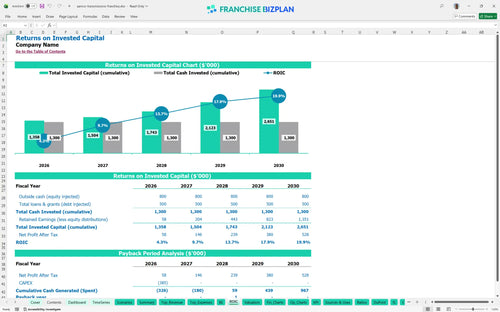
You need to hit your break-even sales estimates by month four to stay on track. The biggest drag on your break-even point isn't the parts; it is the $15,000 monthly rent and the $20,000+ monthly payroll for your lead and certified technicians. High-ticket transmission jobs are the fastest way to cover these fixed costs and reach positive territory.
Your lowest cash point hits in June 2026, so you need to be careful with spending in the first six months. We recommend keeping at least $811,000 in liquid capital to handle the timing gaps between equipment purchases and the ramp-up of fleet maintenance revenue. If leasehold improvements go over budget, your cash runway shrinks fast.
A 10% drop in revenue can push your payback out by a year and significantly increase your peak cash need. Conversely, hitting the High Case through better local marketing execution can boost your Year 1 EBITDA well beyond $155,000. The model lets you toggle these scenarios to see how sensitive your franchise profitability analysis is to volume changes.
This franchise unit financial model lives in Excel, so you can tweak every variable to fit your specific market. We've pre-filled the formulas, but you can change the parts margins or technician headcounts to see how they impact your bottom line. It is built to handle everything from local rent hikes to shifting labor markets without breaking the math.

Mapping out five years of performance is the only way to see the true potential of your investment. This model projects revenue climbing from $1.2 million in year one to over $2.3 million by year five based on researched growth patterns. You will get a clear view of how scaling your technician team from three to five people affects your annual revenue for auto repair business.

Royalties and marketing fees are the tax on your top line that never goes away. With a 7.5% royalty and a 4% marketing fee, you are looking at 11.5% of gross sales leaving the shop before you pay a single tech. This model tracks those outflows precisely so you aren't surprised by the franchise royalty structure when the monthly bill comes due.

Getting the doors open requires significant capital expenditure planning, from the $39,500 franchise fee to $80,000 for automotive lifts. We help you run a break-even analysis for automotive service center operations to find the exact moment you stop burning cash. Knowing your fixed monthly costs-like that $15,000 rent-is key to surviving the first year.

Don't guess if your labor costs are too high for your territory. Our franchise unit financial template includes benchmarks to help you sanity-check your spending on certified technicians and service advisors. If your automotive parts costs drift above 15%, the model flags it so you can adjust your automotive repair business plan before margins erode.


Simply purchase and download the financial model template, then access it instantly using Microsoft Excel or Google Sheets. No installation or technical expertise required-just open and start working.

Enter your business-specific numbers, including revenue projections, costs, and investment details. The pre-built formulas will automatically calculate financial insights, saving you time and effort.

Leverage the investor-ready format to confidently showcase your financial projections to banks, franchise representatives, or investors. Impress stakeholders with clear, data-driven insights and professional reports.

Leverage the investor-ready format to confidently present your projections to banks, franchise representatives, or investors.