


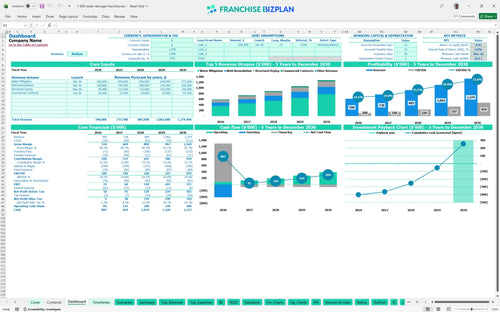
All-in-one Dashboard
Core inputs and core outputs



This franchise unit financial model template provides a comprehensive Excel-based framework for analyzing restoration business startup costs, 5-year profitability, and equipment-heavy capital requirements.
Core inputs and core outputs
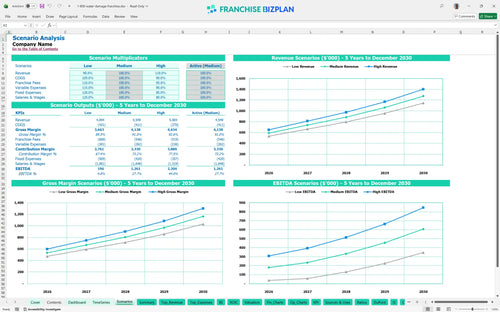
Three scenario analysis
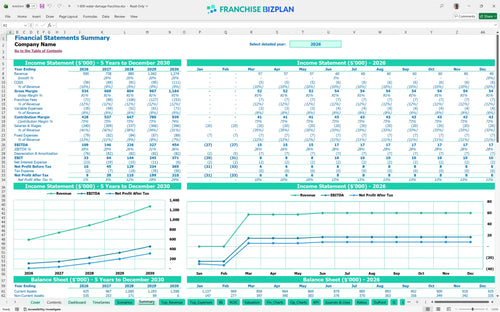
Presentation ready
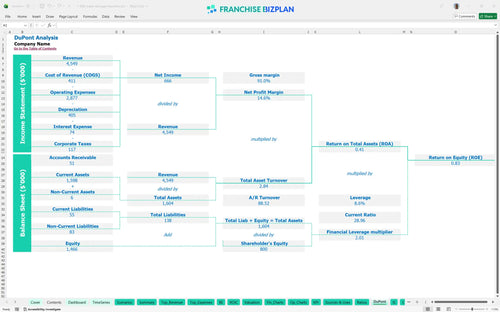
DuPont analysis
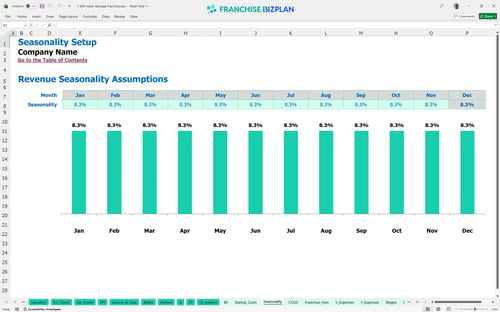
Researched revenue assumptions
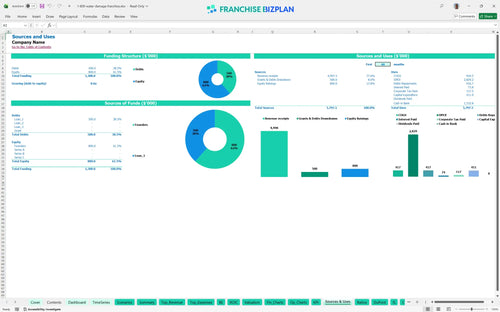
Lender-friendly financial outputs
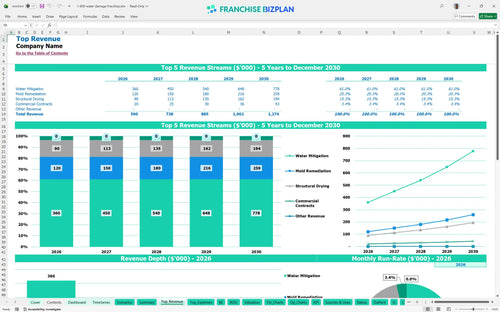
Revenue stream detailed view
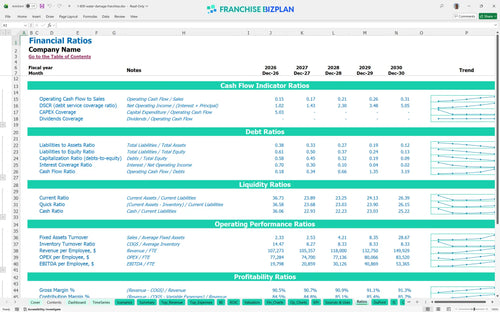
Performance metrics benchmark
We built this franchise unit financial model using our own research into the property restoration industry. Key assumptions, including water mitigation revenue and mold remediation costs, are pre-populated with researched data specific to this restoration franchise unit and are fully editable. Year one revenue is projected at $590,000 with an EBITDA of $109,000, providing a credible baseline for your franchise unit profitability analysis.
The unit becomes profitable in its first year, generating $109,000 in EBITDA after accounting for 10% royalties and 2% marketing fees. By year five, EBITDA is projected to reach $454,000 as high-margin commercial contracts and mold remediation services scale alongside your technician headcount.
Launching this unit requires a total initial investment of $411,000, which covers the $59,000 franchise fee and significant equipment outlays. This capital expenditure planning includes $120,000 for restoration trucks and $105,000 for water extractors and dehumidifiers to handle emergency responses.
Investors can expect an internal rate of return (IRR) of 2.79% and a return on equity (ROE) of 0.83 over the initial five-year period. The payback period is 5 years, which is typical for equipment-heavy restoration businesses where the asset base is significant but the cash flow scales strongly after year three.
The unit reaches its monthly break-even point in April 2026, just 4 months after launch. This fast break-even is defintely driven by the high average ticket of water mitigation jobs, though you must maintain a lean staff of 3 technicians initially to cover the $3,000 monthly rent and $1,800 in insurance premiums.
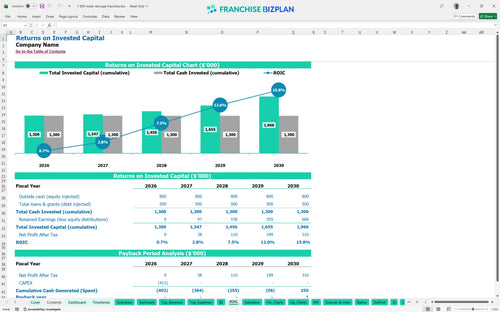
The lowest cash point occurs in March 2026 with a minimum cash balance of $822,000, assuming you start with sufficient working capital. You need at least 6 months of runway to handle the lag between completing emergency jobs and receiving insurance claim payouts, which can often stretch your cash flow thin.
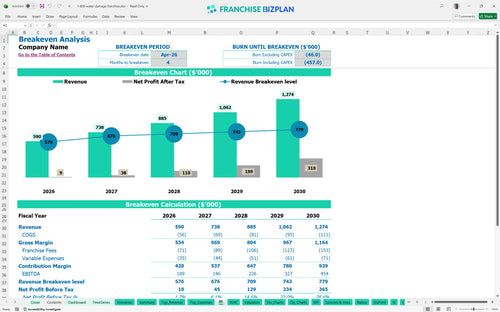
In a high-growth scenario, securing more commercial contracts can push year-5 revenue well above the $1.27 million base case, significantly shortening the payback period. Conversely, a low scenario with fewer emergency calls would increase the peak cash need and delay the break-even point beyond the initial 4-month estimate.
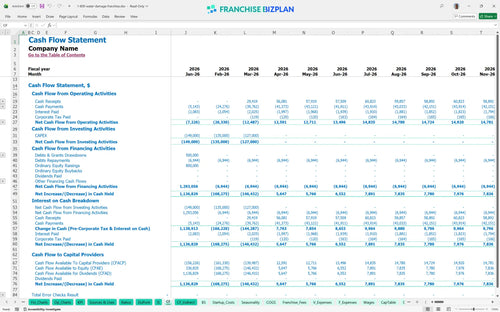
To move forward, you must validate these projections against your specific territory's insurance landscape and local competition. Adjust the technician headcount and equipment financing terms in the model to see how they impact your year-one cash flow and long-term valuation. Honestly, the math only works if you stay on top of your local marketing and response times.
This franchise financial model template is built in Excel with fully editable assumptions, allowing you to adjust every variable from technician wages to local rent. The pre-filled formulas make it simple to adapt the model to your specific territory, ensuring the franchise unit profitability analysis reflects your actual market conditions and operating scenario.

Plan for long-term growth with detailed 5-year projections that track revenue, cost of goods, and cash flow for your restoration unit. This model helps you visualize the transition from a single-truck operation to a multi-unit enterprise by mapping out year-over-year growth and long-term profitability targets.

The model captures the real economics of the brand by tracking the $59,000 initial fee alongside the 10% royalty and 2% marketing fund contributions. By automating these calculations, you can see exactly how much cash remains after meeting your franchise disclosure document obligations and brand-level commitments.

Estimating restoration business startup costs is critical, and this tool breaks down the $411,000 initial investment into clear categories like vehicles and equipment. You can identify the exact revenue needed to cover your fixed facility rent of $3,000 and variable fuel costs, ensuring your emergency response business plan is grounded in reality.

We have incorporated industry-standard benchmarks for labor and supplies to help you sanity-check your unit economics. Comparing your expected gross margins against typical restoration ranges ensures your financial model for emergency response franchise units stays competitive and achievable in the US market.


Simply purchase and download the financial model template, then access it instantly using Microsoft Excel or Google Sheets. No installation or technical expertise required-just open and start working.

Enter your business-specific numbers, including revenue projections, costs, and investment details. The pre-built formulas will automatically calculate financial insights, saving you time and effort.

Leverage the investor-ready format to confidently showcase your financial projections to banks, franchise representatives, or investors. Impress stakeholders with clear, data-driven insights and professional reports.

Leverage the investor-ready format to confidently present your projections to banks, franchise representatives, or investors.